A Home Run!
Ein Homerun!
The batter hits a home run, and everyone cheers. The friends talk about the exciting play and enjoy the game.
Der Schlagmann schlägt einen Homerun, und alle jubeln. Die Freunde sprechen über den aufregenden Spielzug und genießen das Spiel.
Dialog8
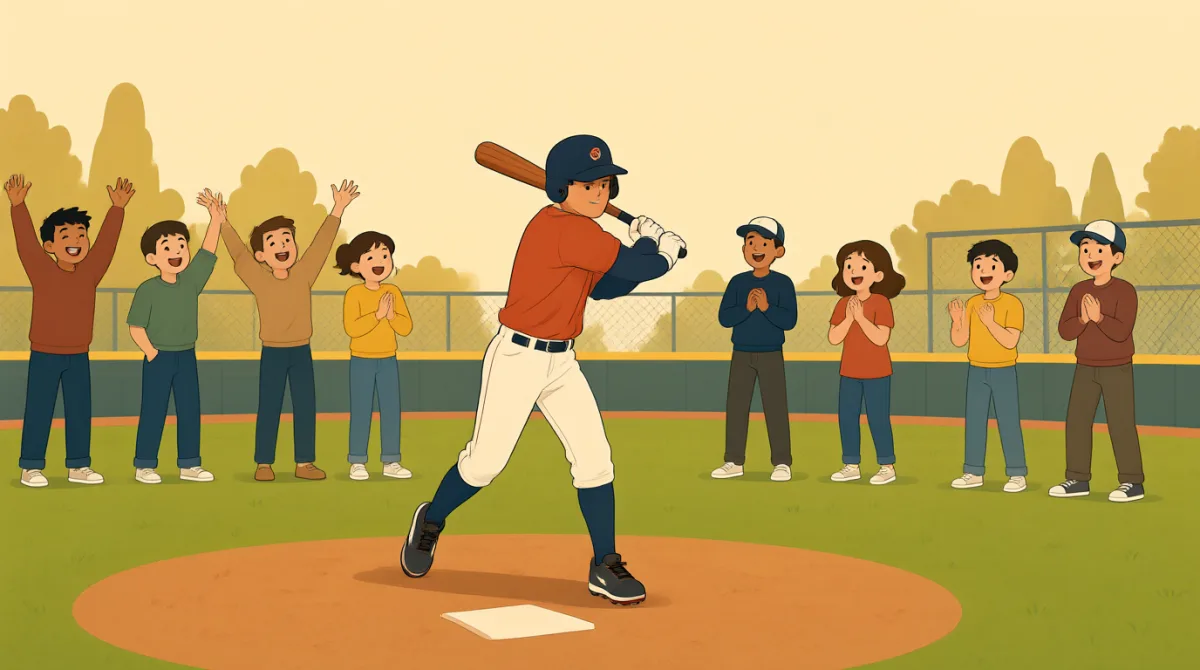

Wow, that ball is flying so high! Is it going over the wall?
Wow, der Ball fliegt ganz schön hoch! Fliegt er über die Mauer?

It’s gone! That’s a home run! Everyone’s cheering!
Er ist weg! Das ist ein Homerun! Alle jubeln!

Yes! The batter hit the ball out of the park. Our team gets a run.
Ja! Der Schlagmann hat den Ball aus dem Stadion geschlagen. Unser Team macht einen Punkt.
That was amazing! Does the batter run around all the bases now?
Das war unglaublich! Läuft der Schlagmann jetzt um alle Bases herum?
That’s right. He runs past first, second, and third base, then comes home.
Genau. Er läuft an der ersten, zweiten und dritten Base vorbei und kommt dann nach Hause.
He made it! What a great play. I’m glad we came today.
Er hat es geschafft! Was für ein toller Spielzug. Ich bin froh, dass wir heute gekommen sind.
Me too! The crowd is so loud. I want to watch another inning.
Ich auch! Die Menge ist so laut. Ich möchte noch ein Inning sehen.
Let’s enjoy the game. Maybe our team will hit another home run!
Lass uns das Spiel genießen. Vielleicht schlägt unser Team noch einen Homerun!
Wortschatz8
- home runHomerun
A home run is a hit that lets the batter run around all the bases and score. Here, the ball goes over the wall.
Ein „home run“ ist ein Schlag, bei dem der Schlagmann einmal um alle Bases laufen und einen Punkt erzielen kann. Hier fliegt der Ball über die Mauer.
- cheeringjubeln
Cheering means shouting to show that you are happy or excited. Fans cheer when their team makes a great play.
„Cheering“ bedeutet, laut zu rufen, um zu zeigen, dass du dich freust oder begeistert bist. Fans jubeln, wenn ihr Team einen tollen Spielzug macht.
- out of the parkaus dem Stadion
This phrase means hitting the ball beyond the edge of the baseball field. It can also describe doing something very successfully.
„Out of the park“ bedeutet, den Ball über die Begrenzung des Baseballfelds hinauszuschlagen. Der Ausdruck kann auch beschreiben, dass jemand etwas mit großem Erfolg macht.
- basesBases
Bases are the four places a player runs to score in baseball. The batter runs past each base and then comes home.
„Bases“ sind die vier Stationen, die ein Spieler beim Baseball anlaufen muss, um einen Punkt zu erzielen. Der Schlagmann läuft an jeder Base vorbei und dann nach Hause.
- made ites geschafft haben
This means that someone succeeded in reaching a place or completing something. Here, the batter reaches home plate safely.
„Made it“ bedeutet, dass jemand erfolgreich einen Ort erreicht oder etwas geschafft hat. Hier erreicht der Schlagmann sicher die Homeplate.
- crowdMenge
A crowd is a large group of people in one place. At a game, the crowd may cheer loudly.
Eine „crowd“ ist eine große Gruppe von Menschen an einem Ort. Bei einem Spiel jubelt die Menge vielleicht laut.
- inningInning
An inning is one part of a baseball game. You can use this word when talking about how much of the game you want to watch.
Ein „inning“ ist ein Abschnitt eines Baseballspiels. Du kannst dieses Wort verwenden, wenn du darüber sprichst, wie viel vom Spiel du noch sehen möchtest.
- hit another home runnoch einen Homerun schlagen
This means to hit the ball out of the park again. You can use it to talk about what you hope a baseball player will do.
„Hit another home run“ bedeutet, den Ball noch einmal aus dem Stadion zu schlagen. Damit kannst du sagen, was du dir von einem Baseballspieler erhoffst.
Wichtige Sätze8
- 1
Is it going over the wall?
Fliegt er über die Mauer?
Use this question when you think something may pass over a barrier. You can also ask, “Is it going over the fence?”
Diese Frage stellst du, wenn du denkst, dass etwas vielleicht über ein Hindernis fliegt. Du kannst auch fragen: „Is it going over the fence?“ (Fliegt er über den Zaun?)
- 2
That’s a home run!
Das ist ein Homerun!
This is a short, excited way to say that a batter has hit a home run. You can use “That’s a [thing]!” to react to something you see.
Das ist eine kurze, begeisterte Art zu sagen, dass der Schlagmann einen Homerun geschlagen hat. Mit „That’s a [thing]!“ kannst du auf etwas reagieren, das du gerade siehst.
- 3
Our team gets a run.
Unser Team macht einen Punkt.
This sentence explains that your team scores a point in baseball. You can replace “our team” with another team or player.
Dieser Satz erklärt, dass dein Team beim Baseball einen Punkt erzielt. Du kannst „our team“ durch ein anderes Team oder einen Spieler ersetzen.
- 4
Does the batter run around all the bases now?
Läuft der Schlagmann jetzt um alle Bases herum?
Use this question to ask what happens next. The present simple with “does” is useful for asking about rules or usual actions.
Mit dieser Frage erkundigst du dich danach, was als Nächstes passiert. Das simple present mit „does“ eignet sich, um nach Regeln oder üblichen Abläufen zu fragen.
- 5
I’m glad we came today.
Ich bin froh, dass wir heute gekommen sind.
Use this phrase to say you feel happy about a choice or experience. You can change the ending, as in “I’m glad we came to the game.”
Mit dieser Wendung sagst du, dass du dich über eine Entscheidung oder ein Erlebnis freust. Du kannst den Schluss ändern, zum Beispiel: „I’m glad we came to the game.“ (Ich bin froh, dass wir zum Spiel gekommen sind.)
- 6
The crowd is so loud.
Die Menge ist so laut.
This is a simple way to describe the sound of a large group of people. Replace “loud” with another adjective to describe the crowd.
Mit diesem einfachen Satz beschreibst du, wie laut eine große Gruppe von Menschen ist. Du kannst „loud“ durch ein anderes Adjektiv ersetzen, um die Menge zu beschreiben.
- 7
I want to watch another inning.
Ich möchte noch ein Inning sehen.
Use “I want to” to say what you would like to do. You can replace “watch another inning” with another activity.
Mit „I want to“ sagst du, was du gern tun möchtest. Du kannst „watch another inning“ durch eine andere Aktivität ersetzen.
- 8
Maybe our team will hit another home run!
Vielleicht schlägt unser Team noch einen Homerun!
Use “Maybe” and “will” to talk about something that could happen in the future. You can replace “hit another home run” with another possible action.
Mit „Maybe“ und „will“ sprichst du über etwas, das in der Zukunft passieren könnte. Du kannst „hit another home run“ durch eine andere mögliche Handlung ersetzen.