A Home Run!
¡Un jonrón!
The batter hits a home run, and everyone cheers. The friends talk about the exciting play and enjoy the game.
El bateador conecta un jonrón y todos vitorean. Los amigos hablan de la emocionante jugada y disfrutan del partido.
Diálogo8
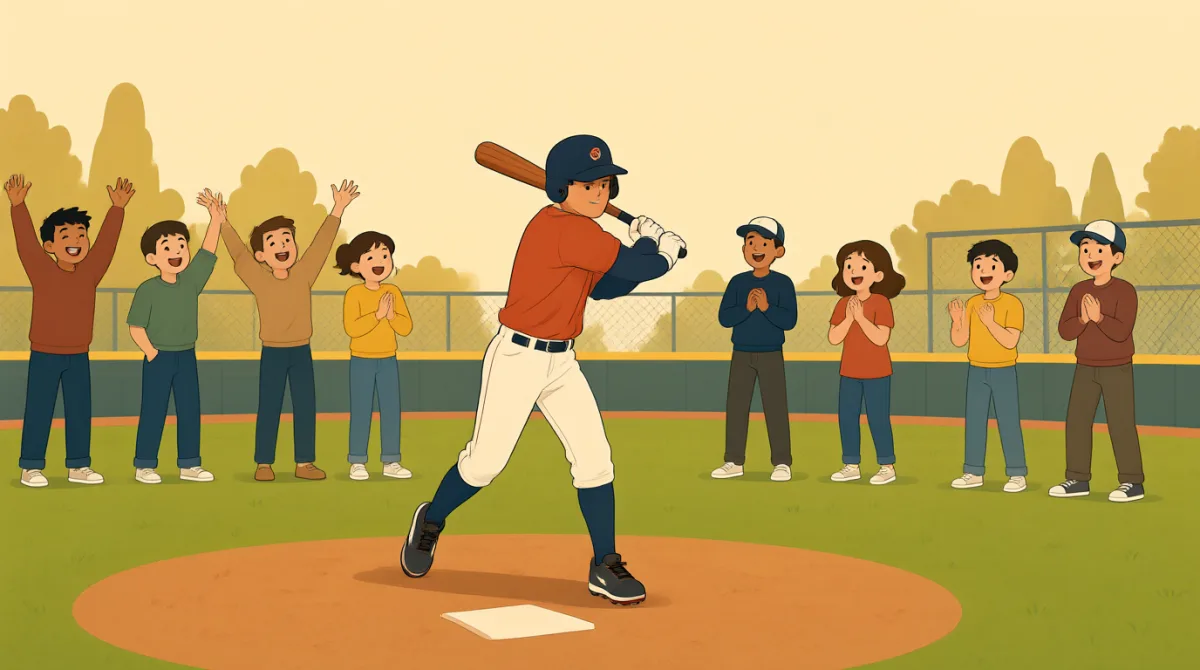

Wow, that ball is flying so high! Is it going over the wall?
¡Guau, esa pelota vuela muy alto! ¿Va a pasar por encima de la cerca?

It’s gone! That’s a home run! Everyone’s cheering!
¡Se fue! ¡Eso es un jonrón! ¡Todos están vitoreando!

Yes! The batter hit the ball out of the park. Our team gets a run.
¡Sí! El bateador sacó la pelota del campo. Nuestro equipo anota una carrera.
That was amazing! Does the batter run around all the bases now?
¡Qué increíble! ¿Ahora el bateador corre por todas las bases?
That’s right. He runs past first, second, and third base, then comes home.
Así es. Pasa por primera, segunda y tercera base, y luego llega al plato.
He made it! What a great play. I’m glad we came today.
¡Lo logró! Qué gran jugada. Me alegra que hayamos venido hoy.
Me too! The crowd is so loud. I want to watch another inning.
¡A mí también! El público hace muchísimo ruido. Quiero ver otra entrada.
Let’s enjoy the game. Maybe our team will hit another home run!
Disfrutemos del partido. ¡Quizá nuestro equipo conecte otro jonrón!
Vocabulario8
- home runjonrón
A home run is a hit that lets the batter run around all the bases and score. Here, the ball goes over the wall.
Un
- cheeringvitoreando
Cheering means shouting to show that you are happy or excited. Fans cheer when their team makes a great play.
«Cheering» significa gritar para demostrar que estás contento o emocionado. Los aficionados vitorean cuando su equipo hace una gran jugada.
- out of the parksacar la pelota del campo
This phrase means hitting the ball beyond the edge of the baseball field. It can also describe doing something very successfully.
Esta expresión significa batear la pelota más allá del límite del campo de béisbol. También puede describir hacer algo con mucho éxito.
- basesbases
Bases are the four places a player runs to score in baseball. The batter runs past each base and then comes home.
Las bases son los cuatro puntos que un jugador debe recorrer para anotar en béisbol. El bateador pasa por cada base y luego llega al plato.
- made itlo logró
This means that someone succeeded in reaching a place or completing something. Here, the batter reaches home plate safely.
Significa que alguien consiguió llegar a un lugar o completar algo. Aquí, el bateador llega sano y salvo al plato.
- crowdpúblico
A crowd is a large group of people in one place. At a game, the crowd may cheer loudly.
Un público es un grupo grande de personas reunidas en un lugar. En un partido, el público puede vitorear a gritos.
- inningentrada
An inning is one part of a baseball game. You can use this word when talking about how much of the game you want to watch.
Una «inning» es una parte de un partido de béisbol. Puedes usar esta palabra para hablar de cuánto más del partido quieres ver.
- hit another home runconectar otro jonrón
This means to hit the ball out of the park again. You can use it to talk about what you hope a baseball player will do.
Significa volver a batear la pelota fuera del campo. Puedes usar esta expresión para hablar de lo que esperas que haga un jugador de béisbol.
Frases clave8
- 1
Is it going over the wall?
¿Va a pasar por encima de la cerca?
Use this question when you think something may pass over a barrier. You can also ask, “Is it going over the fence?”
Usa esta pregunta cuando creas que algo podría pasar por encima de una barrera. También puedes preguntar: «Is it going over the fence?» (¿Va a pasar por encima de la cerca?).
- 2
That’s a home run!
¡Eso es un jonrón!
This is a short, excited way to say that a batter has hit a home run. You can use “That’s a [thing]!” to react to something you see.
Esta es una manera breve y entusiasta de decir que un bateador ha conectado un jonrón. Puedes usar «That’s a [thing]!» para reaccionar a algo que ves.
- 3
Our team gets a run.
Nuestro equipo anota una carrera.
This sentence explains that your team scores a point in baseball. You can replace “our team” with another team or player.
Esta oración explica que tu equipo anota un punto en béisbol. Puedes reemplazar «our team» por otro equipo o jugador.
- 4
Does the batter run around all the bases now?
¿Ahora el bateador corre por todas las bases?
Use this question to ask what happens next. The present simple with “does” is useful for asking about rules or usual actions.
Usa esta pregunta para preguntar qué pasa después. El presente simple con «does» sirve para preguntar sobre reglas o acciones habituales.
- 5
I’m glad we came today.
Me alegra que hayamos venido hoy.
Use this phrase to say you feel happy about a choice or experience. You can change the ending, as in “I’m glad we came to the game.”
Usa esta expresión para decir que estás contento con una decisión o experiencia. Puedes cambiar el final, como en «I’m glad we came to the game.» (Me alegra que hayamos venido al partido.).
- 6
The crowd is so loud.
El público hace muchísimo ruido.
This is a simple way to describe the sound of a large group of people. Replace “loud” with another adjective to describe the crowd.
Esta es una manera sencilla de describir el sonido de un grupo grande de personas. Puedes reemplazar «loud» por otro adjetivo para describir al público.
- 7
I want to watch another inning.
Quiero ver otra entrada.
Use “I want to” to say what you would like to do. You can replace “watch another inning” with another activity.
Usa «I want to» para decir qué te gustaría hacer. Puedes reemplazar «watch another inning» por otra actividad.
- 8
Maybe our team will hit another home run!
¡Quizá nuestro equipo conecte otro jonrón!
Use “Maybe” and “will” to talk about something that could happen in the future. You can replace “hit another home run” with another possible action.
Usa «Maybe» y «will» para hablar de algo que podría pasar en el futuro. Puedes reemplazar «hit another home run» por otra acción posible.