Arriving at the Stadium
Arrivée au stade
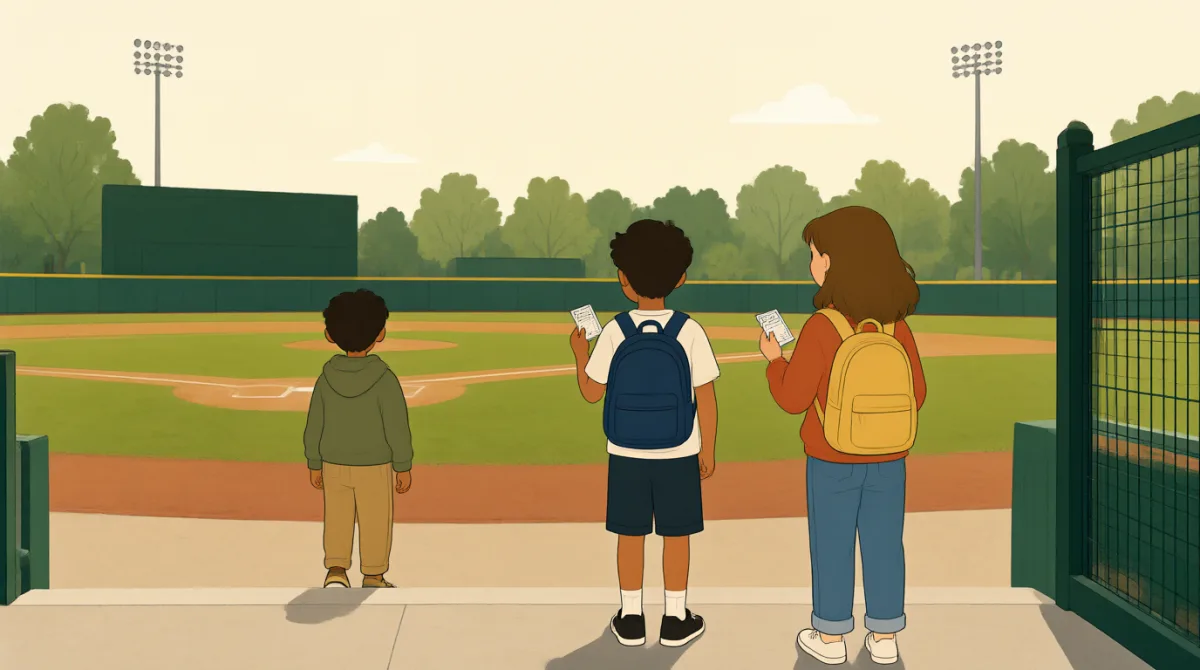
Emma, Leo, and Grace arrive at the baseball stadium. They check their tickets and look for the right entrance.
Emma, Leo et Grace arrivent au stade de baseball. Ils vérifient leurs billets et cherchent la bonne entrée.
Dialogue9

Wow, the stadium is huge! Do you know which entrance we need?
Waouh, le stade est immense ! Tu sais quelle entrée on doit prendre ?

Let me check our tickets. They say Gate B, near the main entrance.
Laisse-moi vérifier nos billets. Ils indiquent la porte B, près de l’entrée principale.

Good. We should find Gate B before the game starts.
Bien. On devrait trouver la porte B avant le début du match.
I see a sign over there. Is that the right way?
Je vois un panneau là-bas. C’est bien par là ?
Yes, it says Gate B. Come on, let's go this way.
Oui, il indique la porte B. Allez, on passe par là.
Keep your tickets ready. They may check them at the entrance.
Gardez vos billets à portée de main. Ils pourraient les vérifier à l’entrée.
Here they are. Do we need to show them on our phones?
Les voilà. On doit les montrer sur nos téléphones ?
Mine is on my phone, and yours are paper tickets.
Le mien est sur mon téléphone, et les tiens sont des billets papier.
Either is fine. Let's go in and find our seats.
Les deux formats conviennent. Entrons et cherchons nos places.
Vocabulaire8
- entranceentrée
An entrance is a place where you go into a building or area. At the stadium, it is a way inside.
Une « entrée », c’est l’endroit par lequel on entre dans un bâtiment ou un lieu. Au stade, c’est un accès à l’intérieur.
- ticketsbillets
Tickets are passes that let you enter an event. You need them to get into the game.
Les billets sont des titres qui permettent d’assister à un événement. Il en faut pour entrer au match.
- nearprès de
Near means close to something. Gate B is close to the main entrance.
« Près de » signifie qu’on est à proximité de quelque chose. La porte B est proche de l’entrée principale.
- signpanneau
A sign shows information or directions. You can follow a sign to find the right gate.
Un panneau donne des informations ou indique une direction. Tu peux suivre un panneau pour trouver la bonne porte.
- this waypar ici
This way means in this direction. Use it to show someone where to go.
“This way” signifie « par ici » ou « dans cette direction ». Utilise cette expression pour indiquer à quelqu’un où aller.
- Keep your tickets ready.Keep your tickets ready.
This means have your tickets out and easy to show. You can say this before entering a place where tickets may be checked.
Cela signifie qu’il faut avoir ses billets sortis et faciles à montrer. Tu peux dire “Keep your tickets ready.” (« Gardez vos billets à portée de main. ») avant d’entrer dans un lieu où les billets peuvent être vérifiés.
- show them on our phonesshow them on our phones
This means display the tickets on your phones. You can use this phrase to ask if digital tickets are accepted.
Cela signifie afficher les billets sur vos téléphones. Tu peux utiliser “show them on our phones” (« les montrer sur nos téléphones ») pour demander si les billets numériques sont acceptés.
- find our seatsfind our seats
This means look for the seats listed on your tickets. You can use it when you arrive at a theater, stadium, or other event.
Cela signifie chercher les places indiquées sur vos billets. Tu peux utiliser “find our seats” (« trouver nos places ») en arrivant au théâtre, au stade ou à un autre événement.
Phrases clés8
- 1
Do you know which entrance we need?
Tu sais quelle entrée on doit prendre ?
Use this to ask which entrance to use. You can replace “entrance” with another place, such as “which platform we need.”
Utilise “Do you know which entrance we need?” pour demander quelle entrée prendre. Tu peux remplacer “entrance” par un autre lieu, comme dans “which platform we need” (« quel quai on doit prendre »).
- 2
Let me check our tickets.
Laisse-moi vérifier nos billets.
Use this when you want to look at tickets or another piece of information. “Let me check” is a common way to offer to find something out.
Utilise “Let me check our tickets.” quand tu veux regarder des billets ou vérifier une information. “Let me check” est une façon courante de proposer de vérifier quelque chose.
- 3
We should find Gate B before the game starts.
On devrait trouver la porte B avant le début du match.
This sentence suggests what to do and when to do it. You can replace “find Gate B” with another task and “the game” with another event.
Cette phrase suggère quoi faire et à quel moment. Tu peux remplacer “find Gate B” par une autre tâche et “the game” par un autre événement.
- 4
Is that the right way?
C’est bien par là ?
Use this to check if you are going in the correct direction. It is useful when following signs or asking someone for directions.
Utilise “Is that the right way?” pour vérifier si tu vas dans la bonne direction. C’est pratique quand tu suis des panneaux ou que tu demandes ton chemin.
- 5
Keep your tickets ready.
Gardez vos billets à portée de main.
Use this to remind someone to have their tickets easy to reach. You can also say “Keep your ID ready” when someone may need to show identification.
Utilise “Keep your tickets ready.” pour rappeler à quelqu’un de garder ses billets à portée de main. Tu peux aussi dire “Keep your ID ready” (« Gardez votre pièce d’identité à portée de main ») si quelqu’un risque de devoir présenter une pièce d’identité.
- 6
Do we need to show them on our phones?
On doit les montrer sur nos téléphones ?
Use this to ask whether you need to display something on your phones. Replace “them” with another item, such as “the passes.”
Utilise “Do we need to show them on our phones?” pour demander si vous devez afficher quelque chose sur vos téléphones. Remplace “them” par un autre objet, comme “the passes” (« les pass »).
- 7
Either is fine.
Les deux formats conviennent.
Use this to say that two choices are both acceptable. For example, you can say it when someone asks whether you prefer paper or digital tickets.
Utilise “Either is fine.” pour dire que deux choix conviennent. Par exemple, tu peux le dire si quelqu’un te demande si tu préfères des billets papier ou numériques.
- 8
Let's go in and find our seats.
Entrons et cherchons nos places.
Use this to suggest entering a place and looking for your assigned seats. You can replace “find our seats” with another next step, such as “get some food.”
Utilise “Let's go in and find our seats.” pour proposer d’entrer dans un lieu et de chercher les places qui vous sont attribuées. Tu peux remplacer “find our seats” par une autre étape, comme “get some food” (« prendre à manger »).