Arriving Late at Night
Arrivée tard dans la nuit
The bus arrives late at night, and Emma checks that her suitcase is there. She asks Mia how to get to the taxi stand before they say goodbye.
Le bus arrive tard dans la nuit et Emma vérifie que sa valise est bien là. Elle demande à Mia comment rejoindre la station de taxis avant qu’elles se disent au revoir.
Dialogue8
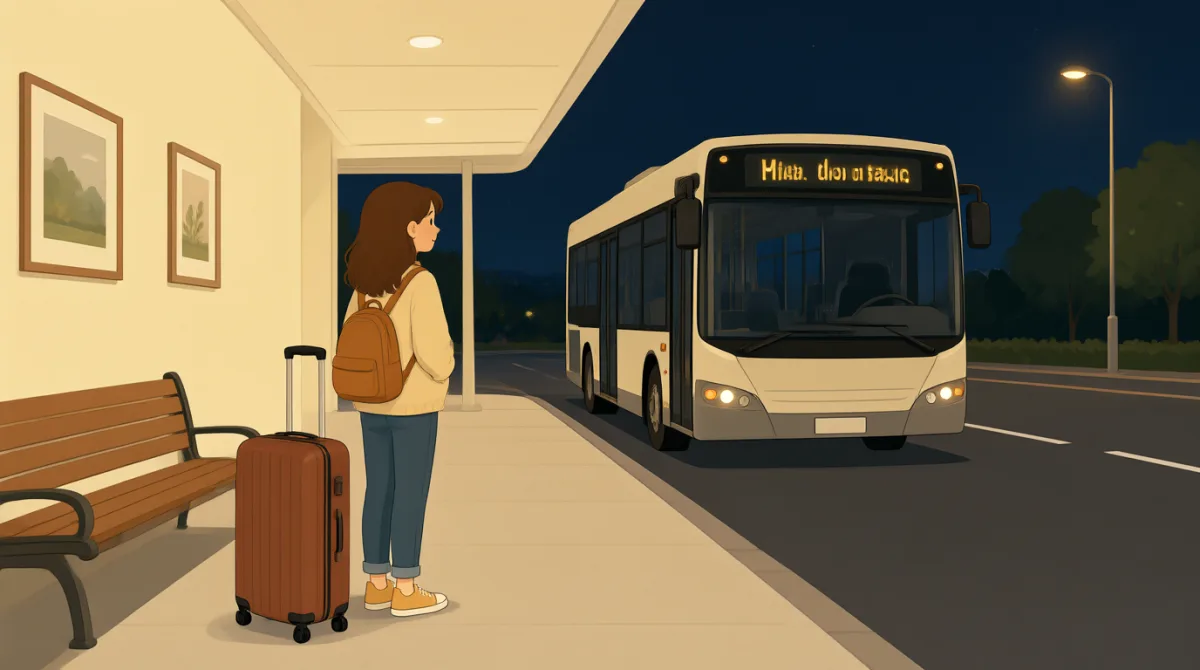

It’s really late. Is this the stop for downtown?
Il est vraiment tard. C’est bien l’arrêt pour le centre-ville ?

Yes, this is downtown. Did you get your suitcase from under the bus?
Oui, on est dans le centre-ville. Tu as récupéré ta valise sous le bus ?
Yes, I have it. Where can I find the taxi stand?
Oui, je l’ai. Où est-ce que je peux trouver la station de taxis ?
Go out through those doors, then turn left. You’ll see the taxis.
Sors par ces portes, puis tourne à gauche. Tu verras les taxis.
Great, thank you. Is it safe to walk there with my suitcase?
Super, merci. C’est sûr d’y aller à pied avec ma valise ?
Yes, it’s close and well lit. Stay on the sidewalk.
Oui, c’est tout près et bien éclairé. Reste sur le trottoir.
Thanks for helping me. I’m glad we arrived safely.
Merci de m’avoir aidée. Je suis contente qu’on soit arrivées sans problème.
You’re welcome. Have a good night, Emma!
Je t’en prie. Bonne nuit, Emma !
Vocabulaire8
- downtowncentre-ville
The central area of a city. You can use it to ask about or describe a place in town.
Le quartier central d’une ville. Tu peux employer ce mot pour demander où se trouve un endroit en ville ou pour le décrire.
- suitcasevalise
A case for carrying clothes and other things when you travel. You can use this word when talking about your luggage.
Un bagage dans lequel on transporte des vêtements et d’autres affaires quand on voyage. Tu peux employer ce mot pour parler de tes bagages.
- under the bussous le bus
This means below the bus, where luggage is often stored. Use it to ask where your bag was placed.
Cela désigne l’espace sous le bus, où les bagages sont souvent rangés. Utilise cette expression pour demander où un sac a été placé.
- taxi standstation de taxis
A place where taxis wait for passengers. You can ask where to find one when you arrive.
Un endroit où les taxis attendent les passagers. À ton arrivée, tu peux demander où en trouver une.
- turn lefttourner à gauche
Change direction to the left. Use it when giving or following directions.
Changer de direction en allant vers la gauche. Utilise cette expression pour donner ou suivre un itinéraire.
- well litbien éclairé
Bright enough to see clearly. You can use this phrase to describe a place that has good lighting.
Assez lumineux pour qu’on y voie clairement. Cette expression décrit un endroit où l’éclairage est bon.
- sidewalktrottoir
The path beside a road where people walk. Use it when talking about walking safely near traffic.
La partie au bord de la route où les piétons marchent. Utilise ce mot pour parler de sécurité quand on marche près de la circulation.
- arrived safelyarrivés sans problème
Got to a place without being hurt or having problems. You can use this phrase to say that a trip went well.
Être arrivé quelque part sans se blesser ni rencontrer de problème. Tu peux employer cette expression pour dire qu’un trajet s’est bien passé.
Phrases clés8
- 1
Is this the stop for downtown?
C’est bien l’arrêt pour le centre-ville ?
Use this question to check whether you have reached the right stop. You can replace “downtown” with another destination.
Utilise cette question pour vérifier que tu es arrivé au bon arrêt. Tu peux remplacer “downtown” par une autre destination.
- 2
Did you get your suitcase from under the bus?
Tu as récupéré ta valise sous le bus ?
Use this question to check that someone collected their luggage. “Did you get...” is useful for asking about a completed action.
Utilise cette question pour vérifier que quelqu’un a bien récupéré ses bagages. “Did you get...” est pratique pour poser une question sur une action qui a déjà eu lieu.
- 3
Where can I find the taxi stand?
Où est-ce que je peux trouver la station de taxis ?
Use this to ask where a taxi pickup area is. You can replace “the taxi stand” with another place you need to find.
Utilise cette question pour demander où se trouve l’endroit où l’on prend un taxi. Tu peux remplacer “the taxi stand” par un autre endroit que tu cherches.
- 4
Go out through those doors, then turn left.
Sors par ces portes, puis tourne à gauche.
This gives two simple directions in order. You can use “then” to show what someone should do next.
Cette phrase donne deux indications simples dans l’ordre. Tu peux utiliser “then” pour indiquer ce qu’il faut faire ensuite.
- 5
Is it safe to walk there with my suitcase?
C’est sûr d’y aller à pied avec ma valise ?
Use this question to ask whether a walk is safe. You can replace “with my suitcase” with another situation or item.
Utilise cette question pour demander si un trajet à pied est sûr. Tu peux remplacer “with my suitcase” par une autre situation ou un autre objet.
- 6
Stay on the sidewalk.
Reste sur le trottoir.
This is a short instruction for walking safely beside a road. You can use “Stay on...” to tell someone where to remain.
C’est une consigne courte pour marcher en sécurité au bord d’une route. Tu peux utiliser “Stay on...” pour dire à quelqu’un où rester.
- 7
I’m glad we arrived safely.
Je suis contente qu’on soit arrivées sans problème.
Use this sentence to show relief that everyone reached a place without problems. You can change “we” to “you” or “they” to talk about others.
Utilise cette phrase pour exprimer ton soulagement : tout le monde est arrivé sans problème. Tu peux remplacer “we” par “you” ou “they” pour parler d’autres personnes.
- 8
Have a good night, Emma!
Bonne nuit, Emma !
This is a friendly way to say goodbye late in the day. Replace the name with the person you are speaking to.
C’est une façon amicale de dire au revoir tard dans la journée. Remplace le nom par celui de la personne à qui tu parles.