Finding Your Seat
Trouver sa place
Emma gets on the bus and checks her ticket number. She asks Mia for help finding her seat and puts her small bag nearby.
Emma monte dans le bus et vérifie le numéro de son siège sur son billet. Elle demande à Mia de l’aider à trouver sa place et pose son petit sac à proximité.
Dialogue8
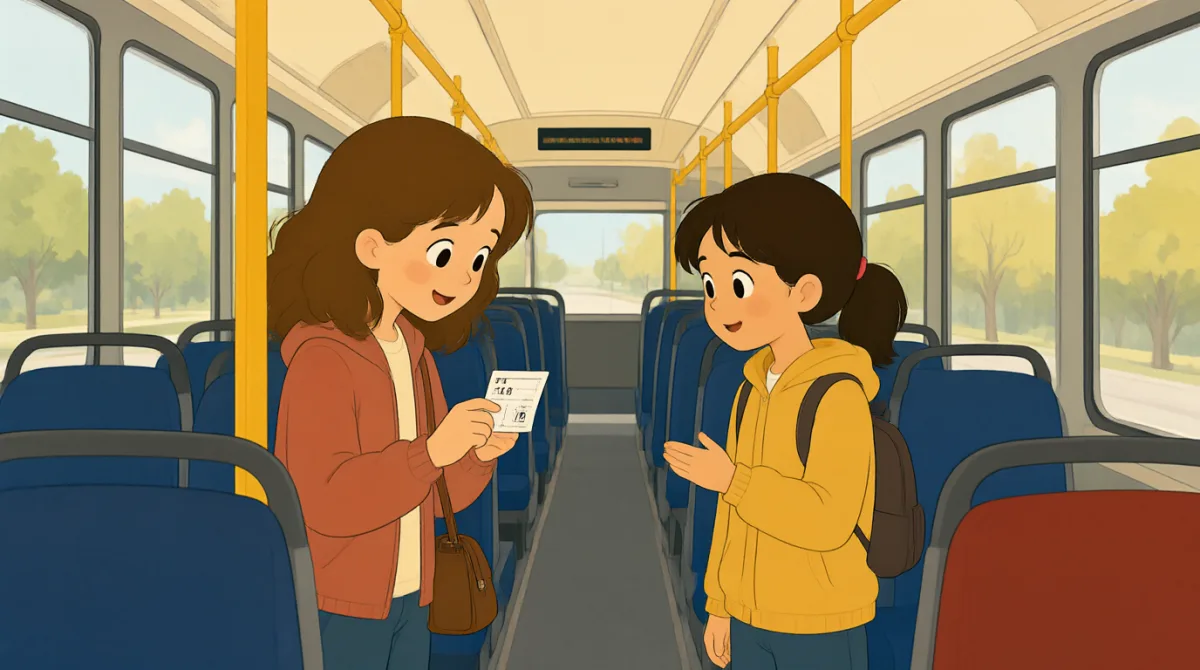

Excuse me, my ticket says seat 14. Is that on this bus?
Excusez-moi, mon billet indique la place 14. C’est bien dans ce bus ?

Yes, it is. Your seat is by the window, about halfway down.
Oui, c’est ça. Votre place est près de la fenêtre, à peu près à mi-chemin.
Thanks! Could you help me find it? The numbers are hard to see.
Merci ! Vous pourriez m’aider à la trouver ? Les numéros sont difficiles à voir.
Sure. Follow me. Look for the number above each seat.
Bien sûr. Suivez-moi. Regardez le numéro au-dessus de chaque siège.
Oh, there it is. Can I put my small bag here?
Ah, la voilà. Je peux mettre mon petit sac ici ?
Yes, you can put it under the seat in front of you.
Oui, vous pouvez le mettre sous le siège devant vous.
Great. I don't want it to block the aisle.
Super. Je ne voudrais pas qu’il bloque l’allée.
Good idea. Keep your ticket with you, and enjoy the ride!
Bonne idée. Gardez votre billet avec vous et bon voyage !
Vocabulaire8
- Excuse meExcusez-moi
Use this polite phrase to get someone's attention or ask a question.
Utilisez cette formule de politesse pour attirer l’attention de quelqu’un ou lui poser une question.
- ticket saysindiquer sur le billet
This means the information is written on your ticket. You can use it to talk about details on a ticket or other document.
Cette expression signifie que l’information est écrite sur votre billet. Vous pouvez l’utiliser pour parler des détails inscrits sur un billet ou un autre document.
- by the windowprès de la fenêtre
This describes a seat next to the window. You can use “by the” to say that something is next to a place or object.
Cette expression décrit un siège situé à côté de la fenêtre. Vous pouvez utiliser “by the” pour dire que quelque chose se trouve à côté d’un endroit ou d’un objet.
- halfway downà mi-chemin
This means partway along something, not near the beginning or the end. It helps describe where a seat is on the bus.
Cette expression signifie qu’on se trouve entre le début et la fin de quelque chose, et non près de l’un ou de l’autre. Elle aide à indiquer où se trouve un siège dans le bus.
- Follow meSuivez-moi
Use this phrase to ask someone to come with you while you show them the way.
Utilisez cette expression pour inviter quelqu’un à vous suivre pendant que vous lui montrez le chemin.
- under the seat in front of yousous le siège devant vous
This tells someone where to put a bag or other item. You can use “under the” to describe a place below something.
Cette expression indique où poser un sac ou un autre objet. Vous pouvez utiliser “under the” pour décrire un endroit situé sous quelque chose.
- block the aislebloquer l’allée
This means to stop people from walking along the aisle. You can use “block” when something is in the way.
Cela signifie empêcher les gens de circuler dans l’allée. Vous pouvez utiliser “block” quand quelque chose se trouve sur le passage.
- Keep your ticket with youGardez votre billet avec vous
This means to carry your ticket and not leave it behind. You can use “keep [something] with you” for important items.
Cela signifie que vous devez garder votre billet sur vous et ne pas le laisser derrière. Vous pouvez utiliser “keep [something] with you” pour parler d’objets importants à garder avec soi.
Phrases clés8
- 1
Excuse me, my ticket says seat 14. Is that on this bus?
Excusez-moi, mon billet indique la place 14. C’est bien dans ce bus ?
Use this to politely check whether your ticket is for the bus you are on. You can replace “seat 14” with your own seat number.
Utilisez cette phrase pour vérifier poliment si votre billet correspond au bus dans lequel vous êtes. Vous pouvez remplacer “seat 14” par le numéro de votre siège.
- 2
Your seat is by the window, about halfway down.
Votre place est près de la fenêtre, à peu près à mi-chemin.
This is a useful way to describe where a seat is. You can change “by the window” and “halfway down” to give other location details.
C’est une façon pratique d’indiquer où se trouve un siège. Vous pouvez modifier “by the window” et “halfway down” pour donner d’autres indications de lieu.
- 3
Could you help me find it?
Vous pourriez m’aider à la trouver ?
Use this polite question when you need help locating something. Replace “it” with the item or place you are looking for.
Utilisez cette question polie quand vous avez besoin d’aide pour trouver quelque chose. Remplacez “it” par l’objet ou l’endroit que vous cherchez.
- 4
Follow me.
Suivez-moi.
Use this short phrase to show someone the way. It is useful when you are guiding someone to a place.
Utilisez cette courte expression pour montrer le chemin à quelqu’un. Elle est pratique pour guider une personne vers un endroit.
- 5
Can I put my small bag here?
Je peux mettre mon petit sac ici ?
Use this to ask permission to put something in a particular place. You can replace “my small bag” with another item.
Utilisez cette phrase pour demander la permission de poser quelque chose à un endroit précis. Vous pouvez remplacer “my small bag” par un autre objet.
- 6
You can put it under the seat in front of you.
Vous pouvez le mettre sous le siège devant vous.
This gives a clear instruction about where to place something. You can change the location phrase to suggest a different spot.
Cette phrase indique clairement où poser quelque chose. Vous pouvez modifier l’expression de lieu pour suggérer un autre endroit.
- 7
I don't want it to block the aisle.
Je ne voudrais pas qu’il bloque l’allée.
Use this to explain that you do not want an item to get in people's way. You can replace “the aisle” with another walkway or space.
Utilisez cette phrase pour expliquer que vous ne voulez pas qu’un objet gêne le passage. Vous pouvez remplacer “the aisle” par un autre passage ou espace.
- 8
Keep your ticket with you, and enjoy the ride!
Gardez votre billet avec vous et bon voyage !
This is a friendly reminder to hold on to your ticket, followed by a warm wish for the trip. You can use “Keep your [item] with you” to remind someone to carry something important.
C’est un rappel amical de garder son billet avec soi, suivi d’un souhait chaleureux pour le voyage. Vous pouvez utiliser “Keep your [item] with you” pour rappeler à quelqu’un de garder un objet important sur lui.