Putting Your Bag Under the Bus
Ranger votre bagage sous le car
At the bus station, Emma asks the driver, David, where to put her suitcase. David helps her store it safely under the bus.
À la gare routière, Emma demande au chauffeur, David, où mettre sa valise. David l’aide à la ranger en toute sécurité sous le car.
Dialogue8
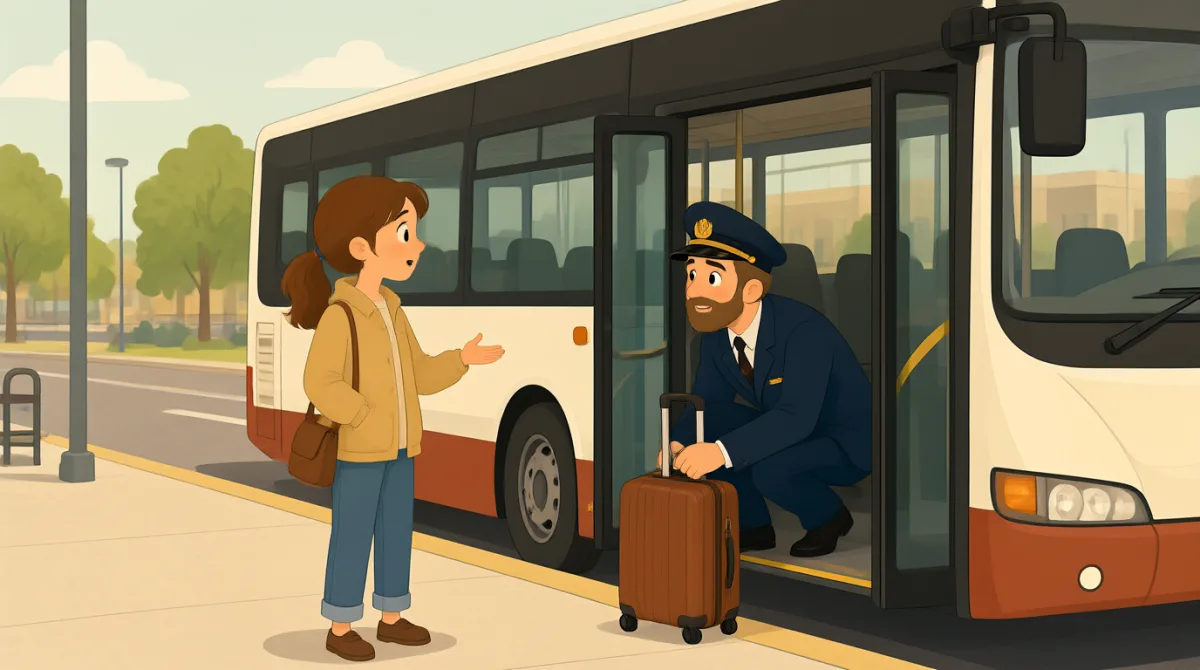

Excuse me, where should I put my suitcase?
Excusez-moi, où dois-je mettre ma valise ?

Put it under the bus, please. I’ll open the luggage door.
Mettez-la sous le car, s’il vous plaît. Je vais ouvrir la soute.
Is this the right place? It’s a little heavy.
C’est au bon endroit ? Elle est un peu lourde.
Yes, that’s right. I can help you lift it.
Oui, c’est ça. Je peux vous aider à la soulever.
Thank you. Should I take my small bag with me?
Merci. Est-ce que je dois garder mon petit sac avec moi ?
Yes, keep your small bag with you on the bus.
Oui, gardez votre petit sac avec vous dans le car.
Okay. Is my suitcase safe under the bus?
D’accord. Ma valise est en sécurité sous le car ?
Yes. I’ll close the door now. Please keep your ticket with you.
Oui. Je vais refermer la soute. Gardez votre billet avec vous, s’il vous plaît.
Vocabulaire7
- put it under the busle mettre sous le car
This means to place an item in the storage space below the bus. You can use “put it under” to say where to store something.
Cela signifie placer un objet dans l’espace de rangement situé sous le car. Vous pouvez utiliser “put it under” pour préciser où ranger quelque chose.
- luggage doorla soute
This is the door to the bus’s luggage storage space. You may hear this phrase when a driver helps you store a suitcase.
C’est l’espace de rangement des bagages dans un car, accessible par une porte. Vous pouvez entendre ce terme quand un chauffeur vous aide à ranger une valise.
- a little heavyun peu lourd
This means something is somewhat difficult to lift because of its weight. You can say “It’s a little heavy” when asking someone for help.
Cela signifie qu’un objet est assez lourd pour être difficile à soulever. Vous pouvez dire “It’s a little heavy” pour demander de l’aide.
- lift itle soulever
This means to raise something off the ground. Use “lift” when talking about picking up a heavy bag or box.
Cela signifie soulever quelque chose du sol. Utilisez “lift” quand vous parlez de soulever un sac ou un carton lourd.
- keep your small bag with yougarder votre petit sac avec vous
This means to take your small bag onto the bus instead of putting it in the luggage storage. You can use “keep … with you” for things you want to carry.
Cela signifie emporter votre petit sac dans le car au lieu de le mettre dans la soute. Vous pouvez utiliser “keep … with you” pour parler des affaires que vous souhaitez garder avec vous.
- close the doorfermer la porte
This means to shut the door. You can use “close” when asking someone to shut a door or other opening.
Cela signifie fermer une porte. Vous pouvez utiliser “close” pour demander à quelqu’un de fermer une porte ou une autre ouverture.
- keep your ticket with yougarder votre billet avec vous
This means to hold on to your ticket and not leave it behind. You can use “keep … with you” for important things you need while traveling.
Cela signifie garder votre billet sur vous et ne pas le laisser derrière. Vous pouvez utiliser “keep … with you” pour les objets importants dont vous avez besoin en voyage.
Phrases clés7
- 1
Excuse me, where should I put my suitcase?
Excusez-moi, où dois-je mettre ma valise ?
Use this polite question to ask where to place your luggage. You can replace “my suitcase” with another item, such as “my backpack.”
Utilisez cette question polie pour demander où déposer vos bagages. Vous pouvez remplacer “my suitcase” par un autre objet, comme “my backpack”.
- 2
I’ll open the luggage door.
Je vais ouvrir la soute.
This tells someone what you are going to do to help. Use “I’ll” plus a verb to offer or explain an action.
Cette phrase indique à quelqu’un ce que vous allez faire pour l’aider. Utilisez “I’ll” suivi d’un verbe pour proposer une action ou expliquer ce que vous allez faire.
- 3
It’s a little heavy.
Elle est un peu lourde.
Use this sentence to explain that something is somewhat difficult to lift. You can say it when asking for help with a bag or box.
Utilisez cette phrase pour expliquer qu’un objet est assez lourd pour être difficile à soulever. Vous pouvez la dire pour demander de l’aide avec un sac ou un carton.
- 4
I can help you lift it.
Je peux vous aider à la soulever.
This is a simple way to offer help with something heavy. Replace “lift it” with another action, such as “carry it.”
C’est une manière simple de proposer son aide pour porter quelque chose de lourd. Remplacez “lift it” par une autre action, comme “carry it”.
- 5
Should I take my small bag with me?
Est-ce que je dois garder mon petit sac avec moi ?
Use this question to check whether you should bring an item along. Replace “my small bag” with another thing you may need.
Utilisez cette question pour vérifier si vous devez emporter un objet avec vous. Remplacez “my small bag” par un autre objet dont vous pourriez avoir besoin.
- 6
Yes, keep your small bag with you on the bus.
Oui, gardez votre petit sac avec vous dans le car.
This gives a clear instruction about what to carry onto the bus. You can use “keep [item] with you” when someone should not put an item away.
Cette phrase indique clairement ce qu’il faut emporter dans le car. Vous pouvez utiliser “keep [item] with you” quand quelqu’un ne doit pas ranger un objet.
- 7
Please keep your ticket with you.
Gardez votre billet avec vous, s’il vous plaît.
This is a polite reminder to hold on to an important item. Replace “your ticket” with something else you need to keep close.
C’est un rappel poli pour vous demander de garder un objet important avec vous. Remplacez “your ticket” par autre chose que vous devez garder à portée de main.