Arriving on the Island
Arrivée sur l’île
The ferry reaches the island, and Emma and Jack get ready to go ashore. They talk about what to see first.
Le ferry arrive sur l’île, et Emma et Jack se préparent à débarquer. Ils discutent de ce qu’ils aimeraient voir en premier.
Dialogue8
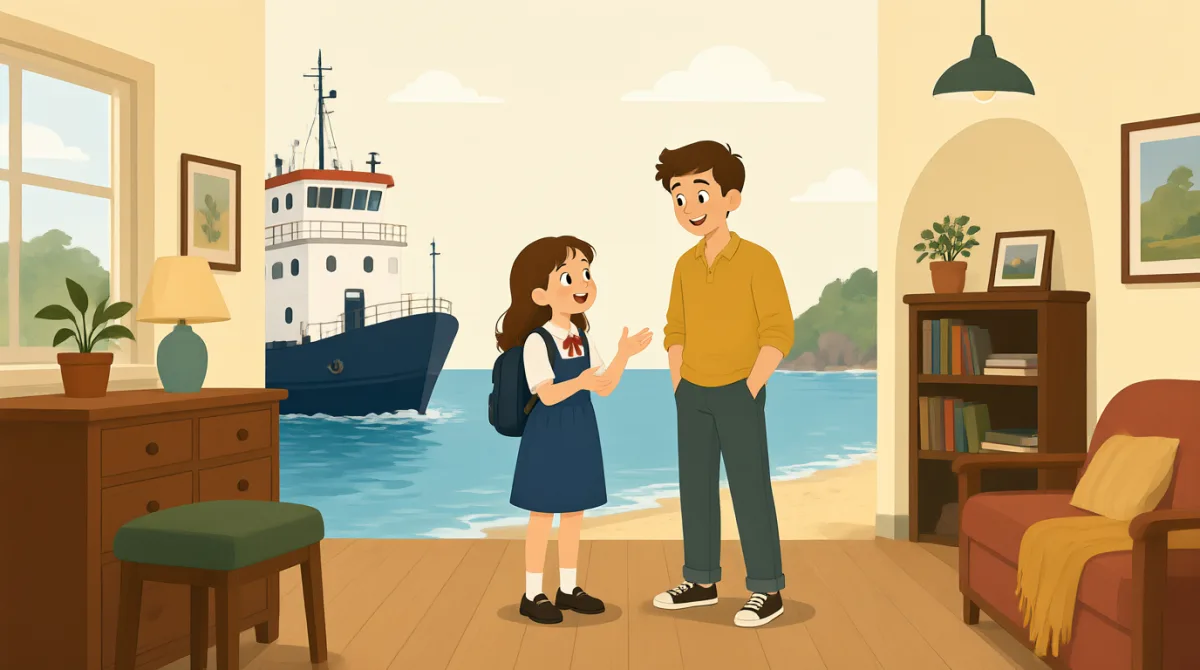

We’re here! The ferry is slowing down, so let’s get our bags ready.
On est arrivés ! Le ferry ralentit, alors préparons nos sacs.

Great! I can see the island now. Do we walk off this way?
Super ! Je vois l’île maintenant. On sort par ici ?
Yes, follow the signs to the exit. The crew will open the gate soon.
Oui, suis les panneaux jusqu’à la sortie. L’équipage va bientôt ouvrir la porte.
I’m excited to explore! What should we see first?
J’ai hâte de découvrir l’île ! Qu’est-ce qu’on devrait voir en premier ?
Let’s walk to the harbor and find the visitor center. It’s nearby.
Allons à pied jusqu’au port et cherchons l’office de tourisme. C’est tout près.
Good idea. We can pick up a map and ask about the beach.
Bonne idée. On peut prendre une carte et se renseigner sur la plage.
Sure. After that, we can follow the path along the water.
Bien sûr. Après, on pourra suivre le sentier le long de l’eau.
Perfect! I’ll take my bag. Let’s go ashore.
Parfait ! Je prends mon sac. Allons débarquer.
Vocabulaire8
- get our bags readypréparer nos sacs
To prepare your bags so you can take them with you. You can say this when you are about to leave a place.
Préparer ses sacs pour pouvoir les emporter. On peut dire ça quand on s’apprête à quitter un endroit.
- walk offsortir (d’un bateau)
To leave a boat or other vehicle by walking. Here, Emma asks if this is the way to leave the ferry.
Quitter un bateau ou un autre véhicule à pied. Ici, Emma demande si c’est par là qu’on sort du ferry.
- follow the signssuivre les panneaux
To go in the direction shown by signs. This is useful when finding your way around a station, airport, or ferry terminal.
Aller dans la direction indiquée par les panneaux. C’est pratique pour se repérer dans une gare, un aéroport ou un terminal de ferry.
- crewéquipage
The people who work on a ship or ferry. Here, the crew will open the gate for passengers.
Les personnes qui travaillent à bord d’un bateau ou d’un ferry. Ici, l’équipage va ouvrir la porte aux passagers.
- visitor centeroffice de tourisme
A place where visitors can get information about an area. You can often pick up maps and ask questions there.
Un endroit où les visiteurs peuvent obtenir des informations sur une région. On peut souvent y prendre des cartes et poser des questions.
- pick up a mapprendre une carte
To get or collect a map. You can use this phrase when you need a map for a new place.
Se procurer ou récupérer une carte. Cette expression est utile quand on a besoin d’une carte pour découvrir un nouvel endroit.
- along the waterle long de l’eau
Beside the water, following its edge. You can use this phrase to describe a path or walk near the sea, a lake, or a river.
Au bord de l’eau, en suivant son contour. Cette expression peut décrire un sentier ou une promenade près de la mer, d’un lac ou d’une rivière.
- go ashoredébarquer
To leave a boat and step onto land. This phrase is often used when arriving by ferry or ship.
Quitter un bateau pour mettre le pied à terre. Cette expression s’emploie souvent quand on arrive en ferry ou en bateau.
Phrases clés8
- 1
The ferry is slowing down, so let’s get our bags ready.
Le ferry ralentit, alors préparons nos sacs.
This sentence explains what is happening and suggests what to do next. Use “Let’s get [something] ready” to prepare for an upcoming activity.
Cette phrase explique ce qui se passe et propose quoi faire ensuite. Utilise “Let’s get [something] ready” (préparons [quelque chose]) pour se préparer à une activité imminente.
- 2
Do we walk off this way?
On sort par ici ?
This is a simple way to check which direction to go when leaving a boat or vehicle. You can replace “walk off” with another action, such as “go out.”
C’est une façon simple de demander dans quelle direction aller pour quitter un bateau ou un véhicule. Tu peux remplacer “walk off” par une autre action, comme “go out”.
- 3
The crew will open the gate soon.
L’équipage va bientôt ouvrir la porte.
This sentence uses “will” to talk about something that is expected to happen. You can use the pattern “will [action] soon” for near-future events.
Cette phrase utilise “will” pour parler de quelque chose qui devrait se produire. Tu peux employer le modèle “will [action] soon” pour parler d’événements qui auront lieu bientôt.
- 4
What should we see first?
Qu’est-ce qu’on devrait voir en premier ?
This is a useful question when deciding what to visit or do. You can replace “see” with another verb, such as “do” or “try.”
C’est une question utile pour décider quoi visiter ou faire. Tu peux remplacer “see” par un autre verbe, comme “do” ou “try”.
- 5
Let’s walk to the harbor and find the visitor center.
Allons à pied jusqu’au port et cherchons l’office de tourisme.
This sentence suggests a plan and gives two things to do. Use “Let’s [action] and [action]” to make a friendly suggestion.
Cette phrase propose un plan avec deux choses à faire. Utilise “Let’s [action] and [action]” pour faire une suggestion amicale.
- 6
We can pick up a map and ask about the beach.
On peut prendre une carte et se renseigner sur la plage.
This sentence uses “can” to describe possible activities. You can use the same pattern to suggest useful things to do in a new place.
Cette phrase utilise “can” pour parler d’activités possibles. Tu peux reprendre le même modèle pour suggérer des choses utiles à faire dans un nouvel endroit.
- 7
After that, we can follow the path along the water.
Après, on pourra suivre le sentier le long de l’eau.
“After that” helps put activities in order. Use it to explain what you plan to do next.
“After that” permet de mettre les activités dans l’ordre. Utilise cette expression pour expliquer ce que tu prévois de faire ensuite.
- 8
Let’s go ashore.
Allons débarquer.
This is a short, natural way to suggest leaving a boat and going onto land. You can also say “Let’s go inside” or “Let’s go outside” when changing places.
C’est une façon courte et naturelle de proposer de quitter un bateau pour aller à terre. Tu peux aussi dire “Let’s go inside” ou “Let’s go outside” quand vous changez d’endroit.