Finding Seats Outside
Trouver des places à l’extérieur
On the ferry, Emma and Jack look for seats outside. They find a place to sit and enjoy the view.
Sur le ferry, Emma et Jack cherchent des places à l’extérieur. Ils trouvent un endroit où s’asseoir et profitent de la vue.
Dialogue8
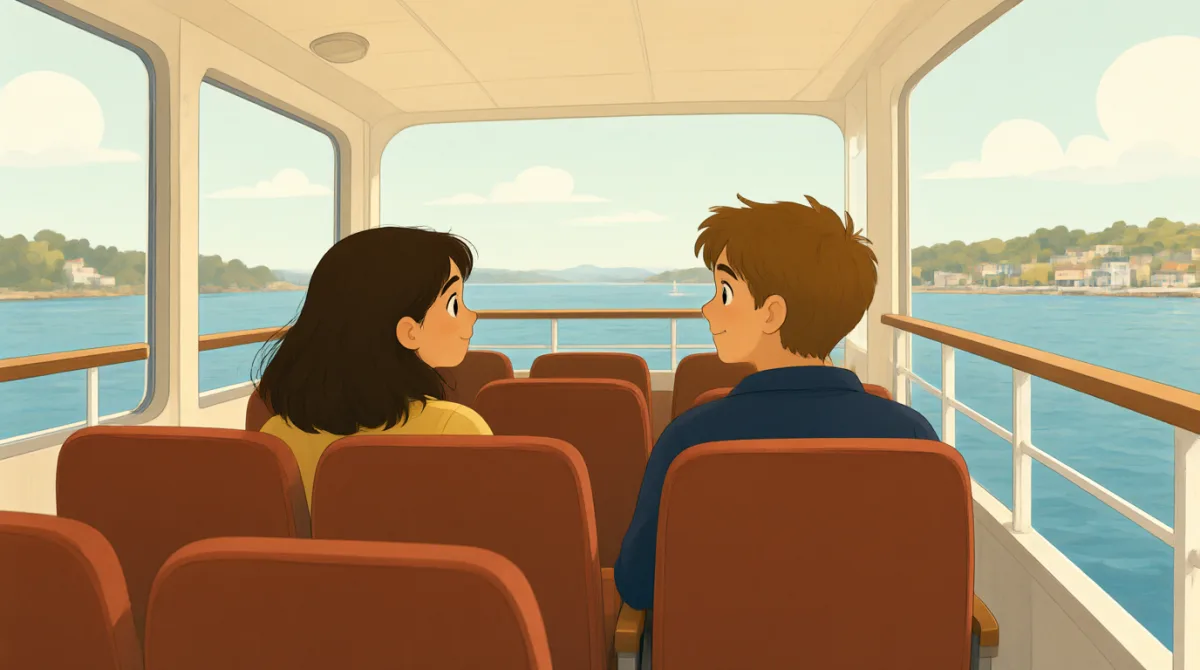

Is there a place to sit outside? I’d love to see the view.
Il y a un endroit où s’asseoir dehors ? J’aimerais bien voir le paysage.

I think there are seats on the upper deck. Let’s go up.
Je crois qu’il y a des places sur le pont supérieur. Allons-y.
Are these seats free? I don’t see anyone here.
Ces places sont libres ? Je ne vois personne ici.
They look free. Let’s sit here, near the rail.
Elles ont l’air libres. Asseyons-nous ici, près du bastingage.
Great! The water looks so blue today.
Super ! L’eau est vraiment si bleue aujourd’hui.
Yeah, and we can see the island from here.
Ouais, et on voit l’île d’ici.
I’m glad we came outside. It’s much nicer up here.
Je suis contente qu’on soit sortis. C’est bien plus agréable ici.
Me too. Let’s enjoy the ride before we arrive.
Moi aussi. Profitons du trajet avant d’arriver.
Vocabulaire8
- outsidedehors
In this conversation, outside means in the open air, not inside the ferry. You can ask, “Can we sit outside?”
Dans cette conversation, « outside » signifie à l’air libre, et non à l’intérieur du ferry. Tu peux demander : “Can we sit outside?”
- the viewla vue
The view is what you can see around you, such as the sea and the island. Use “I’d love to see the view” to say you want to look at the scenery.
« The view », c’est ce que tu peux voir autour de toi, comme la mer et l’île. Utilise “I’d love to see the view” pour dire que tu aimerais admirer le paysage.
- upper deckle pont supérieur
The upper deck is the higher level of a boat or ferry. You can say, “Let’s go up to the upper deck.”
« The upper deck », c’est le niveau le plus élevé d’un bateau ou d’un ferry. Tu peux dire : “Let’s go up to the upper deck.”
- freelibre
Here, free means available for someone to use, not costing no money. You can ask, “Is this seat free?”
Ici, « free » signifie qu’une place est disponible, et non qu’elle ne coûte rien. Tu peux demander : “Is this seat free?”
- near the railprès du bastingage
Near the rail means close to the barrier along the edge of the deck. You can use this phrase to describe where you want to sit.
« Near the rail » signifie près de la rambarde qui longe le bord du pont. Tu peux utiliser cette expression pour préciser où tu veux t’asseoir.
- the islandl’île
An island is land with water all around it. In this dialogue, Emma and Jack can see the island from the ferry.
Une île est une étendue de terre entourée d’eau. Dans ce dialogue, Emma et Jack peuvent voir l’île depuis le ferry.
- came outsideêtre sortis
“Came outside” means moved from inside to a place outdoors. You can say, “I’m glad we came outside” when you are happy you went outdoors.
“Came outside” signifie qu’on est passé de l’intérieur à un endroit en plein air. Tu peux dire “I’m glad we came outside” pour exprimer que tu es content d’être sorti.
- arrivearriver
To arrive means to reach a place. Use “before we arrive” to talk about what you can do before reaching your destination.
« Arrive » signifie atteindre un endroit. Utilise “before we arrive” pour parler de ce que tu peux faire avant d’arriver à destination.
Phrases clés7
- 1
Is there a place to sit outside?
Il y a un endroit où s’asseoir dehors ?
Use this question to ask if there is somewhere to sit outdoors. You can replace “outside” with another place, such as “near the window.”
Utilise cette question pour demander s’il y a un endroit où s’asseoir en plein air. Tu peux remplacer “outside” par un autre lieu, par exemple “near the window.”
- 2
I think there are seats on the upper deck.
Je crois qu’il y a des places sur le pont supérieur.
This is a useful way to share information when you are not completely sure. You can replace “seats” or “on the upper deck” with other details.
C’est une façon pratique de donner une information quand tu n’en es pas tout à fait sûr. Tu peux remplacer “seats” ou “on the upper deck” par d’autres précisions.
- 3
Are these seats free?
Ces places sont libres ?
Use this question to check if seats are available. You can also ask, “Is this seat free?” when asking about one seat.
Utilise cette question pour vérifier si des places sont disponibles. Tu peux aussi demander “Is this seat free?” pour une seule place.
- 4
Let’s sit here, near the rail.
Asseyons-nous ici, près du bastingage.
Use “Let’s” to suggest doing something together, and add a place to say where. For example, “Let’s sit here, near the window.”
Utilise “Let’s” pour proposer de faire quelque chose ensemble, puis ajoute un lieu pour préciser où. Par exemple : “Let’s sit here, near the window.”
- 5
The water looks so blue today.
L’eau est vraiment si bleue aujourd’hui.
This sentence describes what you see and gives a simple opinion. You can change “blue” to another describing word, such as “calm.”
Cette phrase décrit ce que tu vois et donne une opinion simple. Tu peux remplacer “blue” par un autre adjectif, comme “calm.”
- 6
I’m glad we came outside.
Je suis contente qu’on soit sortis.
Use this sentence to say you are happy about a choice you made. You can replace “came outside” with another activity, such as “took the ferry.”
Utilise cette phrase pour dire que tu es heureux d’un choix que tu as fait. Tu peux remplacer “came outside” par une autre activité, comme “took the ferry.”
- 7
Let’s enjoy the ride before we arrive.
Profitons du trajet avant d’arriver.
This is a friendly suggestion to enjoy a journey before reaching your destination. You can replace “the ride” with “the trip.”
C’est une proposition amicale pour profiter du voyage avant d’arriver à destination. Tu peux remplacer “the ride” par “the trip.”