Arriving on the Island
Llegada a la isla
The ferry reaches the island, and Emma and Jack get ready to go ashore. They talk about what to see first.
El ferry llega a la isla y Emma y Jack se preparan para bajar. Hablan de qué ver primero.
Diálogo8
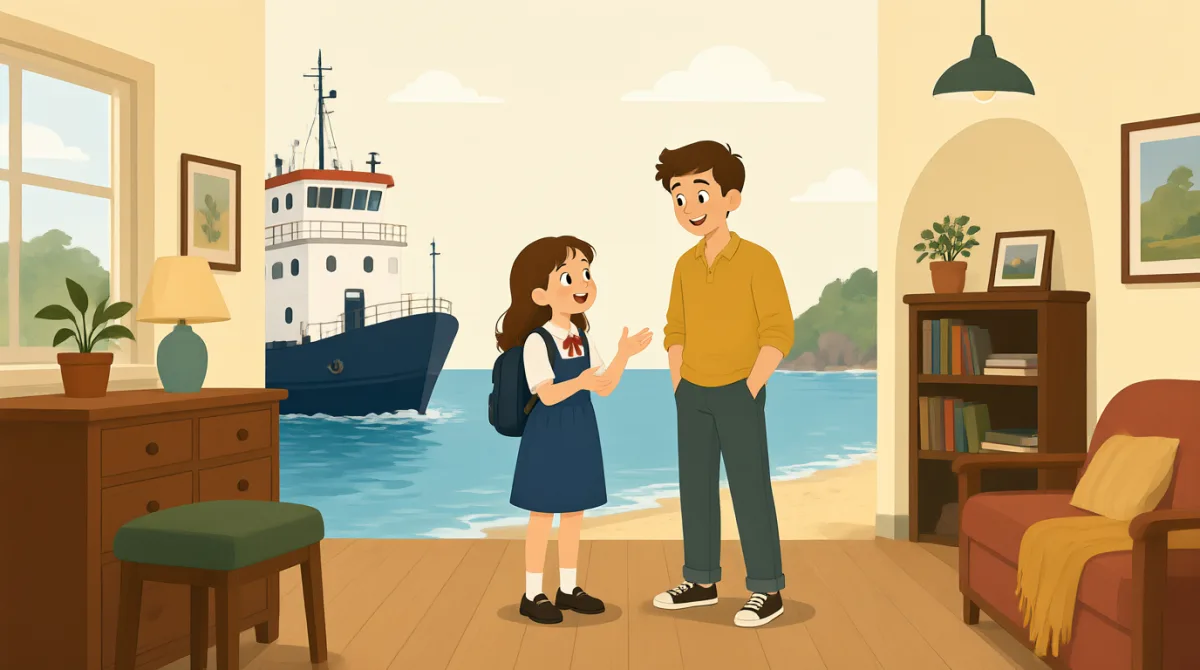

We’re here! The ferry is slowing down, so let’s get our bags ready.
¡Ya llegamos! El ferry está frenando, así que preparemos las bolsas.

Great! I can see the island now. Do we walk off this way?
¡Genial! Ya veo la isla. ¿Bajamos por aquí?
Yes, follow the signs to the exit. The crew will open the gate soon.
Sí, sigue los letreros hasta la salida. La tripulación abrirá la puerta pronto.
I’m excited to explore! What should we see first?
¡Tengo muchas ganas de explorar! ¿Qué deberíamos ver primero?
Let’s walk to the harbor and find the visitor center. It’s nearby.
Vamos caminando hasta el puerto y buscamos el centro de visitantes. Está cerca.
Good idea. We can pick up a map and ask about the beach.
Buena idea. Podemos conseguir un mapa y preguntar por la playa.
Sure. After that, we can follow the path along the water.
Claro. Después, podemos seguir el sendero junto al agua.
Perfect! I’ll take my bag. Let’s go ashore.
¡Perfecto! Llevo mi bolsa. Vamos a desembarcar.
Vocabulario8
- get our bags readypreparar las bolsas
To prepare your bags so you can take them with you. You can say this when you are about to leave a place.
Preparar las bolsas para llevártelas contigo. Puedes decirlo cuando estás a punto de irte de un lugar.
- walk offbajar
To leave a boat or other vehicle by walking. Here, Emma asks if this is the way to leave the ferry.
Salir de un barco u otro vehículo caminando. Aquí, Emma pregunta si por ahí se baja del ferry.
- follow the signsseguir los letreros
To go in the direction shown by signs. This is useful when finding your way around a station, airport, or ferry terminal.
Ir en la dirección que indican los letreros. Esta expresión es útil para orientarte en una estación, un aeropuerto o una terminal de ferry.
- crewtripulación
The people who work on a ship or ferry. Here, the crew will open the gate for passengers.
Las personas que trabajan en un barco o ferry. Aquí, la tripulación abrirá la puerta para los pasajeros.
- visitor centercentro de visitantes
A place where visitors can get information about an area. You can often pick up maps and ask questions there.
Un lugar donde los visitantes pueden conseguir información sobre una zona. A menudo puedes recoger mapas y hacer preguntas allí.
- pick up a mapconseguir un mapa
To get or collect a map. You can use this phrase when you need a map for a new place.
Obtener o recoger un mapa. Puedes usar esta expresión cuando necesitas un mapa de un lugar nuevo.
- along the waterjunto al agua
Beside the water, following its edge. You can use this phrase to describe a path or walk near the sea, a lake, or a river.
Al lado del agua, siguiendo su borde. Puedes usar esta expresión para describir un sendero o un paseo cerca del mar, un lago o un río.
- go ashoredesembarcar
To leave a boat and step onto land. This phrase is often used when arriving by ferry or ship.
Salir de un barco y pisar tierra. Esta expresión se usa a menudo al llegar en ferry o barco.
Frases clave8
- 1
The ferry is slowing down, so let’s get our bags ready.
El ferry está frenando, así que preparemos las bolsas.
This sentence explains what is happening and suggests what to do next. Use “Let’s get [something] ready” to prepare for an upcoming activity.
Esta oración explica lo que está pasando y sugiere qué hacer a continuación. Usa “Let’s get [something] ready” para prepararte para una actividad que está por empezar.
- 2
Do we walk off this way?
¿Bajamos por aquí?
This is a simple way to check which direction to go when leaving a boat or vehicle. You can replace “walk off” with another action, such as “go out.”
Esta es una forma sencilla de preguntar qué dirección tomar al bajar de un barco o vehículo. Puedes reemplazar “walk off” por otra acción, como “go out”.
- 3
The crew will open the gate soon.
La tripulación abrirá la puerta pronto.
This sentence uses “will” to talk about something that is expected to happen. You can use the pattern “will [action] soon” for near-future events.
Esta oración usa “will” para hablar de algo que se espera que ocurra. Puedes usar la estructura “will [action] soon” para hablar de algo que pasará pronto.
- 4
What should we see first?
¿Qué deberíamos ver primero?
This is a useful question when deciding what to visit or do. You can replace “see” with another verb, such as “do” or “try.”
Esta pregunta es útil para decidir qué visitar o qué hacer. Puedes reemplazar “see” por otro verbo, como “do” o “try”.
- 5
Let’s walk to the harbor and find the visitor center.
Vamos caminando hasta el puerto y buscamos el centro de visitantes.
This sentence suggests a plan and gives two things to do. Use “Let’s [action] and [action]” to make a friendly suggestion.
Esta oración propone un plan e indica dos cosas que hacer. Usa “Let’s [action] and [action]” para hacer una sugerencia amistosa.
- 6
We can pick up a map and ask about the beach.
Podemos conseguir un mapa y preguntar por la playa.
This sentence uses “can” to describe possible activities. You can use the same pattern to suggest useful things to do in a new place.
Esta oración usa “can” para hablar de actividades posibles. Puedes usar la misma estructura para sugerir cosas útiles que hacer en un lugar nuevo.
- 7
After that, we can follow the path along the water.
Después, podemos seguir el sendero junto al agua.
“After that” helps put activities in order. Use it to explain what you plan to do next.
“After that” ayuda a ordenar las actividades. Úsalo para explicar qué planeas hacer a continuación.
- 8
Let’s go ashore.
Vamos a desembarcar.
This is a short, natural way to suggest leaving a boat and going onto land. You can also say “Let’s go inside” or “Let’s go outside” when changing places.
Esta es una forma breve y natural de proponer bajar de un barco y pisar tierra. También puedes decir “Let’s go inside” o “Let’s go outside” cuando cambias de lugar.