Arriving on the Island
The ferry reaches the island, and Emma and Jack get ready to go ashore. They talk about what to see first.
Dialogue8
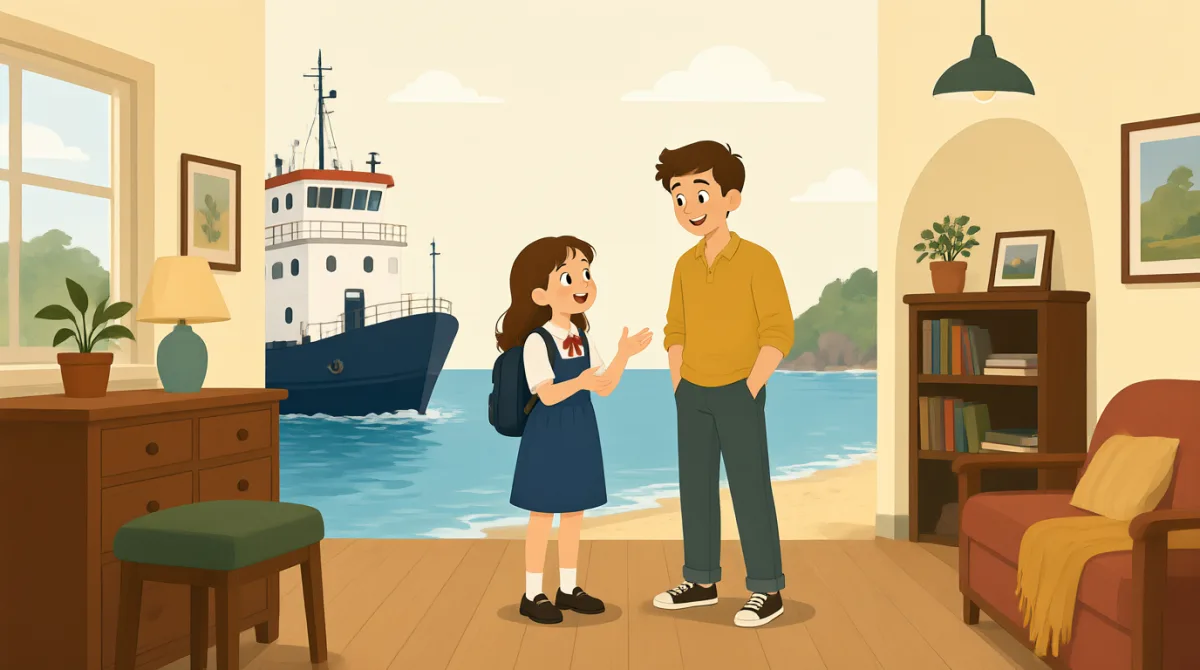

We’re here! The ferry is slowing down, so let’s get our bags ready.

Great! I can see the island now. Do we walk off this way?
Yes, follow the signs to the exit. The crew will open the gate soon.
I’m excited to explore! What should we see first?
Let’s walk to the harbor and find the visitor center. It’s nearby.
Good idea. We can pick up a map and ask about the beach.
Sure. After that, we can follow the path along the water.
Perfect! I’ll take my bag. Let’s go ashore.
Vocabulary8
- get our bags ready
To prepare your bags so you can take them with you. You can say this when you are about to leave a place.
- walk off
To leave a boat or other vehicle by walking. Here, Emma asks if this is the way to leave the ferry.
- follow the signs
To go in the direction shown by signs. This is useful when finding your way around a station, airport, or ferry terminal.
- crew
The people who work on a ship or ferry. Here, the crew will open the gate for passengers.
- visitor center
A place where visitors can get information about an area. You can often pick up maps and ask questions there.
- pick up a map
To get or collect a map. You can use this phrase when you need a map for a new place.
- along the water
Beside the water, following its edge. You can use this phrase to describe a path or walk near the sea, a lake, or a river.
- go ashore
To leave a boat and step onto land. This phrase is often used when arriving by ferry or ship.
Key Sentences8
- 1
The ferry is slowing down, so let’s get our bags ready.
This sentence explains what is happening and suggests what to do next. Use “Let’s get [something] ready” to prepare for an upcoming activity.
- 2
Do we walk off this way?
This is a simple way to check which direction to go when leaving a boat or vehicle. You can replace “walk off” with another action, such as “go out.”
- 3
The crew will open the gate soon.
This sentence uses “will” to talk about something that is expected to happen. You can use the pattern “will [action] soon” for near-future events.
- 4
What should we see first?
This is a useful question when deciding what to visit or do. You can replace “see” with another verb, such as “do” or “try.”
- 5
Let’s walk to the harbor and find the visitor center.
This sentence suggests a plan and gives two things to do. Use “Let’s [action] and [action]” to make a friendly suggestion.
- 6
We can pick up a map and ask about the beach.
This sentence uses “can” to describe possible activities. You can use the same pattern to suggest useful things to do in a new place.
- 7
After that, we can follow the path along the water.
“After that” helps put activities in order. Use it to explain what you plan to do next.
- 8
Let’s go ashore.
This is a short, natural way to suggest leaving a boat and going onto land. You can also say “Let’s go inside” or “Let’s go outside” when changing places.