Bringing Your Own Bag
Apportez votre propre sac
Emma and Mia reach the checkout with their market purchases. Emma remembers her reusable bag, and Mia asks how to keep the vegetables fresh on the way home.
Emma et Mia arrivent à la caisse avec leurs achats du marché. Emma se souvient qu’elle a apporté son sac réutilisable, et Mia demande comment garder les légumes frais sur le chemin du retour.
Dialogue9
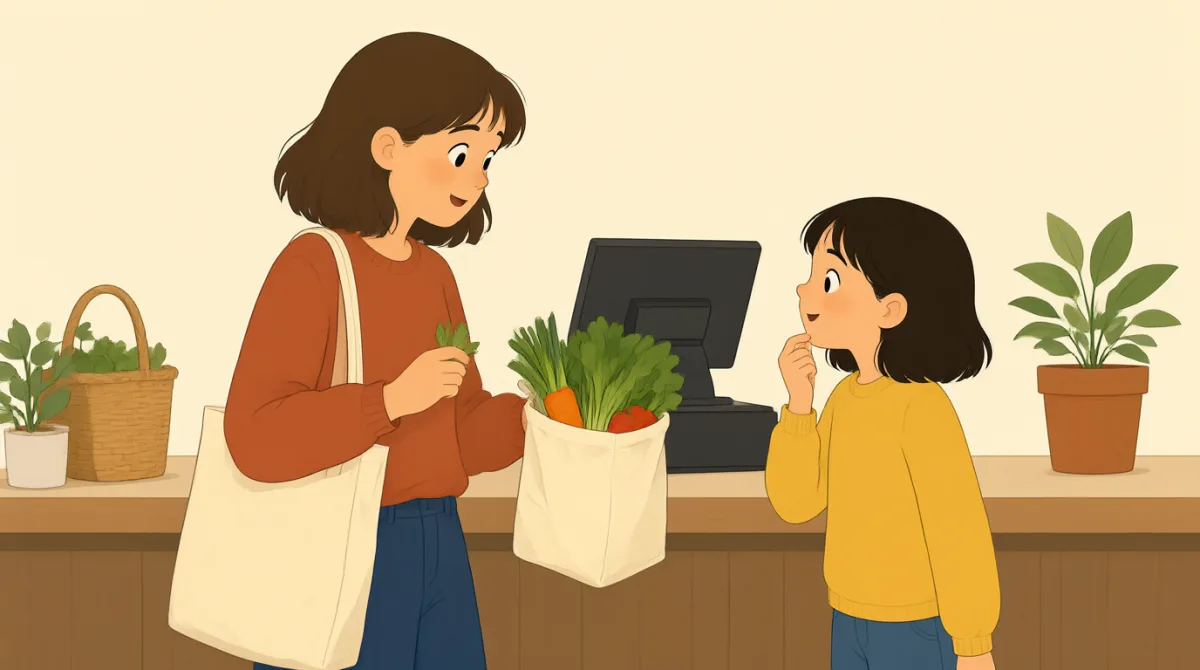

Here’s my reusable bag. We bought more than I expected!
Voilà mon sac réutilisable. On a acheté plus que je ne le pensais !

Good thinking. I’ll put your vegetables and fruit in here.
Bonne idée. Je vais mettre vos légumes et vos fruits dedans.

Thanks. How can we keep the vegetables fresh on the way home?
Merci. Comment peut-on garder les légumes frais sur le chemin du retour ?
Keep them out of the sun, and don’t leave them in a hot car.
Gardez-les à l’abri du soleil et ne les laissez pas dans une voiture chaude.
We’re walking home, so that should be easy.
On rentre à pied, alors ça devrait être facile.
Should we keep the greens separate from the apples?
On devrait séparer les légumes verts des pommes ?
Yes, that’s best. The apples can make the greens wilt sooner.
Oui, c’est mieux. Les pommes peuvent faire faner les légumes verts plus vite.
Good to know. How much do we owe you?
Bon à savoir. Combien est-ce qu’on vous doit ?
That’s twelve dollars. Thanks for shopping local, and enjoy your food!
Ça fait douze dollars. Merci de faire vos achats chez les producteurs locaux, et régalez-vous !
Vocabulaire6
- reusable bagsac réutilisable
A bag you can use many times instead of throwing it away. Here, Emma brings one to carry their market purchases.
Un sac qu’on peut utiliser plusieurs fois au lieu de le jeter. Ici, Emma en apporte un pour transporter leurs achats du marché.
- Good thinking.Bonne idée.
This means someone made a smart choice. You can say it to praise a helpful idea.
Cette expression signifie que quelqu’un a fait un choix judicieux. Vous pouvez l’utiliser pour complimenter quelqu’un qui a eu une idée utile.
- on the way homesur le chemin du retour
This means while traveling home. Use it to talk about something that happens during your trip back.
Cette expression signifie pendant le trajet pour rentrer chez soi. Utilisez-la pour parler de quelque chose qui se passe pendant le trajet du retour.
- out of the sunà l’abri du soleil
This means in a place where direct sunlight does not reach. You can use it when giving advice about protecting food or other things.
Cela désigne un endroit où les rayons directs du soleil n’arrivent pas. Vous pouvez utiliser cette expression pour conseiller à quelqu’un de protéger des aliments ou d’autres choses.
- leave them in a hot carlaisser les légumes dans une voiture chaude
This means to let the vegetables stay inside a warm car. The phrase is useful for warning someone about where not to store food.
Cela signifie laisser les légumes dans une voiture où il fait chaud. Cette expression est utile pour avertir quelqu’un de ne pas conserver les aliments à un endroit donné.
- owe youvous devoir de l’argent
This means to need to pay you money. Ask “How much do we owe you?” to find out the amount to pay.
Cela signifie devoir vous payer une somme d’argent. Demandez “How much do we owe you?” pour savoir combien vous devez payer.
Phrases clés8
- 1
Here’s my reusable bag.
Voici mon sac réutilisable.
This is a simple way to tell someone you brought a bag for your shopping. You can replace “reusable bag” with another item you have brought.
C’est une façon simple de dire à quelqu’un que vous avez apporté un sac pour vos achats. Vous pouvez remplacer “reusable bag” par un autre objet que vous avez apporté.
- 2
We bought more than I expected!
On a acheté plus que je ne le pensais !
Use this sentence when you purchased a larger amount than you thought you would. “More than I expected” is also useful for talking about time, cost, or results.
Utilisez cette phrase lorsque vous avez acheté une plus grande quantité que prévu. “More than I expected” est aussi utile pour parler du temps, du coût ou des résultats.
- 3
How can we keep the vegetables fresh on the way home?
Comment peut-on garder les légumes frais sur le chemin du retour ?
This is a polite way to ask for advice about keeping food fresh during a trip. Replace “the vegetables” with another item you want to protect.
C’est une façon polie de demander conseil pour garder les aliments frais pendant un trajet. Remplacez “the vegetables” par un autre aliment que vous voulez protéger.
- 4
Keep them out of the sun, and don’t leave them in a hot car.
Gardez-les à l’abri du soleil et ne les laissez pas dans une voiture chaude.
This gives two clear instructions for protecting food from heat. You can use “Keep them out of...” to explain where something should not be.
Cette phrase donne deux consignes claires pour protéger les aliments de la chaleur. Vous pouvez utiliser “Keep them out of...” pour expliquer où il ne faut pas mettre quelque chose.
- 5
We’re walking home, so that should be easy.
On rentre à pied, alors ça devrait être facile.
This sentence connects a plan with a likely result. Use “so that should be easy” when you think something will not be difficult.
Cette phrase relie un projet à un résultat probable. Utilisez “so that should be easy” quand vous pensez que quelque chose ne sera pas difficile.
- 6
Should we keep the greens separate from the apples?
On devrait séparer les légumes verts des pommes ?
Use “Should we...?” to ask for advice about what to do. “Keep [one thing] separate from [another]” is useful for talking about storage.
Utilisez “Should we...?” pour demander conseil sur ce qu’il faut faire. “Keep [one thing] separate from [another]” est utile pour parler de rangement ou de conservation.
- 7
How much do we owe you?
Combien est-ce qu’on vous doit ?
This is a natural question to ask when you are ready to pay. You can use it at a market, shop, or restaurant.
C’est une question naturelle à poser quand vous êtes prêts à payer. Vous pouvez l’utiliser au marché, dans un magasin ou au restaurant.
- 8
Thanks for shopping local, and enjoy your food!
Merci de faire vos achats chez les producteurs locaux, et régalez-vous !
This is a friendly way to thank customers for buying from nearby sellers. You can reuse “Thanks for...” to show appreciation for someone’s action.
C’est une façon amicale de remercier les clients d’acheter auprès de vendeurs locaux. Vous pouvez réutiliser “Thanks for...” pour exprimer votre reconnaissance pour ce que quelqu’un a fait.