Bringing Your Own Bag
Traer tu propia bolsa
Emma and Mia reach the checkout with their market purchases. Emma remembers her reusable bag, and Mia asks how to keep the vegetables fresh on the way home.
Emma y Mia llegan a la caja con sus compras del mercado. Emma se acuerda de su bolsa reutilizable y Mia pregunta cómo mantener frescas las verduras de camino a casa.
Diálogo9
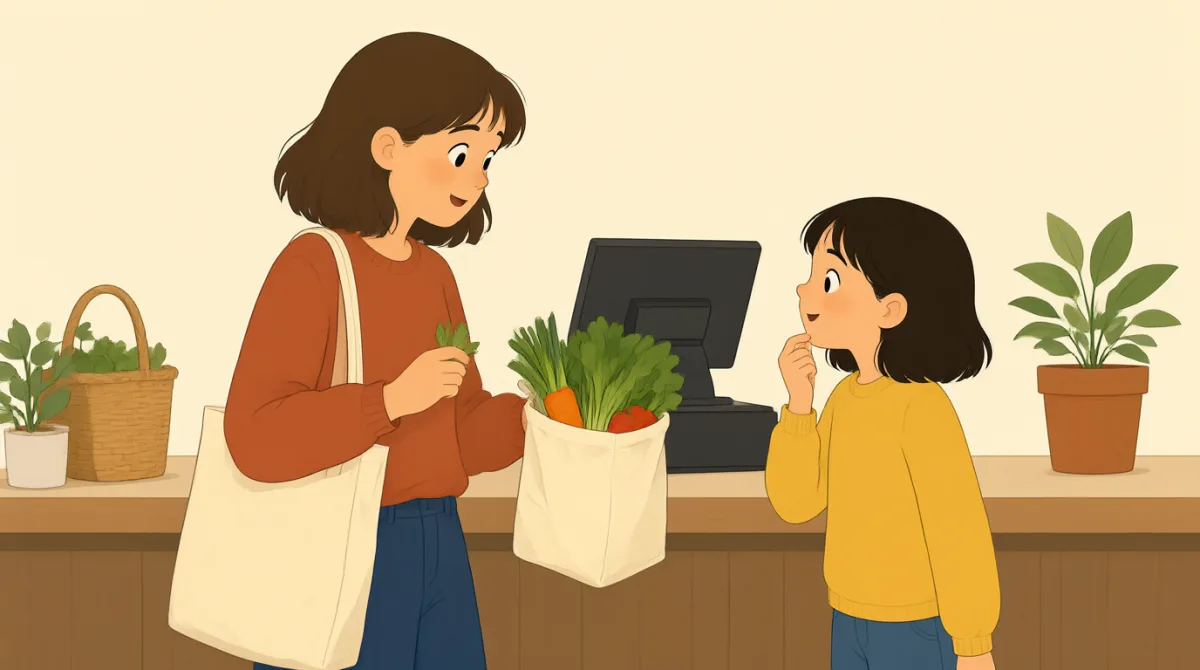

Here’s my reusable bag. We bought more than I expected!
Aquí está mi bolsa reutilizable. ¡Compramos más de lo que esperaba!

Good thinking. I’ll put your vegetables and fruit in here.
Buena idea. Voy a poner aquí las verduras y la fruta.

Thanks. How can we keep the vegetables fresh on the way home?
Gracias. ¿Cómo podemos mantener frescas las verduras de camino a casa?
Keep them out of the sun, and don’t leave them in a hot car.
No las dejen al sol ni las dejen en un auto caliente.
We’re walking home, so that should be easy.
Vamos caminando a casa, así que eso será fácil.
Should we keep the greens separate from the apples?
¿Deberíamos separar las verduras de hoja de las manzanas?
Yes, that’s best. The apples can make the greens wilt sooner.
Sí, es mejor. Las manzanas pueden hacer que las verduras de hoja se marchiten antes.
Good to know. How much do we owe you?
Qué bueno saberlo. ¿Cuánto te debemos?
That’s twelve dollars. Thanks for shopping local, and enjoy your food!
Son doce dólares. Gracias por comprar productos locales, ¡y que disfruten la comida!
Vocabulario6
- reusable bagbolsa reutilizable
A bag you can use many times instead of throwing it away. Here, Emma brings one to carry their market purchases.
Una bolsa que puedes usar muchas veces en vez de tirarla. Aquí, Emma trae una para llevar sus compras del mercado.
- Good thinking.Buena idea.
This means someone made a smart choice. You can say it to praise a helpful idea.
Significa que alguien tomó una decisión inteligente. Puedes decirlo para elogiar una idea útil.
- on the way homede camino a casa
This means while traveling home. Use it to talk about something that happens during your trip back.
Significa mientras vuelves a casa. Úsalo para hablar de algo que ocurre durante el viaje de regreso.
- out of the suna la sombra
This means in a place where direct sunlight does not reach. You can use it when giving advice about protecting food or other things.
Significa en un lugar donde no llega la luz directa del sol. Puedes usarlo para aconsejar cómo proteger alimentos u otras cosas.
- leave them in a hot cardejarlas en un auto caliente
This means to let the vegetables stay inside a warm car. The phrase is useful for warning someone about where not to store food.
Significa dejar las verduras dentro de un auto caliente. Esta expresión sirve para advertirle a alguien dónde no debe guardar la comida.
- owe youdeberte
This means to need to pay you money. Ask “How much do we owe you?” to find out the amount to pay.
Significa tener que pagarte dinero. Pregunta “How much do we owe you?” para saber cuánto hay que pagar.
Frases clave8
- 1
Here’s my reusable bag.
Aquí está mi bolsa reutilizable.
This is a simple way to tell someone you brought a bag for your shopping. You can replace “reusable bag” with another item you have brought.
Esta es una forma sencilla de decirle a alguien que trajiste una bolsa para tus compras. Puedes sustituir “reusable bag” por otro artículo que hayas traído.
- 2
We bought more than I expected!
¡Compramos más de lo que esperaba!
Use this sentence when you purchased a larger amount than you thought you would. “More than I expected” is also useful for talking about time, cost, or results.
Usa esta oración cuando compraste más de lo que pensabas. “More than I expected” también sirve para hablar de tiempo, costo o resultados.
- 3
How can we keep the vegetables fresh on the way home?
¿Cómo podemos mantener frescas las verduras de camino a casa?
This is a polite way to ask for advice about keeping food fresh during a trip. Replace “the vegetables” with another item you want to protect.
Esta es una forma amable de pedir consejos para mantener la comida fresca durante un viaje. Sustituye “the vegetables” por otro alimento que quieras proteger.
- 4
Keep them out of the sun, and don’t leave them in a hot car.
No las dejen al sol ni las dejen en un auto caliente.
This gives two clear instructions for protecting food from heat. You can use “Keep them out of...” to explain where something should not be.
Esta oración da dos instrucciones claras para proteger los alimentos del calor. Puedes usar “Keep them out of...” para explicar dónde no debería estar algo.
- 5
We’re walking home, so that should be easy.
Vamos caminando a casa, así que eso será fácil.
This sentence connects a plan with a likely result. Use “so that should be easy” when you think something will not be difficult.
Esta oración conecta un plan con un resultado probable. Usa “so that should be easy” cuando pienses que algo no será difícil.
- 6
Should we keep the greens separate from the apples?
¿Deberíamos separar las verduras de hoja de las manzanas?
Use “Should we...?” to ask for advice about what to do. “Keep [one thing] separate from [another]” is useful for talking about storage.
Usa “Should we...?” para pedir consejo sobre qué hacer. “Keep [one thing] separate from [another]” sirve para hablar de cómo guardar cosas.
- 7
How much do we owe you?
¿Cuánto te debemos?
This is a natural question to ask when you are ready to pay. You can use it at a market, shop, or restaurant.
Esta es una pregunta natural para hacer cuando estás listo para pagar. Puedes usarla en un mercado, una tienda o un restaurante.
- 8
Thanks for shopping local, and enjoy your food!
¡Gracias por comprar productos locales y que disfruten la comida!
This is a friendly way to thank customers for buying from nearby sellers. You can reuse “Thanks for...” to show appreciation for someone’s action.
Esta es una forma amable de agradecer a los clientes por comprarles a vendedores de la zona. Puedes reutilizar “Thanks for...” para agradecerle a alguien por lo que hizo.