Buying Fresh Vegetables
Acheter des légumes frais
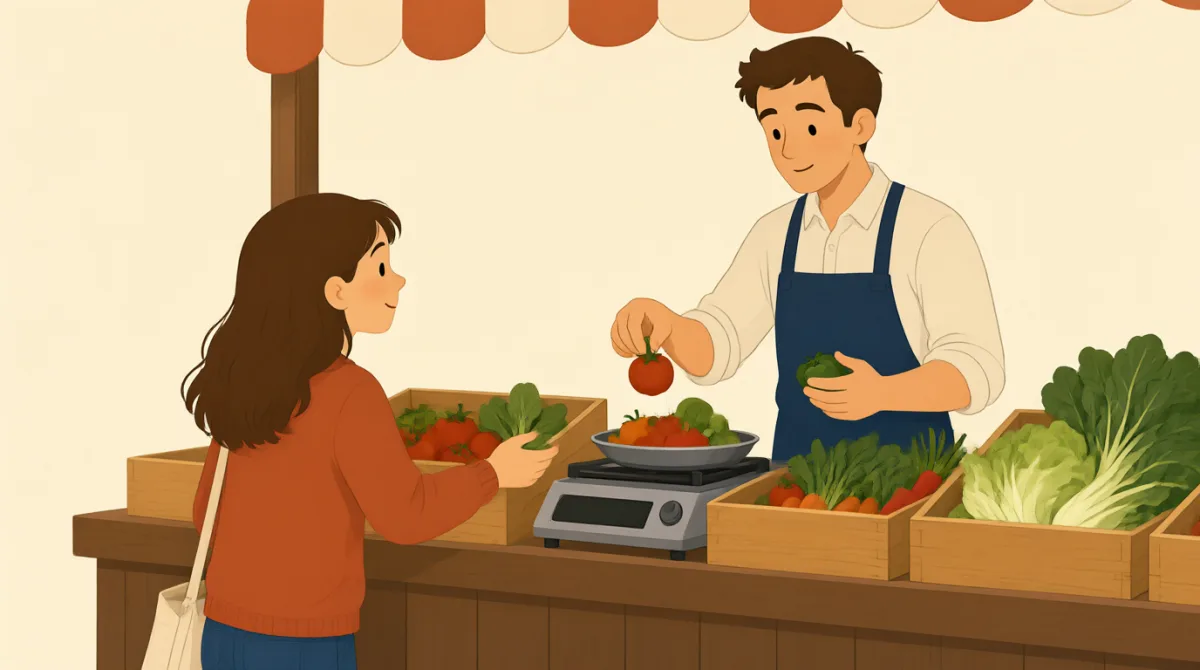
Emma picks out vegetables at David’s stall and asks how much they cost. David weighs her choices and helps her stay within her budget.
Emma choisit des légumes sur l’étal de David et lui demande combien ils coûtent. David pèse ses achats et l’aide à respecter son budget.
Dialogue9

Hi, David. I’d like some carrots and tomatoes. How much are they?
Bonjour, David. Je voudrais des carottes et des tomates. Combien ça coûte ?

The carrots are two dollars a pound, and the tomatoes are three.
Les carottes sont à deux dollars la livre, et les tomates à trois.
I’ll take one pound of carrots and two pounds of tomatoes, please.
Je vais prendre une livre de carottes et deux livres de tomates, s’il vous plaît.
Sure. I’ll weigh them now. The total comes to eight dollars.
Bien sûr. Je vais les peser. Le total fait huit dollars.
Oh, I only have six dollars. Could I get fewer tomatoes?
Oh, je n’ai que six dollars. Est-ce que je pourrais prendre moins de tomates ?
Of course. One pound of tomatoes makes the total five dollars.
Bien sûr. Avec une livre de tomates, le total fait cinq dollars.
That works. Are these carrots fresh? They look great.
Ça me va. Ces carottes sont fraîches ? Elles ont l’air très bonnes.
They came in this morning. They’re crisp and sweet.
Elles sont arrivées ce matin. Elles sont croquantes et sucrées.
Great! I’ll take them. Here’s five dollars.
Parfait ! Je les prends. Voilà cinq dollars.
Vocabulaire8
- a poundune livre
A pound is a unit for measuring weight. You can use it when asking for or buying food.
Une livre est une unité de mesure du poids. Vous pouvez l’utiliser pour demander ou acheter des aliments.
- I’ll takeI’ll take
This is a common way to say you want to buy something. You can use it to order items or choose what to buy.
C’est une façon courante de dire que vous voulez acheter quelque chose. Vous pouvez l’utiliser pour commander ou choisir ce que vous voulez acheter.
- weigh themweigh them
To weigh something is to find out how heavy it is. At a market, a seller may weigh your food before giving you the price.
To weigh something, c’est déterminer son poids. Au marché, le vendeur peut peser vos aliments avant de vous donner le prix.
- the total comes tothe total comes to
This phrase tells you the full price of the items together. You can use it when talking about the cost of a purchase.
Cette expression indique le prix total de plusieurs articles. Vous pouvez l’utiliser pour parler du coût d’un achat.
- fewer tomatoesfewer tomatoes
Use “fewer” with things you can count, such as tomatoes. You can use this phrase to ask for a smaller number of items.
Utilisez “fewer” avec les choses que l’on peut compter, comme les tomates. Cette expression permet de demander une plus petite quantité d’articles.
- That works.That works.
This means that something is okay or suitable for you. You can say it when you agree with a price or suggestion.
Cela signifie que quelque chose vous convient. Vous pouvez le dire pour accepter un prix ou une proposition.
- came in this morningcame in this morning
This means the vegetables arrived earlier today. You can ask when food came in to learn how fresh it is.
Cela signifie que les légumes sont arrivés plus tôt dans la journée. Vous pouvez demander quand les aliments sont arrivés pour savoir s’ils sont frais.
- crisp and sweetcrisp and sweet
“Crisp” describes food that is firm and fresh, while “sweet” describes its taste. These words are useful for talking about vegetables and fruit.
“Crisp” décrit un aliment ferme et frais, tandis que “sweet” décrit son goût. Ces mots sont utiles pour parler des légumes et des fruits.
Phrases clés8
- 1
I’d like some carrots and tomatoes.
Je voudrais des carottes et des tomates.
This is a polite way to say what you want to buy. You can reuse it with other foods, such as “I’d like some apples and bread.”
C’est une façon polie de dire ce que vous voulez acheter. Vous pouvez reprendre cette phrase avec d’autres aliments, par exemple : “I’d like some apples and bread.” (Je voudrais des pommes et du pain.)
- 2
How much are they?
Combien ça coûte ?
Use this question to ask the price of more than one item. For one item, you can ask, “How much is it?”
Posez cette question pour demander le prix de plusieurs articles. Pour un seul article, vous pouvez demander : “How much is it?” (Combien ça coûte ?)
- 3
I’ll take one pound of carrots and two pounds of tomatoes, please.
Je vais prendre une livre de carottes et deux livres de tomates, s’il vous plaît.
This sentence places an order and gives the amounts you want. You can change the foods and quantities to fit your shopping list.
Cette phrase permet de passer commande et d’indiquer les quantités souhaitées. Vous pouvez changer les aliments et les quantités selon votre liste de courses.
- 4
The total comes to eight dollars.
Le total fait huit dollars.
This tells someone the full price of a purchase. You can replace “eight dollars” with the correct amount.
Cette phrase indique à quelqu’un le prix total d’un achat. Vous pouvez remplacer “eight dollars” par le montant exact.
- 5
Could I get fewer tomatoes?
Est-ce que je pourrais prendre moins de tomates ?
This is a polite way to ask for a smaller number of something. You can use “Could I get fewer…” with other countable items.
C’est une façon polie de demander une plus petite quantité de quelque chose. Vous pouvez utiliser “Could I get fewer…” avec d’autres articles que l’on peut compter.
- 6
Are these carrots fresh?
Ces carottes sont-elles fraîches ?
Use this question to ask whether food is fresh. You can replace “carrots” with another food, such as “apples.”
Posez cette question pour savoir si un aliment est frais. Vous pouvez remplacer “carrots” par un autre aliment, comme “apples.”
- 7
They came in this morning.
Elles sont arrivées ce matin.
This tells someone when the items arrived. You can use it to answer a question about how fresh market food is.
Cette phrase indique à quelqu’un quand les articles sont arrivés. Vous pouvez l’utiliser pour répondre à une question sur la fraîcheur des produits du marché.
- 8
Here’s five dollars.
Voilà cinq dollars.
This is a simple way to hand over money when paying. You can change the amount to match the price.
C’est une façon simple de tendre de l’argent au moment de payer. Vous pouvez changer le montant selon le prix.