Bringing Your Own Bag
Die eigene Tasche mitbringen
Emma and Mia reach the checkout with their market purchases. Emma remembers her reusable bag, and Mia asks how to keep the vegetables fresh on the way home.
Emma und Mia kommen mit ihren Einkäufen vom Markt zur Kasse. Emma denkt an ihre wiederverwendbare Tasche, und Mia fragt, wie sie das Gemüse auf dem Heimweg frisch halten können.
Dialog9
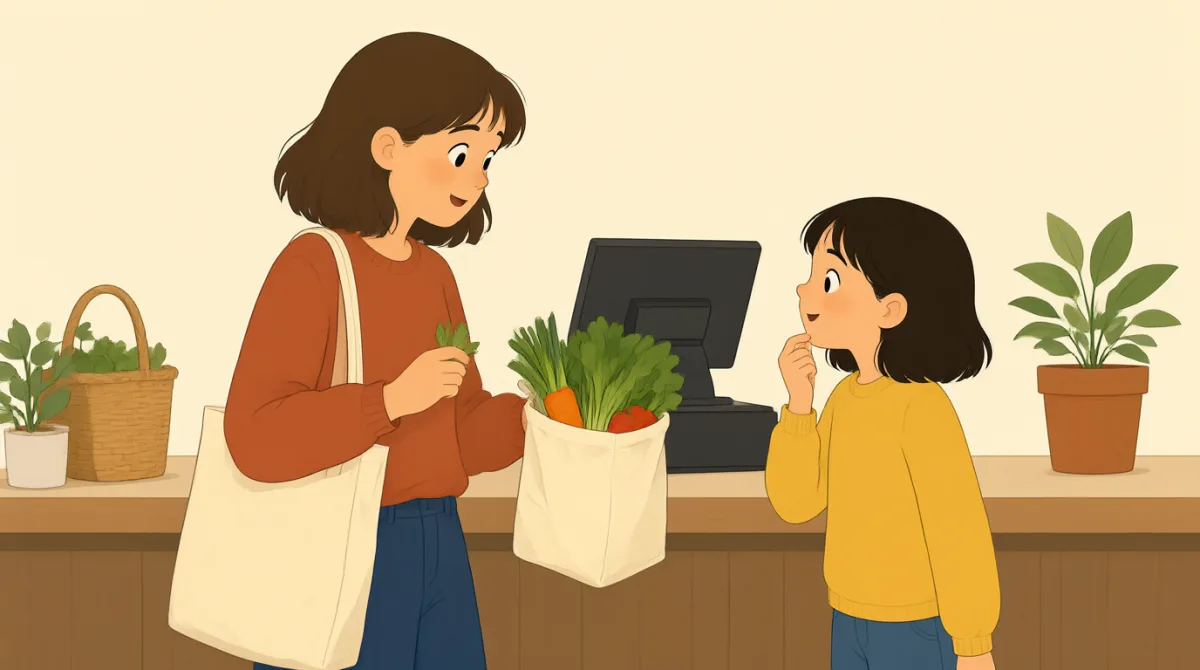

Here’s my reusable bag. We bought more than I expected!
Hier ist meine wiederverwendbare Tasche. Wir haben mehr gekauft, als ich gedacht hätte!

Good thinking. I’ll put your vegetables and fruit in here.
Gute Idee. Ich packe euer Gemüse und Obst hier hinein.

Thanks. How can we keep the vegetables fresh on the way home?
Danke. Wie können wir das Gemüse auf dem Heimweg frisch halten?
Keep them out of the sun, and don’t leave them in a hot car.
Haltet es aus der Sonne und lasst es nicht in einem heißen Auto liegen.
We’re walking home, so that should be easy.
Wir gehen zu Fuß nach Hause, also dürfte das kein Problem sein.
Should we keep the greens separate from the apples?
Sollen wir das Blattgemüse getrennt von den Äpfeln aufbewahren?
Yes, that’s best. The apples can make the greens wilt sooner.
Ja, das ist am besten. Die Äpfel können dazu führen, dass das Blattgemüse schneller welk wird.
Good to know. How much do we owe you?
Gut zu wissen. Wie viel bekommen Sie von uns?
That’s twelve dollars. Thanks for shopping local, and enjoy your food!
Das macht zwölf Dollar. Danke, dass Sie hier vor Ort einkaufen, und lassen Sie es sich schmecken!
Wortschatz6
- reusable bagwiederverwendbare Tasche
A bag you can use many times instead of throwing it away. Here, Emma brings one to carry their market purchases.
Eine Tasche, die du viele Male benutzen kannst, statt sie wegzuwerfen. Hier bringt Emma eine mit, um ihre Einkäufe vom Markt darin zu tragen.
- Good thinking.Gute Idee.
This means someone made a smart choice. You can say it to praise a helpful idea.
Damit sagst du, dass jemand eine kluge Entscheidung getroffen hat. Du kannst es sagen, um eine hilfreiche Idee zu loben.
- on the way homeauf dem Heimweg
This means while traveling home. Use it to talk about something that happens during your trip back.
Das bedeutet: während man nach Hause unterwegs ist. Du verwendest den Ausdruck, wenn du über etwas sprichst, das auf dem Rückweg passiert.
- out of the sunaus der Sonne
This means in a place where direct sunlight does not reach. You can use it when giving advice about protecting food or other things.
Das bedeutet: an einem Ort, an den kein direktes Sonnenlicht gelangt. Du kannst den Ausdruck verwenden, wenn du Tipps gibst, wie man Lebensmittel oder andere Dinge schützt.
- leave them in a hot carsie in einem heißen Auto liegen lassen
This means to let the vegetables stay inside a warm car. The phrase is useful for warning someone about where not to store food.
Das bedeutet, das Gemüse in einem warmen Auto liegen zu lassen. Der Ausdruck ist nützlich, wenn du jemanden davor warnen möchtest, Lebensmittel an einem ungeeigneten Ort aufzubewahren.
- owe youjemandem etwas schulden
This means to need to pay you money. Ask “How much do we owe you?” to find out the amount to pay.
Das bedeutet, dass du jemandem Geld zahlen musst. Mit „How much do we owe you?“ fragst du, wie viel ihr bezahlen müsst.
Wichtige Sätze8
- 1
Here’s my reusable bag.
Hier ist meine wiederverwendbare Tasche.
This is a simple way to tell someone you brought a bag for your shopping. You can replace “reusable bag” with another item you have brought.
So kannst du einfach sagen, dass du eine Tasche für deine Einkäufe mitgebracht hast. Du kannst „reusable bag“ durch einen anderen Gegenstand ersetzen, den du mitgebracht hast.
- 2
We bought more than I expected!
Wir haben mehr gekauft, als ich gedacht hätte!
Use this sentence when you purchased a larger amount than you thought you would. “More than I expected” is also useful for talking about time, cost, or results.
Verwende diesen Satz, wenn du mehr gekauft hast, als du erwartet hattest. „More than I expected“ ist auch nützlich, wenn du über Zeit, Kosten oder Ergebnisse sprichst.
- 3
How can we keep the vegetables fresh on the way home?
Wie können wir das Gemüse auf dem Heimweg frisch halten?
This is a polite way to ask for advice about keeping food fresh during a trip. Replace “the vegetables” with another item you want to protect.
So fragst du höflich um Rat, wie Lebensmittel unterwegs frisch bleiben. Ersetze „the vegetables“ durch einen anderen Gegenstand, den du schützen möchtest.
- 4
Keep them out of the sun, and don’t leave them in a hot car.
Haltet es aus der Sonne und lasst es nicht in einem heißen Auto liegen.
This gives two clear instructions for protecting food from heat. You can use “Keep them out of...” to explain where something should not be.
Hier werden zwei klare Anweisungen gegeben, um Lebensmittel vor Hitze zu schützen. Mit „Keep them out of...“ kannst du erklären, wo etwas nicht sein sollte.
- 5
We’re walking home, so that should be easy.
Wir gehen zu Fuß nach Hause, also dürfte das kein Problem sein.
This sentence connects a plan with a likely result. Use “so that should be easy” when you think something will not be difficult.
Dieser Satz verbindet einen Plan mit einem wahrscheinlichen Ergebnis. Verwende „so that should be easy“, wenn du denkst, dass etwas nicht schwierig sein wird.
- 6
Should we keep the greens separate from the apples?
Sollen wir das Blattgemüse getrennt von den Äpfeln aufbewahren?
Use “Should we...?” to ask for advice about what to do. “Keep [one thing] separate from [another]” is useful for talking about storage.
Mit „Should we...?“ fragst du nach einem Rat, was ihr tun solltet. „Keep [one thing] separate from [another]“ ist nützlich, wenn du über die Aufbewahrung sprichst.
- 7
How much do we owe you?
Wie viel bekommen Sie von uns?
This is a natural question to ask when you are ready to pay. You can use it at a market, shop, or restaurant.
Das ist eine natürliche Frage, wenn du bereit bist zu bezahlen. Du kannst sie auf einem Markt, in einem Geschäft oder im Restaurant stellen.
- 8
Thanks for shopping local, and enjoy your food!
Danke, dass Sie hier vor Ort einkaufen, und lassen Sie es sich schmecken!
This is a friendly way to thank customers for buying from nearby sellers. You can reuse “Thanks for...” to show appreciation for someone’s action.
So bedankst du dich freundlich bei Kunden dafür, dass sie bei Anbietern aus der Nähe einkaufen. Mit „Thanks for...“ kannst du dich auch für andere Handlungen bedanken.