Bringing Your Own Bag
Levando sua própria sacola
Emma and Mia reach the checkout with their market purchases. Emma remembers her reusable bag, and Mia asks how to keep the vegetables fresh on the way home.
Emma e Mia chegam ao caixa com as compras da feira. Emma se lembra da sacola reutilizável, e Mia pergunta como manter os vegetais frescos no caminho de volta para casa.
Diálogo9
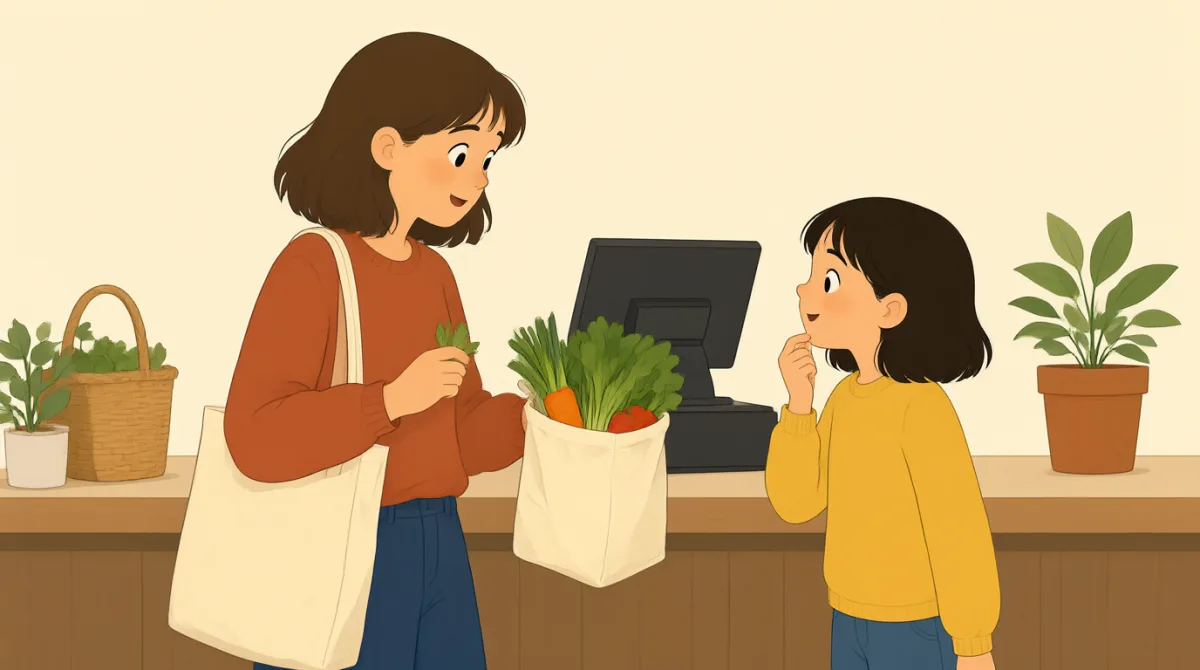

Here’s my reusable bag. We bought more than I expected!
Aqui está minha sacola reutilizável. Compramos mais do que eu esperava!

Good thinking. I’ll put your vegetables and fruit in here.
Boa ideia. Vou colocar seus vegetais e frutas aqui.

Thanks. How can we keep the vegetables fresh on the way home?
Obrigada. Como podemos manter os vegetais frescos no caminho de volta para casa?
Keep them out of the sun, and don’t leave them in a hot car.
Deixe-os longe do sol e não os deixe dentro de um carro quente.
We’re walking home, so that should be easy.
Vamos voltar para casa a pé, então deve ser fácil.
Should we keep the greens separate from the apples?
Devemos deixar as folhas separadas das maçãs?
Yes, that’s best. The apples can make the greens wilt sooner.
Sim, é melhor. As maçãs podem fazer as folhas murcharem mais rápido.
Good to know. How much do we owe you?
Que bom saber. Quanto devemos a você?
That’s twelve dollars. Thanks for shopping local, and enjoy your food!
São doze dólares. Obrigado por comprar de produtores locais. Aproveitem a comida!
Vocabulário6
- reusable bagsacola reutilizável
A bag you can use many times instead of throwing it away. Here, Emma brings one to carry their market purchases.
Uma sacola que você pode usar muitas vezes, em vez de jogá-la fora. Aqui, Emma leva uma para carregar as compras da feira.
- Good thinking.Boa ideia.
This means someone made a smart choice. You can say it to praise a helpful idea.
Essa expressão significa que alguém fez uma escolha inteligente. Você pode usá-la para elogiar uma ideia útil.
- on the way homeno caminho de volta para casa
This means while traveling home. Use it to talk about something that happens during your trip back.
Significa durante o trajeto de volta para casa. Use essa expressão para falar sobre algo que acontece durante o caminho de volta.
- out of the sunlonge do sol
This means in a place where direct sunlight does not reach. You can use it when giving advice about protecting food or other things.
Significa em um lugar onde a luz direta do sol não chega. Você pode usar essa expressão ao dar conselhos sobre como proteger alimentos ou outros objetos.
- leave them in a hot cardeixar dentro de um carro quente
This means to let the vegetables stay inside a warm car. The phrase is useful for warning someone about where not to store food.
Significa deixar os vegetais dentro de um carro aquecido. Essa expressão é útil para avisar alguém sobre onde não guardar alimentos.
- owe youdever a você
This means to need to pay you money. Ask “How much do we owe you?” to find out the amount to pay.
Significa precisar pagar dinheiro a você. Pergunte “How much do we owe you?” para saber quanto deve pagar.
Frases-chave8
- 1
Here’s my reusable bag.
Aqui está minha sacola reutilizável.
This is a simple way to tell someone you brought a bag for your shopping. You can replace “reusable bag” with another item you have brought.
Esta é uma maneira simples de dizer a alguém que você trouxe uma sacola para suas compras. Você pode substituir “reusable bag” por outro item que tenha trazido.
- 2
We bought more than I expected!
Compramos mais do que eu esperava!
Use this sentence when you purchased a larger amount than you thought you would. “More than I expected” is also useful for talking about time, cost, or results.
Use esta frase quando você comprou uma quantidade maior do que imaginava. “More than I expected” também é útil para falar de tempo, custo ou resultados.
- 3
How can we keep the vegetables fresh on the way home?
Como podemos manter os vegetais frescos no caminho de volta para casa?
This is a polite way to ask for advice about keeping food fresh during a trip. Replace “the vegetables” with another item you want to protect.
Esta é uma maneira educada de pedir conselhos sobre como manter os alimentos frescos durante um trajeto. Substitua “the vegetables” por outro item que você queira proteger.
- 4
Keep them out of the sun, and don’t leave them in a hot car.
Deixe-os longe do sol e não os deixe dentro de um carro quente.
This gives two clear instructions for protecting food from heat. You can use “Keep them out of...” to explain where something should not be.
Esta frase dá duas instruções claras para proteger os alimentos do calor. Você pode usar “Keep them out of...” para explicar onde algo não deve ficar.
- 5
We’re walking home, so that should be easy.
Vamos voltar para casa a pé, então deve ser fácil.
This sentence connects a plan with a likely result. Use “so that should be easy” when you think something will not be difficult.
Esta frase relaciona um plano a um resultado provável. Use “so that should be easy” quando achar que algo não será difícil.
- 6
Should we keep the greens separate from the apples?
Devemos deixar as folhas separadas das maçãs?
Use “Should we...?” to ask for advice about what to do. “Keep [one thing] separate from [another]” is useful for talking about storage.
Use “Should we...?” para pedir conselhos sobre o que fazer. “Keep [one thing] separate from [another]” é útil para falar sobre como guardar coisas.
- 7
How much do we owe you?
Quanto devemos a você?
This is a natural question to ask when you are ready to pay. You can use it at a market, shop, or restaurant.
Esta é uma pergunta natural para fazer quando você está pronto para pagar. Você pode usá-la em uma feira, loja ou restaurante.
- 8
Thanks for shopping local, and enjoy your food!
Obrigado por comprar de produtores locais. Aproveitem a comida!
This is a friendly way to thank customers for buying from nearby sellers. You can reuse “Thanks for...” to show appreciation for someone’s action.
Esta é uma maneira simpática de agradecer aos clientes por comprar de vendedores da região. Você pode reutilizar “Thanks for...” para agradecer a alguém por uma ação.