Meeting a Neighbor
Rencontre avec une voisine
Emma meets her neighbor, Mia, in the hallway while carrying a box. They introduce themselves and talk about the building.
Emma rencontre sa voisine, Mia, dans le couloir alors qu’elle porte un carton. Elles se présentent et parlent de l’immeuble.
Dialogue8
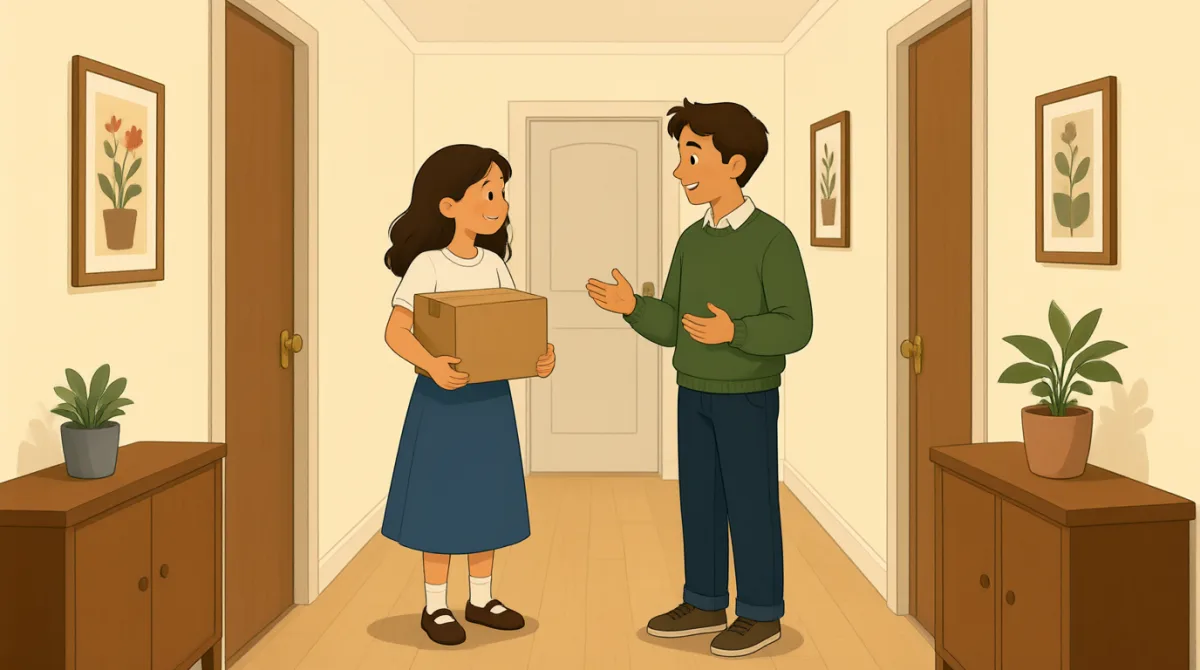

Hi! I’m your new neighbor. I’m Emma, and I’m trying to carry this box upstairs.
Salut ! Je suis ta nouvelle voisine. Moi, c’est Emma, et j’essaie de monter ce carton à l’étage.

Hi, Emma! I’m Mia. Let me hold the door for you.
Salut, Emma ! Moi, c’est Mia. Je vais te tenir la porte.
Thanks! I just moved in today. Do you live on this floor?
Merci ! J’ai emménagé aujourd’hui. Tu habites à cet étage ?
Yes, I live right next door. Welcome to the building!
Oui, j’habite juste à côté. Bienvenue dans l’immeuble !
That’s great. Is it usually quiet here at night?
Super. C’est généralement calme ici, le soir ?
Yes, it’s pretty quiet. The laundry room is downstairs, near the lobby.
Oui, c’est plutôt calme. La buanderie est en bas, près du hall.
Good to know! Is there a grocery store nearby?
Bon à savoir ! Il y a une épicerie dans le coin ?
There’s one two blocks away. I can show you later if you like.
Il y en a une à deux rues d’ici. Je peux te montrer le chemin plus tard, si tu veux.
Vocabulaire8
- new neighbornouvelle voisine
A person who has recently moved into a home near yours. You can use this phrase when introducing yourself to people who live nearby.
Une personne qui vient d’emménager près de chez vous. Vous pouvez employer cette expression pour vous présenter aux personnes qui habitent dans le quartier.
- hold the doortenir la porte
To keep a door open for someone so they can pass through. You can offer to hold the door when someone is carrying something.
Garder une porte ouverte pour laisser quelqu’un passer. Vous pouvez proposer de tenir la porte quand une personne porte quelque chose.
- moved inemménager
Started living in a new home. Use “I just moved in” to tell someone you arrived at your new home recently.
Commencer à vivre dans un nouveau logement. Dites « I just moved in » pour expliquer que vous venez d’arriver dans votre nouveau logement.
- right next doorjuste à côté
In the home immediately beside yours. Use this phrase to explain where you live in relation to someone else.
Dans le logement situé immédiatement à côté du vôtre. Employez cette expression pour expliquer où vous habitez par rapport à quelqu’un.
- pretty quietplutôt calme
Quite calm, with little noise. You can use it to describe a place or time that is not very noisy.
Assez tranquille, avec peu de bruit. Vous pouvez employer cette expression pour décrire un endroit ou un moment qui n’est pas très bruyant.
- downstairsen bas
On a lower floor of a building. Use it to give the location of a room or place below you.
À un étage inférieur d’un bâtiment. Employez cette expression pour indiquer où se trouve une pièce ou un endroit situé plus bas.
- nearbydans le coin
Not far away. You can ask if a shop or other place is nearby when you want to know if it is close.
Pas loin. Vous pouvez demander si un magasin ou un autre endroit est dans le coin pour savoir s’il est proche.
- two blocks awayà deux rues d’ici
A short distance measured as two city blocks. Use this phrase to say how far a place is from where you are.
À une courte distance, équivalant à deux pâtés de maisons. Employez cette expression pour indiquer la distance entre un endroit et celui où vous vous trouvez.
Phrases clés8
- 1
I’m your new neighbor.
Je suis ta nouvelle voisine.
This is a simple way to introduce yourself to someone who lives near you. You can replace “neighbor” with another role, such as “new coworker.”
C’est une façon simple de vous présenter à quelqu’un qui habite près de chez vous. Vous pouvez remplacer « neighbor » par un autre rôle, comme « new coworker ».
- 2
Let me hold the door for you.
Je vais te tenir la porte.
Use this friendly offer when someone needs help getting through a door. You can also say, “Let me carry that for you.”
Employez cette proposition amicale quand quelqu’un a besoin d’aide pour passer une porte. Vous pouvez aussi dire « Let me carry that for you. »
- 3
I just moved in today.
J’ai emménagé aujourd’hui.
This tells someone that you started living in a new home today. Replace “today” with another time to say when you moved.
Cette phrase indique à quelqu’un que vous avez commencé à vivre dans un nouveau logement aujourd’hui. Remplacez « today » par un autre moment pour préciser quand vous avez emménagé.
- 4
Do you live on this floor?
Tu habites à cet étage ?
This is a polite question to ask where someone lives in a building. You can also ask, “Do you live upstairs?”
C’est une question polie pour demander où quelqu’un habite dans un immeuble. Vous pouvez aussi demander « Do you live upstairs? »
- 5
Is it usually quiet here at night?
C’est généralement calme ici, le soir ?
Use this question to ask whether a place is normally noisy or calm at night. Replace “at night” with another time, such as “in the morning.”
Employez cette question pour savoir si un endroit est habituellement bruyant ou tranquille le soir. Remplacez « at night » par un autre moment, comme « in the morning ».
- 6
The laundry room is downstairs, near the lobby.
La buanderie est en bas, près du hall.
This sentence gives the location of a room in a building. Use the same pattern to explain where other places are.
Cette phrase indique où se trouve une pièce dans un immeuble. Utilisez la même structure pour expliquer où se trouvent d’autres endroits.
- 7
Is there a grocery store nearby?
Il y a une épicerie dans le coin ?
This is a useful way to ask if a shop is close to you. Replace “grocery store” with another place, such as “a pharmacy.”
C’est une façon pratique de demander si un magasin est proche de vous. Remplacez « grocery store » par un autre endroit, comme « a pharmacy ».
- 8
I can show you later if you like.
Je peux te montrer le chemin plus tard, si tu veux.
Use this friendly offer to say you can help someone at a later time. You can replace “show you” with another action, such as “help you.”
Employez cette proposition amicale pour dire que vous pouvez aider quelqu’un plus tard. Vous pouvez remplacer « show you » par une autre action, comme « help you ».