Meeting a Neighbor
Conocer a una vecina
Emma meets her neighbor, Mia, in the hallway while carrying a box. They introduce themselves and talk about the building.
Emma conoce a su vecina Mia en el pasillo mientras lleva una caja. Se presentan y hablan del edificio.
Diálogo8
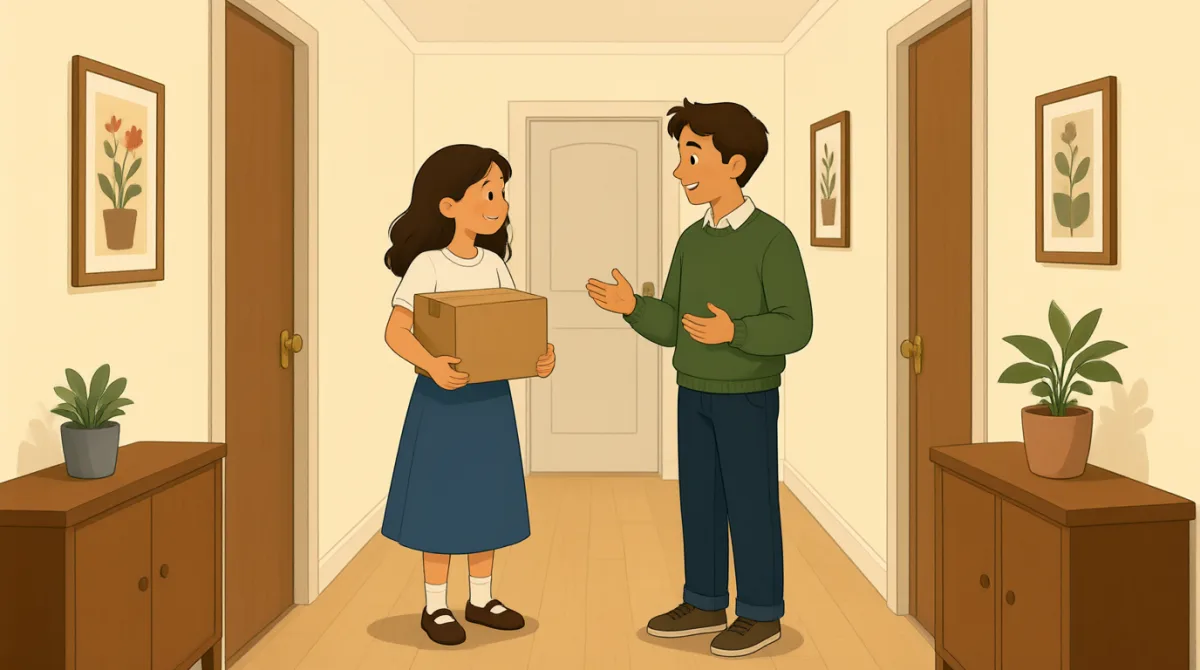

Hi! I’m your new neighbor. I’m Emma, and I’m trying to carry this box upstairs.
¡Hola! Soy tu nueva vecina. Me llamo Emma y estoy intentando subir esta caja.

Hi, Emma! I’m Mia. Let me hold the door for you.
¡Hola, Emma! Soy Mia. Déjame sujetarte la puerta.
Thanks! I just moved in today. Do you live on this floor?
¡Gracias! Me mudé hoy. ¿Vives en este piso?
Yes, I live right next door. Welcome to the building!
Sí, vivo justo al lado. ¡Bienvenida al edificio!
That’s great. Is it usually quiet here at night?
Qué bien. ¿Suele estar tranquilo por aquí por la noche?
Yes, it’s pretty quiet. The laundry room is downstairs, near the lobby.
Sí, suele estar bastante tranquilo. La lavandería está abajo, cerca del vestíbulo.
Good to know! Is there a grocery store nearby?
¡Qué bien saberlo! ¿Hay algún supermercado cerca?
There’s one two blocks away. I can show you later if you like.
Hay uno a dos manzanas. Si quieres, puedo enseñártelo más tarde.
Vocabulario8
- new neighbornueva vecina
A person who has recently moved into a home near yours. You can use this phrase when introducing yourself to people who live nearby.
Una persona que se ha mudado hace poco a una vivienda cerca de la tuya. Puedes usar esta expresión al presentarte a quienes viven cerca.
- hold the doorsujetar la puerta
To keep a door open for someone so they can pass through. You can offer to hold the door when someone is carrying something.
Mantener abierta una puerta para que alguien pueda pasar. Puedes ofrecerte a sujetar la puerta cuando alguien lleva algo.
- moved inmudarse
Started living in a new home. Use “I just moved in” to tell someone you arrived at your new home recently.
Empezar a vivir en una casa nueva. Usa “I just moved in” para decirle a alguien que acabas de llegar a tu nuevo hogar.
- right next doorjusto al lado
In the home immediately beside yours. Use this phrase to explain where you live in relation to someone else.
En la vivienda que está inmediatamente junto a la tuya. Usa esta expresión para explicar dónde vives en relación con otra persona.
- pretty quietbastante tranquilo
Quite calm, with little noise. You can use it to describe a place or time that is not very noisy.
Bastante calmado y con poco ruido. Puedes usar esta expresión para describir un lugar o un momento que no es muy ruidoso.
- downstairsabajo
On a lower floor of a building. Use it to give the location of a room or place below you.
En un piso inferior de un edificio. Usa esta palabra para indicar dónde está una habitación o un lugar que queda más abajo.
- nearbycerca
Not far away. You can ask if a shop or other place is nearby when you want to know if it is close.
A poca distancia. Puedes preguntar si una tienda u otro lugar está cerca cuando quieras saber si queda a poca distancia.
- two blocks awaya dos manzanas
A short distance measured as two city blocks. Use this phrase to say how far a place is from where you are.
Una distancia corta que equivale a dos manzanas de la ciudad. Usa esta expresión para decir a qué distancia está un lugar.
Frases clave8
- 1
I’m your new neighbor.
Soy tu nueva vecina.
This is a simple way to introduce yourself to someone who lives near you. You can replace “neighbor” with another role, such as “new coworker.”
Esta es una forma sencilla de presentarte a alguien que vive cerca de ti. Puedes cambiar “neighbor” por otro papel, como “new coworker”.
- 2
Let me hold the door for you.
Déjame sujetarte la puerta.
Use this friendly offer when someone needs help getting through a door. You can also say, “Let me carry that for you.”
Usa esta oferta amable cuando alguien necesite ayuda para pasar por una puerta. También puedes decir “Let me carry that for you.”
- 3
I just moved in today.
Me mudé hoy.
This tells someone that you started living in a new home today. Replace “today” with another time to say when you moved.
Esta frase le dice a alguien que empezaste a vivir en una casa nueva hoy. Cambia “today” por otro momento para decir cuándo te mudaste.
- 4
Do you live on this floor?
¿Vives en este piso?
This is a polite question to ask where someone lives in a building. You can also ask, “Do you live upstairs?”
Esta es una pregunta amable para averiguar dónde vive alguien en un edificio. También puedes preguntar “Do you live upstairs?”
- 5
Is it usually quiet here at night?
¿Suele estar tranquilo por aquí por la noche?
Use this question to ask whether a place is normally noisy or calm at night. Replace “at night” with another time, such as “in the morning.”
Usa esta pregunta para averiguar si normalmente hay mucho ruido o si reina la calma por la noche. Cambia “at night” por otro momento, como “in the morning.”
- 6
The laundry room is downstairs, near the lobby.
La lavandería está abajo, cerca del vestíbulo.
This sentence gives the location of a room in a building. Use the same pattern to explain where other places are.
Esta frase indica dónde está una habitación del edificio. Puedes usar la misma estructura para explicar dónde están otros lugares.
- 7
Is there a grocery store nearby?
¿Hay algún supermercado cerca?
This is a useful way to ask if a shop is close to you. Replace “grocery store” with another place, such as “a pharmacy.”
Esta es una forma útil de preguntar si hay una tienda cerca. Cambia “grocery store” por otro lugar, como “a pharmacy.”
- 8
I can show you later if you like.
Puedo enseñártelo más tarde, si quieres.
Use this friendly offer to say you can help someone at a later time. You can replace “show you” with another action, such as “help you.”
Usa esta oferta amable para decir que puedes ayudar a alguien más tarde. Puedes cambiar “show you” por otra acción, como “help you.”