Meeting a Neighbor
Einen Nachbarn kennenlernen
Emma meets her neighbor, Mia, in the hallway while carrying a box. They introduce themselves and talk about the building.
Emma begegnet ihrer Nachbarin Mia im Flur, während sie einen Karton trägt. Sie stellen sich vor und sprechen über das Gebäude.
Dialog8
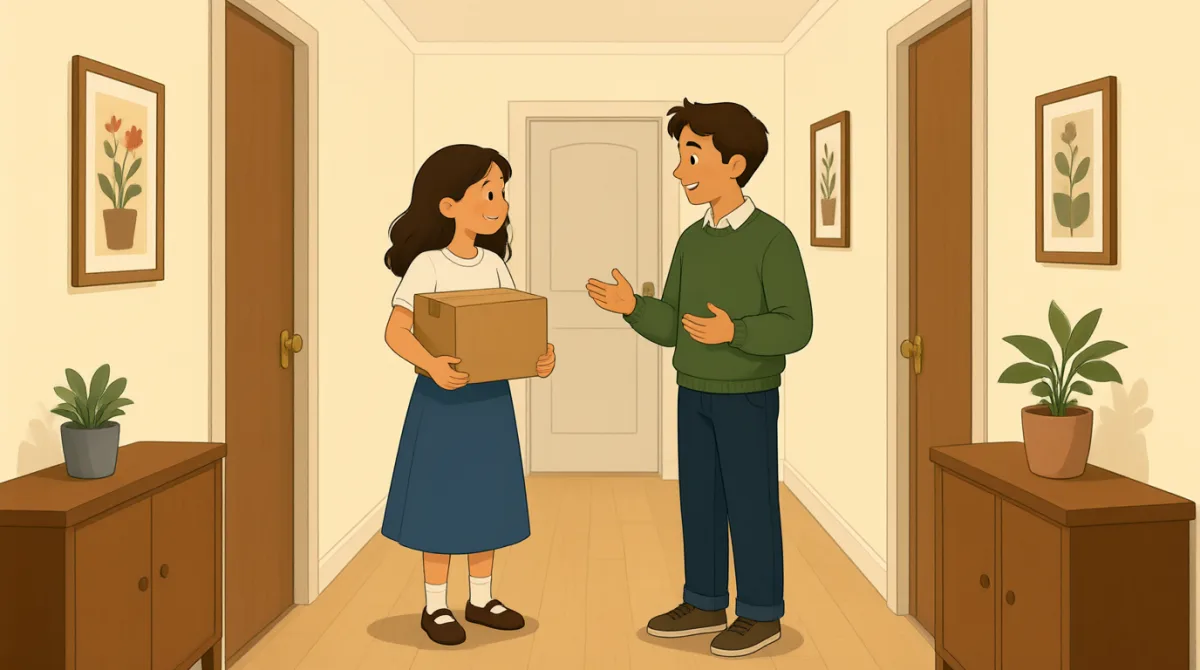

Hi! I’m your new neighbor. I’m Emma, and I’m trying to carry this box upstairs.
Hallo! Ich bin deine neue Nachbarin. Ich heiße Emma und versuche gerade, diesen Karton nach oben zu tragen.

Hi, Emma! I’m Mia. Let me hold the door for you.
Hallo, Emma! Ich bin Mia. Ich halte dir die Tür auf.
Thanks! I just moved in today. Do you live on this floor?
Danke! Ich bin heute erst eingezogen. Wohnst du auf dieser Etage?
Yes, I live right next door. Welcome to the building!
Ja, ich wohne direkt nebenan. Willkommen im Haus!
That’s great. Is it usually quiet here at night?
Das ist toll. Ist es hier nachts normalerweise ruhig?
Yes, it’s pretty quiet. The laundry room is downstairs, near the lobby.
Ja, es ist ziemlich ruhig. Der Waschraum ist unten, in der Nähe der Lobby.
Good to know! Is there a grocery store nearby?
Gut zu wissen! Gibt es hier in der Nähe einen Supermarkt?
There’s one two blocks away. I can show you later if you like.
Einer ist zwei Straßenblöcke entfernt. Wenn du möchtest, kann ich ihn dir später zeigen.
Wortschatz8
- new neighborneue Nachbarin
A person who has recently moved into a home near yours. You can use this phrase when introducing yourself to people who live nearby.
Eine Person, die gerade in eine Wohnung oder ein Haus in deiner Nähe gezogen ist. Mit diesem Ausdruck kannst du dich Menschen vorstellen, die in der Nachbarschaft wohnen.
- hold the doordie Tür aufhalten
To keep a door open for someone so they can pass through. You can offer to hold the door when someone is carrying something.
Eine Tür für jemanden offen halten, damit die Person hindurchgehen kann. Du kannst anbieten, jemandem die Tür aufzuhalten, wenn die Person etwas trägt.
- moved ineingezogen
Started living in a new home. Use “I just moved in” to tell someone you arrived at your new home recently.
Angefangen, in einem neuen Zuhause zu wohnen. Mit „I just moved in“ sagst du jemandem, dass du erst vor Kurzem in dein neues Zuhause gezogen bist.
- right next doordirekt nebenan
In the home immediately beside yours. Use this phrase to explain where you live in relation to someone else.
In der Wohnung oder im Haus direkt neben deinem Zuhause. Mit diesem Ausdruck erklärst du, wo du im Verhältnis zu einer anderen Person wohnst.
- pretty quietziemlich ruhig
Quite calm, with little noise. You can use it to describe a place or time that is not very noisy.
Relativ still, mit wenig Lärm. Damit kannst du einen Ort oder eine Zeit beschreiben, an dem oder in der es nicht sehr laut ist.
- downstairsunten
On a lower floor of a building. Use it to give the location of a room or place below you.
Auf einer tiefer gelegenen Etage eines Gebäudes. Damit kannst du sagen, dass sich ein Raum oder ein Ort unter dir befindet.
- nearbyin der Nähe
Not far away. You can ask if a shop or other place is nearby when you want to know if it is close.
Nicht weit entfernt. Du kannst fragen, ob ein Geschäft oder ein anderer Ort in der Nähe ist, wenn du wissen möchtest, ob er nicht weit weg liegt.
- two blocks awayzwei Straßenblöcke entfernt
A short distance measured as two city blocks. Use this phrase to say how far a place is from where you are.
Eine kurze Entfernung, die zwei Straßenblöcke beträgt. Mit diesem Ausdruck sagst du, wie weit ein Ort von deinem Standort entfernt ist.
Wichtige Sätze8
- 1
I’m your new neighbor.
Ich bin deine neue Nachbarin.
This is a simple way to introduce yourself to someone who lives near you. You can replace “neighbor” with another role, such as “new coworker.”
So kannst du dich einfach bei jemandem vorstellen, der in deiner Nähe wohnt. Du kannst „neighbor“ durch eine andere Rolle ersetzen, zum Beispiel mit „new coworker“.
- 2
Let me hold the door for you.
Ich halte dir die Tür auf.
Use this friendly offer when someone needs help getting through a door. You can also say, “Let me carry that for you.”
Dieses freundliche Angebot passt, wenn jemand Hilfe braucht, um durch eine Tür zu kommen. Du kannst auch sagen: „Let me carry that for you.“
- 3
I just moved in today.
Ich bin heute erst eingezogen.
This tells someone that you started living in a new home today. Replace “today” with another time to say when you moved.
Damit sagst du jemandem, dass du heute angefangen hast, in einem neuen Zuhause zu wohnen. Ersetze „today“ durch einen anderen Zeitpunkt, um zu sagen, wann du eingezogen bist.
- 4
Do you live on this floor?
Wohnst du auf dieser Etage?
This is a polite question to ask where someone lives in a building. You can also ask, “Do you live upstairs?”
Das ist eine höfliche Frage, um herauszufinden, wo jemand in einem Gebäude wohnt. Du kannst auch fragen: „Do you live upstairs?“
- 5
Is it usually quiet here at night?
Ist es hier nachts normalerweise ruhig?
Use this question to ask whether a place is normally noisy or calm at night. Replace “at night” with another time, such as “in the morning.”
Mit dieser Frage erkundigst du dich, ob es an einem Ort nachts normalerweise laut oder ruhig ist. Ersetze „at night“ durch eine andere Tageszeit, zum Beispiel mit „in the morning.“
- 6
The laundry room is downstairs, near the lobby.
Der Waschraum ist unten, in der Nähe der Lobby.
This sentence gives the location of a room in a building. Use the same pattern to explain where other places are.
Dieser Satz sagt, wo sich ein Raum in einem Gebäude befindet. Mit dem gleichen Muster kannst du erklären, wo andere Orte sind.
- 7
Is there a grocery store nearby?
Gibt es hier in der Nähe einen Supermarkt?
This is a useful way to ask if a shop is close to you. Replace “grocery store” with another place, such as “a pharmacy.”
So kannst du gut fragen, ob ein Geschäft in deiner Nähe ist. Ersetze „grocery store“ durch einen anderen Ort, zum Beispiel mit „a pharmacy.“
- 8
I can show you later if you like.
Ich kann ihn dir später zeigen, wenn du möchtest.
Use this friendly offer to say you can help someone at a later time. You can replace “show you” with another action, such as “help you.”
Mit diesem freundlichen Angebot sagst du, dass du jemandem später helfen kannst. Du kannst „show you“ durch eine andere Handlung ersetzen, zum Beispiel mit „help you.“