Coming Back for a Forgotten Item
Revenir chercher un objet oublié
After leaving the hotel, Emma realizes she forgot something and comes back to ask Jack for help. He finds it and returns it to her before she heads to the airport.
Après avoir quitté l’hôtel, Emma se rend compte qu’elle a oublié quelque chose et revient demander de l’aide à Jack. Il le retrouve et le lui rend avant qu’elle ne parte pour l’aéroport.
Dialogue9
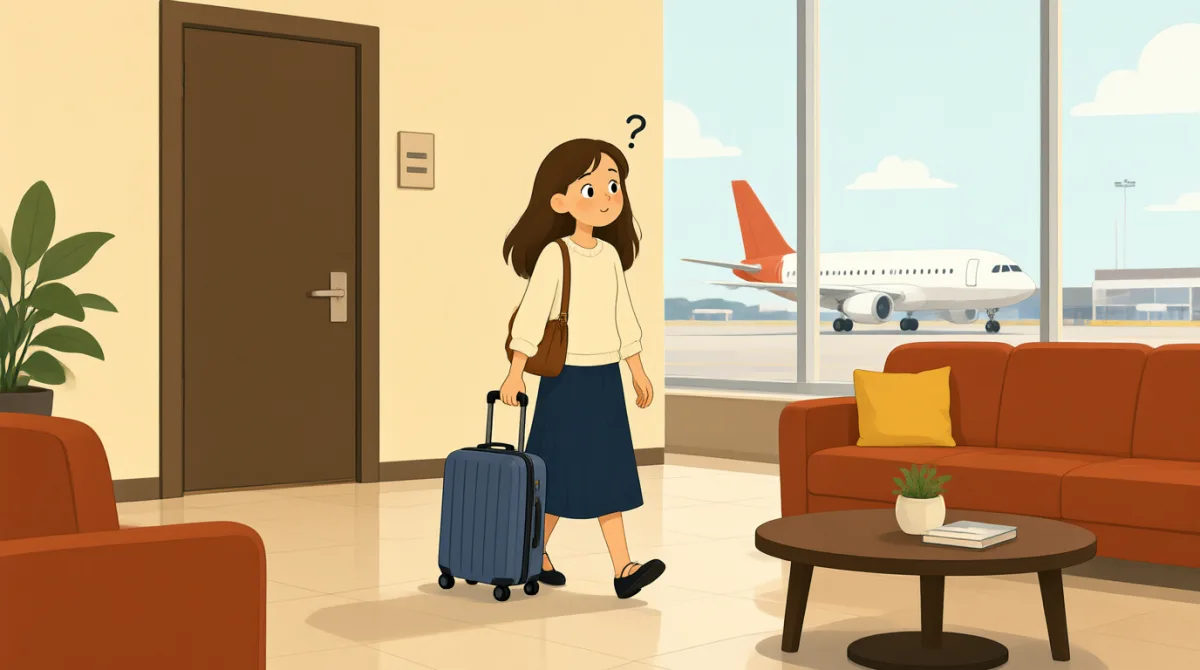

Hi, Jack. I just checked out, but I think I left my phone in my room.
Bonjour, Jack. Je viens de quitter l’hôtel, mais je crois que j’ai oublié mon téléphone dans ma chambre.

I can help. What room were you in?
Je peux vous aider. Vous étiez dans quelle chambre ?
Room 408. I noticed it was missing when I got outside.
La chambre 408. Je me suis rendu compte qu’il me manquait quand je suis sortie.
Let me call housekeeping and ask them to check the room.
Je vais appeler le service d’étage et leur demander de vérifier la chambre.
Thank you. I need it to show my taxi driver the airport address.
Merci. J’en ai besoin pour montrer l’adresse de l’aéroport à mon chauffeur de taxi.
They found a phone on the desk. Is yours in a blue case?
Ils ont trouvé un téléphone sur le bureau. Le vôtre est dans une coque bleue ?
Yes, that's mine! I'm so glad you found it.
Oui, c’est le mien ! Je suis tellement contente que vous l’ayez trouvé.
Here you are. Please check that everything is still there.
Le voilà. Vérifiez que tout y est encore, s’il vous plaît.
It is. Thanks for your help. Now I can head to the airport.
Oui, tout y est. Merci pour votre aide. Je peux maintenant partir pour l’aéroport.
Vocabulaire8
- checked outquitter l’hôtel
This means Emma finished her stay and left the hotel. You can say, “I checked out this morning.”
Cela signifie qu’Emma a terminé son séjour et a quitté l’hôtel. Vous pouvez dire : “I checked out this morning.” (J’ai quitté l’hôtel ce matin.)
- left my phoneoublier mon téléphone
This means Emma forgot her phone somewhere. Use “I left my [item] in…” to say where you forgot something.
Cela signifie qu’Emma a oublié son téléphone quelque part. Utilisez “I left my [item] in…” pour dire où vous avez oublié quelque chose.
- noticed it was missingremarquer qu’il manquait
Emma realized that her phone was not with her. You can use “I noticed [something] was missing” when you realize an item is gone.
Emma s’est rendu compte qu’elle n’avait pas son téléphone avec elle. Vous pouvez utiliser “I noticed [something] was missing” lorsque vous vous apercevez qu’un objet a disparu.
- call housekeepingappeler le service d’étage
This means contacting the hotel staff who clean and look after the rooms. You can ask, “Could you call housekeeping, please?”
Cela signifie contacter le personnel de l’hôtel qui nettoie les chambres et s’en occupe. Vous pouvez demander : “Could you call housekeeping, please?” (Pourriez-vous appeler le service d’étage, s’il vous plaît ?)
- check the roomvérifier la chambre
This means look in the room to find or confirm something. You can ask someone to “check the room” for a forgotten item.
Cela signifie regarder dans la chambre pour trouver quelque chose ou vérifier sa présence. Vous pouvez demander à quelqu’un de “check the room” pour retrouver un objet oublié.
- blue casecoque bleue
A case is a cover that protects a phone. You can describe a lost phone by saying, “It has a [color] case.”
Une coque protège un téléphone. Vous pouvez décrire un téléphone perdu en disant : “It has a [color] case.” (Il a une coque [couleur].)
- Here you are.Le voilà.
Jack says this as he gives Emma her phone. Use it when handing something to another person.
Jack dit cela en donnant son téléphone à Emma. Utilisez cette expression quand vous donnez quelque chose à quelqu’un.
- head to the airportpartir pour l’aéroport
This means go to the airport. You can say, “I need to head to the airport now.”
Cela signifie aller à l’aéroport. Vous pouvez dire : “I need to head to the airport now.” (Je dois partir pour l’aéroport maintenant.)
Phrases clés8
- 1
I just checked out, but I think I left my phone in my room.
Je viens de quitter l’hôtel, mais je crois que j’ai oublié mon téléphone dans ma chambre.
Use this to explain that you have left a place but may have forgotten something there. Replace “phone” and “my room” with the item and place.
Utilisez cette phrase pour expliquer que vous avez quitté un endroit, mais que vous y avez peut-être oublié quelque chose. Remplacez “phone” et “my room” par l’objet et le lieu concernés.
- 2
What room were you in?
Vous étiez dans quelle chambre ?
This is a simple way to ask which hotel room someone stayed in. You can use the same question at a hotel when helping a guest.
C’est une façon simple de demander dans quelle chambre d’hôtel quelqu’un a séjourné. Vous pouvez poser la même question à l’hôtel pour aider un client.
- 3
I noticed it was missing when I got outside.
Je me suis rendu compte qu’il me manquait quand je suis sortie.
Use this to say when you realized something was gone. Replace “it” with the missing item if the meaning is not clear.
Utilisez cette phrase pour dire quand vous vous êtes rendu compte que quelque chose avait disparu. Remplacez “it” par le nom de l’objet manquant si le contexte ne permet pas de comprendre.
- 4
Let me call housekeeping and ask them to check the room.
Je vais appeler le service d’étage et leur demander de vérifier la chambre.
This is a helpful way to offer to contact hotel staff and ask them to look for something. Replace “housekeeping” with another person or department as needed.
C’est une façon serviable de proposer de contacter le personnel de l’hôtel pour lui demander de chercher quelque chose. Remplacez “housekeeping” par une autre personne ou un autre service, selon le besoin.
- 5
I need it to show my taxi driver the airport address.
J’en ai besoin pour montrer l’adresse de l’aéroport à mon chauffeur de taxi.
Use “I need it to…” to explain why something is important. You can replace the action with another purpose, such as “I need it to make a call.”
Utilisez “I need it to…” pour expliquer pourquoi quelque chose est important. Vous pouvez remplacer l’action par un autre objectif, comme dans “I need it to make a call.” (J’en ai besoin pour passer un appel.)
- 6
Is yours in a blue case?
Le vôtre est dans une coque bleue ?
This is a useful question for checking whether a found item belongs to someone. Replace “blue case” with another detail, such as its color or size.
Cette question est utile pour vérifier si un objet trouvé appartient à quelqu’un. Remplacez “blue case” par un autre détail, comme sa couleur ou sa taille.
- 7
Please check that everything is still there.
Vérifiez que tout y est encore, s’il vous plaît.
Use this when returning a bag or another item and asking someone to make sure nothing is missing. You can also say, “Please check that your keys are there.”
Utilisez cette phrase quand vous rendez un sac ou un autre objet et demandez à quelqu’un de vérifier qu’il ne manque rien. Vous pouvez aussi dire : “Please check that your keys are there.” (Vérifiez que vos clés sont là, s’il vous plaît.)
- 8
Now I can head to the airport.
Je peux maintenant partir pour l’aéroport.
This means Emma can go to the airport now that she has her phone. Replace “the airport” with another destination, such as “the station.”
Cela signifie qu’Emma peut aller à l’aéroport maintenant qu’elle a récupéré son téléphone. Remplacez “the airport” par une autre destination, comme “the station.” (la gare)