Coming Back for a Forgotten Item
Volver por un objeto olvidado
After leaving the hotel, Emma realizes she forgot something and comes back to ask Jack for help. He finds it and returns it to her before she heads to the airport.
Después de salir del hotel, Emma se da cuenta de que olvidó algo y vuelve para pedirle ayuda a Jack. Él lo encuentra y se lo devuelve antes de que ella se vaya al aeropuerto.
Diálogo9
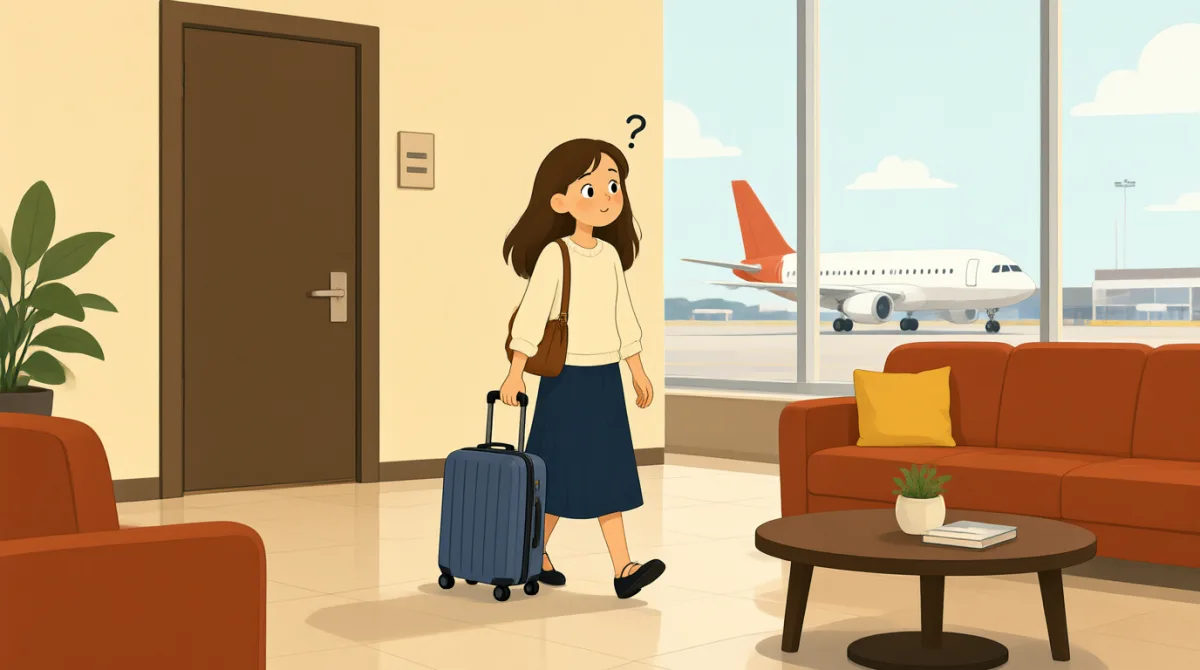

Hi, Jack. I just checked out, but I think I left my phone in my room.
Hola, Jack. Acabo de hacer el check-out, pero creo que dejé el teléfono en mi habitación.

I can help. What room were you in?
Puedo ayudarte. ¿En qué habitación estabas?
Room 408. I noticed it was missing when I got outside.
En la 408. Me di cuenta de que no lo tenía cuando salí.
Let me call housekeeping and ask them to check the room.
Voy a llamar al servicio de limpieza para pedirles que revisen la habitación.
Thank you. I need it to show my taxi driver the airport address.
Gracias. Lo necesito para mostrarle la dirección del aeropuerto al taxista.
They found a phone on the desk. Is yours in a blue case?
Encontraron un teléfono en el escritorio. ¿El tuyo tiene una funda azul?
Yes, that's mine! I'm so glad you found it.
¡Sí, es mío! Me alegra mucho que lo hayas encontrado.
Here you are. Please check that everything is still there.
Aquí tienes. Comprueba que siga estando todo.
It is. Thanks for your help. Now I can head to the airport.
Sí, está todo. Gracias por tu ayuda. Ahora ya puedo ir al aeropuerto.
Vocabulario8
- checked outhacer el check-out
This means Emma finished her stay and left the hotel. You can say, “I checked out this morning.”
Esto significa que Emma terminó su estancia y se fue del hotel. Puedes decir: “I checked out this morning” (Hice el check-out esta mañana).
- left my phonedejarme el teléfono
This means Emma forgot her phone somewhere. Use “I left my [item] in…” to say where you forgot something.
Esto significa que Emma olvidó el teléfono en algún lugar. Usa “I left my [item] in…” (Dejé mi [objeto] en…) para decir dónde olvidaste algo.
- noticed it was missingdarme cuenta de que no estaba
Emma realized that her phone was not with her. You can use “I noticed [something] was missing” when you realize an item is gone.
Emma se dio cuenta de que no tenía el teléfono consigo. Puedes usar “I noticed [something] was missing” (Me di cuenta de que faltaba [algo]) cuando te das cuenta de que ya no tienes un objeto.
- call housekeepingllamar al servicio de limpieza
This means contacting the hotel staff who clean and look after the rooms. You can ask, “Could you call housekeeping, please?”
Esto significa ponerse en contacto con el personal del hotel que limpia y se ocupa de las habitaciones. Puedes preguntar: “Could you call housekeeping, please?” (¿Podría llamar al servicio de limpieza, por favor?).
- check the roomrevisar la habitación
This means look in the room to find or confirm something. You can ask someone to “check the room” for a forgotten item.
Esto significa buscar o comprobar algo en la habitación. Puedes pedirle a alguien que “check the room” (revise la habitación) para buscar un objeto olvidado.
- blue casefunda azul
A case is a cover that protects a phone. You can describe a lost phone by saying, “It has a [color] case.”
Una funda es una cubierta que protege el teléfono. Puedes describir un teléfono perdido diciendo: “It has a [color] case” (Tiene una funda de color [color]).
- Here you are.Aquí tienes.
Jack says this as he gives Emma her phone. Use it when handing something to another person.
Jack dice esto mientras le entrega el teléfono a Emma. Úsalo cuando le das algo a otra persona.
- head to the airportir al aeropuerto
This means go to the airport. You can say, “I need to head to the airport now.”
Esto significa ir al aeropuerto. Puedes decir: “I need to head to the airport now” (Tengo que ir al aeropuerto ahora).
Frases clave8
- 1
I just checked out, but I think I left my phone in my room.
Acabo de hacer el check-out, pero creo que dejé el teléfono en mi habitación.
Use this to explain that you have left a place but may have forgotten something there. Replace “phone” and “my room” with the item and place.
Usa esta frase para explicar que ya saliste de un lugar, pero que quizá olvidaste algo allí. Sustituye “phone” y “my room” por el objeto y el lugar correspondientes.
- 2
What room were you in?
¿En qué habitación estabas?
This is a simple way to ask which hotel room someone stayed in. You can use the same question at a hotel when helping a guest.
Esta es una forma sencilla de preguntar en qué habitación del hotel se alojó alguien. Puedes usar la misma pregunta en un hotel cuando ayudas a un huésped.
- 3
I noticed it was missing when I got outside.
Me di cuenta de que no lo tenía cuando salí.
Use this to say when you realized something was gone. Replace “it” with the missing item if the meaning is not clear.
Usa esta frase para decir cuándo te diste cuenta de que algo había desaparecido. Sustituye “it” por el objeto que falta si no queda claro a qué te refieres.
- 4
Let me call housekeeping and ask them to check the room.
Voy a llamar al servicio de limpieza para pedirles que revisen la habitación.
This is a helpful way to offer to contact hotel staff and ask them to look for something. Replace “housekeeping” with another person or department as needed.
Esta es una forma útil de ofrecerte a contactar al personal del hotel y pedirle que busque algo. Sustituye “housekeeping” por otra persona o departamento, según sea necesario.
- 5
I need it to show my taxi driver the airport address.
Lo necesito para mostrarle la dirección del aeropuerto al taxista.
Use “I need it to…” to explain why something is important. You can replace the action with another purpose, such as “I need it to make a call.”
Usa “I need it to…” (Lo necesito para…) para explicar por qué algo es importante. Puedes sustituir la acción por otro propósito, como en “I need it to make a call” (Lo necesito para hacer una llamada).
- 6
Is yours in a blue case?
¿El tuyo tiene una funda azul?
This is a useful question for checking whether a found item belongs to someone. Replace “blue case” with another detail, such as its color or size.
Esta es una pregunta útil para comprobar si un objeto encontrado pertenece a alguien. Sustituye “blue case” por otro detalle, como el color o el tamaño.
- 7
Please check that everything is still there.
Comprueba que siga estando todo.
Use this when returning a bag or another item and asking someone to make sure nothing is missing. You can also say, “Please check that your keys are there.”
Usa esta frase cuando devuelvas un bolso u otro objeto y quieras pedirle a alguien que compruebe que no falte nada. También puedes decir: “Please check that your keys are there” (Comprueba que estén tus llaves, por favor).
- 8
Now I can head to the airport.
Ahora ya puedo ir al aeropuerto.
This means Emma can go to the airport now that she has her phone. Replace “the airport” with another destination, such as “the station.”
Esto significa que Emma ya puede ir al aeropuerto porque recuperó su teléfono. Sustituye “the airport” por otro destino, como “the station” (la estación).