Coming Back for a Forgotten Item
Zurück wegen eines vergessenen Gegenstands
After leaving the hotel, Emma realizes she forgot something and comes back to ask Jack for help. He finds it and returns it to her before she heads to the airport.
Nachdem Emma das Hotel verlassen hat, merkt sie, dass sie etwas vergessen hat, und kommt zurück, um Jack um Hilfe zu bitten. Er findet den Gegenstand und gibt ihn ihr zurück, bevor sie zum Flughafen fährt.
Dialog9
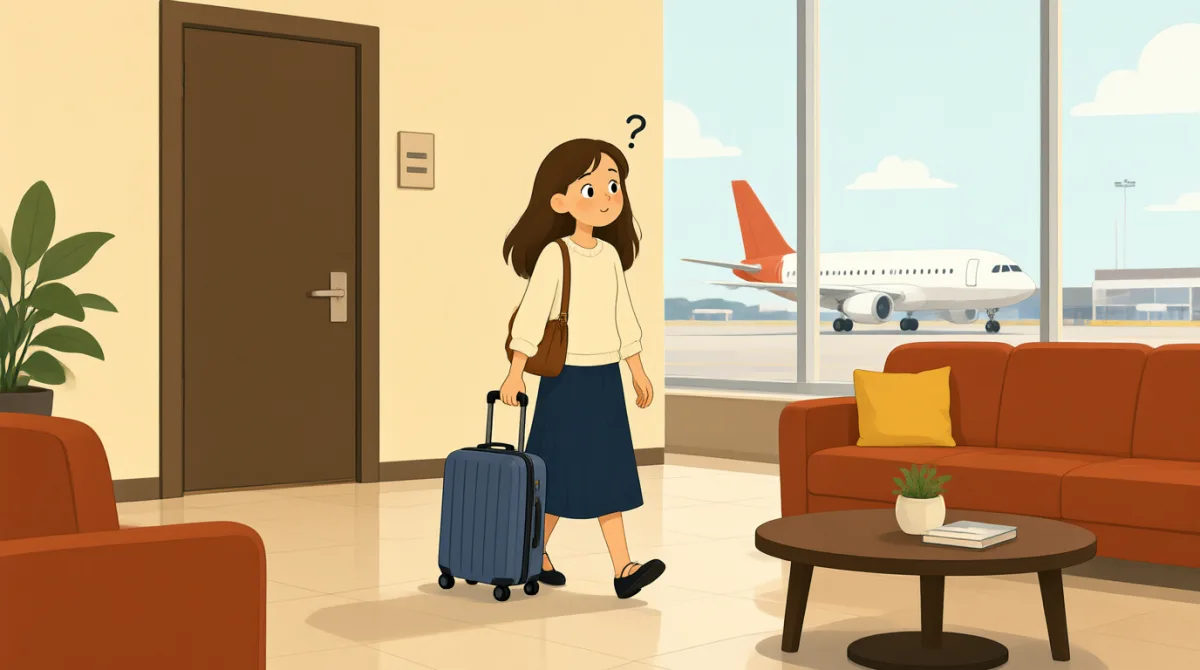

Hi, Jack. I just checked out, but I think I left my phone in my room.
Hallo, Jack. Ich habe gerade ausgecheckt, aber ich glaube, ich habe mein Handy im Zimmer liegen lassen.

I can help. What room were you in?
Ich helfe dir gern. In welchem Zimmer warst du?
Room 408. I noticed it was missing when I got outside.
Zimmer 408. Draußen ist mir aufgefallen, dass es fehlt.
Let me call housekeeping and ask them to check the room.
Ich rufe beim Housekeeping an und bitte sie, im Zimmer nachzusehen.
Thank you. I need it to show my taxi driver the airport address.
Danke. Ich brauche es, um meinem Taxifahrer die Adresse des Flughafens zu zeigen.
They found a phone on the desk. Is yours in a blue case?
Sie haben ein Handy auf dem Schreibtisch gefunden. Ist deins in einer blauen Hülle?
Yes, that's mine! I'm so glad you found it.
Ja, das ist meins! Ich bin so froh, dass du es gefunden hast.
Here you are. Please check that everything is still there.
Hier, bitte. Schau nach, ob noch alles da ist.
It is. Thanks for your help. Now I can head to the airport.
Ja, alles da. Danke für deine Hilfe. Jetzt kann ich zum Flughafen fahren.
Wortschatz8
- checked outausgecheckt
This means Emma finished her stay and left the hotel. You can say, “I checked out this morning.”
Das bedeutet, dass Emma ihren Aufenthalt beendet und das Hotel verlassen hat. Du kannst sagen: “I checked out this morning.”
- left my phonemein Handy liegen lassen
This means Emma forgot her phone somewhere. Use “I left my [item] in…” to say where you forgot something.
Das bedeutet, dass Emma ihr Handy irgendwo vergessen hat. Mit “I left my [item] in…” kannst du sagen, wo du etwas vergessen hast.
- noticed it was missingmir ist aufgefallen, dass es fehlt
Emma realized that her phone was not with her. You can use “I noticed [something] was missing” when you realize an item is gone.
Emma hat bemerkt, dass sie ihr Handy nicht bei sich hatte. “I noticed [something] was missing” kannst du sagen, wenn du feststellst, dass ein Gegenstand verschwunden ist.
- call housekeepingbeim Housekeeping anrufen
This means contacting the hotel staff who clean and look after the rooms. You can ask, “Could you call housekeeping, please?”
Das bedeutet, das Hotelpersonal zu kontaktieren, das die Zimmer reinigt und sich darum kümmert. Du kannst fragen: “Could you call housekeeping, please?”
- check the roomim Zimmer nachsehen
This means look in the room to find or confirm something. You can ask someone to “check the room” for a forgotten item.
Das bedeutet, im Zimmer nach etwas zu suchen oder etwas zu überprüfen. Du kannst jemanden bitten, wegen eines vergessenen Gegenstands “check the room”.
- blue caseblaue Hülle
A case is a cover that protects a phone. You can describe a lost phone by saying, “It has a [color] case.”
Eine Hülle schützt ein Handy. Du kannst ein verlorenes Handy beschreiben und sagen: “It has a [color] case.”
- Here you are.Hier, bitte.
Jack says this as he gives Emma her phone. Use it when handing something to another person.
Jack sagt das, während er Emma ihr Handy gibt. Verwende die Wendung, wenn du jemandem etwas reichst.
- head to the airportzum Flughafen fahren
This means go to the airport. You can say, “I need to head to the airport now.”
Das bedeutet, zum Flughafen zu fahren oder zu gehen. Du kannst sagen: “I need to head to the airport now.”
Wichtige Sätze8
- 1
I just checked out, but I think I left my phone in my room.
Ich habe gerade ausgecheckt, aber ich glaube, ich habe mein Handy im Zimmer liegen lassen.
Use this to explain that you have left a place but may have forgotten something there. Replace “phone” and “my room” with the item and place.
Verwende diesen Satz, um zu erklären, dass du einen Ort verlassen hast, dort aber vielleicht etwas vergessen hast. Ersetze “phone” und “my room” durch den Gegenstand und den Ort.
- 2
What room were you in?
In welchem Zimmer warst du?
This is a simple way to ask which hotel room someone stayed in. You can use the same question at a hotel when helping a guest.
So kannst du einfach fragen, in welchem Hotelzimmer jemand gewohnt hat. Du kannst die Frage im Hotel stellen, wenn du einem Gast hilfst.
- 3
I noticed it was missing when I got outside.
Draußen ist mir aufgefallen, dass es fehlt.
Use this to say when you realized something was gone. Replace “it” with the missing item if the meaning is not clear.
Verwende diesen Satz, um zu sagen, wann du bemerkt hast, dass etwas weg war. Ersetze “it” durch den fehlenden Gegenstand, wenn nicht klar ist, worum es geht.
- 4
Let me call housekeeping and ask them to check the room.
Ich rufe beim Housekeeping an und bitte sie, im Zimmer nachzusehen.
This is a helpful way to offer to contact hotel staff and ask them to look for something. Replace “housekeeping” with another person or department as needed.
So kannst du anbieten, das Hotelpersonal zu kontaktieren und es zu bitten, nach etwas zu suchen. Ersetze “housekeeping” bei Bedarf durch eine andere Person oder Abteilung.
- 5
I need it to show my taxi driver the airport address.
Ich brauche es, um meinem Taxifahrer die Adresse des Flughafens zu zeigen.
Use “I need it to…” to explain why something is important. You can replace the action with another purpose, such as “I need it to make a call.”
Verwende “I need it to…”, um zu erklären, warum etwas wichtig ist. Du kannst den Zweck ändern, zum Beispiel in “I need it to make a call.”
- 6
Is yours in a blue case?
Ist deins in einer blauen Hülle?
This is a useful question for checking whether a found item belongs to someone. Replace “blue case” with another detail, such as its color or size.
Mit dieser praktischen Frage kannst du überprüfen, ob ein gefundener Gegenstand jemandem gehört. Ersetze “blue case” durch ein anderes Merkmal, etwa die Farbe oder Größe.
- 7
Please check that everything is still there.
Schau bitte nach, ob noch alles da ist.
Use this when returning a bag or another item and asking someone to make sure nothing is missing. You can also say, “Please check that your keys are there.”
Verwende diesen Satz, wenn du eine Tasche oder einen anderen Gegenstand zurückgibst und jemanden bittest, zu prüfen, ob nichts fehlt. Du kannst auch sagen: “Please check that your keys are there.”
- 8
Now I can head to the airport.
Jetzt kann ich zum Flughafen fahren.
This means Emma can go to the airport now that she has her phone. Replace “the airport” with another destination, such as “the station.”
Das bedeutet, dass Emma jetzt zum Flughafen fahren kann, da sie ihr Handy wiederhat. Ersetze “the airport” durch ein anderes Ziel, zum Beispiel “the station.”