Telling a Friend You Are Late
Dire à une amie qu’on est en retard
Emma calls Mia and says she is late because she got off at the wrong stop. Mia tells her not to worry.
Emma appelle Mia pour lui dire qu’elle est en retard parce qu’elle est descendue au mauvais arrêt. Mia lui dit de ne pas s’inquiéter.
Dialogue7
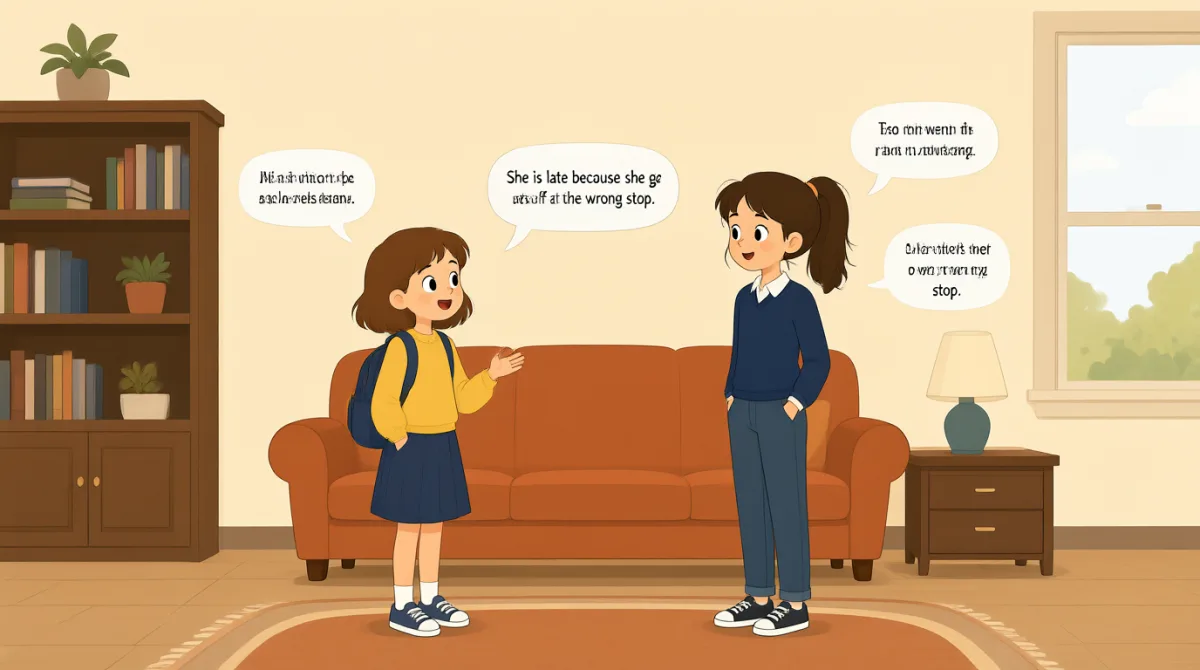

Hi, Mia. I’m sorry, but I’m late.
Salut, Mia. Désolée, je suis en retard.

That’s okay. Are you on the train?
Ce n’est pas grave. Tu es dans le train ?
No. I got off at the wrong stop.
Non. Je suis descendue au mauvais arrêt.
Oh no! Are you going back now?
Oh non ! Tu fais demi-tour maintenant ?
Yes. I’m waiting for the next train.
Oui. J’attends le prochain train.
Don’t worry. Take your time.
Ne t’inquiète pas. Prends ton temps.
Thanks. I’ll call you when I arrive.
Merci. Je t’appellerai quand j’arriverai.
Vocabulaire6
- I’m lateêtre en retard
This means you are not on time. Use it to tell someone you will arrive after the planned time.
Cela signifie que tu n’es pas à l’heure. Utilise cette expression pour dire à quelqu’un que tu arriveras après l’heure prévue.
- That’s okayCe n’est pas grave
This means you are not upset about something. Use it to make someone feel better.
Cela signifie que tu n’es pas contrarié par quelque chose. Utilise cette expression pour rassurer quelqu’un.
- the wrong stople mauvais arrêt
This means a stop that is not the one you wanted. Use it when you leave a bus or train in the wrong place.
C’est un arrêt qui n’est pas celui où tu voulais descendre. Utilise cette expression quand tu descends du bus ou du train au mauvais endroit.
- the next trainle prochain train
This means the train that comes after the one you missed or left. You can also say “the next bus.”
C’est le train qui arrive après celui que tu as raté ou quitté. Tu peux aussi dire « le prochain bus ».
- Take your timePrends ton temps
This means there is no need to hurry. Use it to tell someone to go at a comfortable speed.
Cela signifie qu’il n’y a pas besoin de se dépêcher. Utilise cette expression pour dire à quelqu’un d’avancer à son rythme.
- when I arrivequand j’arrive
This means at the time I get to a place. Use it to say when you will do something.
Cela signifie au moment où j’arrive quelque part. Utilise cette expression pour dire quand tu feras quelque chose.
Phrases clés8
- 1
I’m sorry, but I’m late.
Je suis désolée, mais je suis en retard.
Use this to apologize and explain that you will not arrive on time. You can replace “late” with a short reason, such as “I’m sorry, but I’m sick.”
Utilise cette phrase pour t’excuser et expliquer que tu n’arriveras pas à l’heure. Tu peux remplacer “late” par une courte explication, comme “I’m sorry, but I’m sick.”
- 2
Are you on the train?
Tu es dans le train ?
Use this question to ask if someone is riding a train now. You can replace “train” with “bus” or another form of transport.
Utilise cette question pour demander si quelqu’un est dans un train en ce moment. Tu peux remplacer “train” par “bus” ou par un autre moyen de transport.
- 3
I got off at the wrong stop.
Je suis descendue au mauvais arrêt.
Use this to explain that you left a bus or train at a stop you did not want. You can change “stop” to “station” when talking about a train station.
Utilise cette phrase pour expliquer que tu es descendue du bus ou du train à un arrêt où tu ne voulais pas descendre. Tu peux remplacer “stop” par “station” quand tu parles d’une gare.
- 4
Are you going back now?
Tu fais demi-tour maintenant ?
Use this to ask if someone is returning to a place now. You can replace “back” with a place, such as “Are you going home now?”
Utilise cette question pour demander si quelqu’un retourne quelque part maintenant. Tu peux remplacer “back” par un lieu, comme dans “Are you going home now?”
- 5
I’m waiting for the next train.
J’attends le prochain train.
Use this to say that you are staying somewhere until another train comes. You can replace “train” with “bus” or another thing you are waiting for.
Utilise cette phrase pour dire que tu restes quelque part jusqu’à l’arrivée d’un autre train. Tu peux remplacer “train” par “bus” ou par une autre chose que tu attends.
- 6
Don’t worry.
Ne t’inquiète pas.
Use this to comfort someone who feels nervous or upset. You can say it by itself or add a reason to feel calm.
Utilise cette phrase pour réconforter quelqu’un qui est nerveux ou contrarié. Tu peux la dire seule ou ajouter une raison de rester calme.
- 7
Take your time.
Prends ton temps.
Use this to tell someone that they do not need to hurry. It is a kind response when someone is late or moving slowly.
Utilise cette phrase pour dire à quelqu’un qu’il n’a pas besoin de se dépêcher. C’est une réponse gentille quand quelqu’un est en retard ou avance lentement.
- 8
I’ll call you when I arrive.
Je t’appellerai quand j’arriverai.
Use this to promise to call someone after you get to a place. Replace “call” with another action, such as “text you.”
Utilise cette phrase pour promettre d’appeler quelqu’un après être arrivé quelque part. Remplace “call” par une autre action, comme “text you.”