Telling a Friend You Are Late
Einem Freund sagen, dass man sich verspätet
Emma calls Mia and says she is late because she got off at the wrong stop. Mia tells her not to worry.
Emma ruft Mia an und sagt, dass sie sich verspätet, weil sie an der falschen Haltestelle ausgestiegen ist. Mia sagt ihr, sie soll sich keine Sorgen machen.
Dialog7
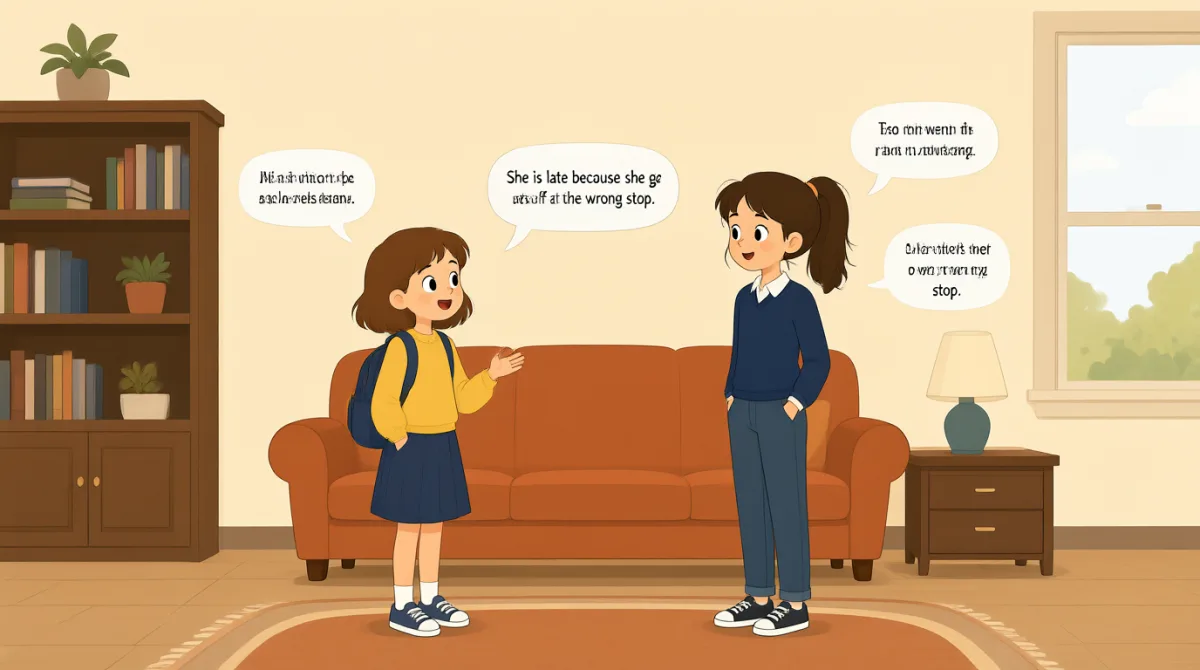

Hi, Mia. I’m sorry, but I’m late.
Hi, Mia. Tut mir leid, aber ich bin spät dran.

That’s okay. Are you on the train?
Schon okay. Bist du im Zug?
No. I got off at the wrong stop.
Nein. Ich bin an der falschen Haltestelle ausgestiegen.
Oh no! Are you going back now?
Oh nein! Fährst du jetzt zurück?
Yes. I’m waiting for the next train.
Ja. Ich warte auf den nächsten Zug.
Don’t worry. Take your time.
Mach dir keine Sorgen. Lass dir Zeit.
Thanks. I’ll call you when I arrive.
Danke. Ich ruf dich an, wenn ich angekommen bin.
Wortschatz6
- I’m latespät dran sein
This means you are not on time. Use it to tell someone you will arrive after the planned time.
Das bedeutet, dass du nicht pünktlich bist. Du kannst es sagen, wenn du später als geplant ankommst.
- That’s okaySchon okay
This means you are not upset about something. Use it to make someone feel better.
Damit sagst du, dass dich etwas nicht stört. Du kannst es sagen, um jemanden zu beruhigen.
- the wrong stopdie falsche Haltestelle
This means a stop that is not the one you wanted. Use it when you leave a bus or train in the wrong place.
Damit ist eine Haltestelle gemeint, an der du gar nicht aussteigen wolltest. Du sagst das, wenn du an der falschen Stelle aus einem Bus oder Zug aussteigst.
- the next trainder nächste Zug
This means the train that comes after the one you missed or left. You can also say “the next bus.”
Damit ist der Zug gemeint, der nach dem kommt, den du verpasst hast oder aus dem du ausgestiegen bist. Du kannst auch „the next bus“ sagen.
- Take your timeLass dir Zeit
This means there is no need to hurry. Use it to tell someone to go at a comfortable speed.
Das bedeutet, dass du dich nicht beeilen musst. Du kannst es sagen, damit jemand in seinem eigenen Tempo weitermacht.
- when I arrivewenn ich angekommen bin
This means at the time I get to a place. Use it to say when you will do something.
Damit ist der Zeitpunkt gemeint, an dem ich an einem Ort ankomme. Du kannst den Ausdruck verwenden, um zu sagen, wann du etwas tun wirst.
Wichtige Sätze8
- 1
I’m sorry, but I’m late.
Tut mir leid, aber ich bin spät dran.
Use this to apologize and explain that you will not arrive on time. You can replace “late” with a short reason, such as “I’m sorry, but I’m sick.”
Damit entschuldigst du dich und erklärst, dass du nicht pünktlich ankommst. Du kannst „late“ durch einen kurzen Grund ersetzen, zum Beispiel: “I’m sorry, but I’m sick.”
- 2
Are you on the train?
Bist du im Zug?
Use this question to ask if someone is riding a train now. You can replace “train” with “bus” or another form of transport.
Mit dieser Frage fragst du, ob jemand gerade mit dem Zug fährt. Du kannst „train“ durch „bus“ oder ein anderes Verkehrsmittel ersetzen.
- 3
I got off at the wrong stop.
Ich bin an der falschen Haltestelle ausgestiegen.
Use this to explain that you left a bus or train at a stop you did not want. You can change “stop” to “station” when talking about a train station.
Damit erklärst du, dass du an einer Haltestelle aus einem Bus oder Zug ausgestiegen bist, an der du gar nicht aussteigen wolltest. Wenn du über einen Bahnhof sprichst, kannst du „stop“ durch „station“ ersetzen.
- 4
Are you going back now?
Fährst du jetzt zurück?
Use this to ask if someone is returning to a place now. You can replace “back” with a place, such as “Are you going home now?”
Damit fragst du, ob jemand jetzt an einen Ort zurückfährt. Du kannst „back“ durch einen Ort ersetzen, zum Beispiel: “Are you going home now?”
- 5
I’m waiting for the next train.
Ich warte auf den nächsten Zug.
Use this to say that you are staying somewhere until another train comes. You can replace “train” with “bus” or another thing you are waiting for.
Damit sagst du, dass du irgendwo wartest, bis ein weiterer Zug kommt. Du kannst „train“ durch „bus“ oder etwas anderes ersetzen, worauf du wartest.
- 6
Don’t worry.
Mach dir keine Sorgen.
Use this to comfort someone who feels nervous or upset. You can say it by itself or add a reason to feel calm.
Damit beruhigst du jemanden, der nervös oder aufgebracht ist. Du kannst es allein sagen oder noch einen Grund hinzufügen, warum die Person ruhig bleiben kann.
- 7
Take your time.
Lass dir Zeit.
Use this to tell someone that they do not need to hurry. It is a kind response when someone is late or moving slowly.
Damit sagst du jemandem, dass er sich nicht beeilen muss. Das ist eine freundliche Antwort, wenn jemand zu spät kommt oder sich langsam bewegt.
- 8
I’ll call you when I arrive.
Ich ruf dich an, wenn ich angekommen bin.
Use this to promise to call someone after you get to a place. Replace “call” with another action, such as “text you.”
Damit versprichst du, jemanden anzurufen, nachdem du an einem Ort angekommen bist. Du kannst „call“ durch eine andere Handlung ersetzen, zum Beispiel „text you“.