Going to the Ticket Office
Ir a la taquilla
After missing her connection, Emma goes to the ticket office for help. She asks which ticket she needs to change.
Después de perder su conexión, Emma va a la taquilla para pedir ayuda. Pregunta qué billete tiene que cambiar.
Diálogo8
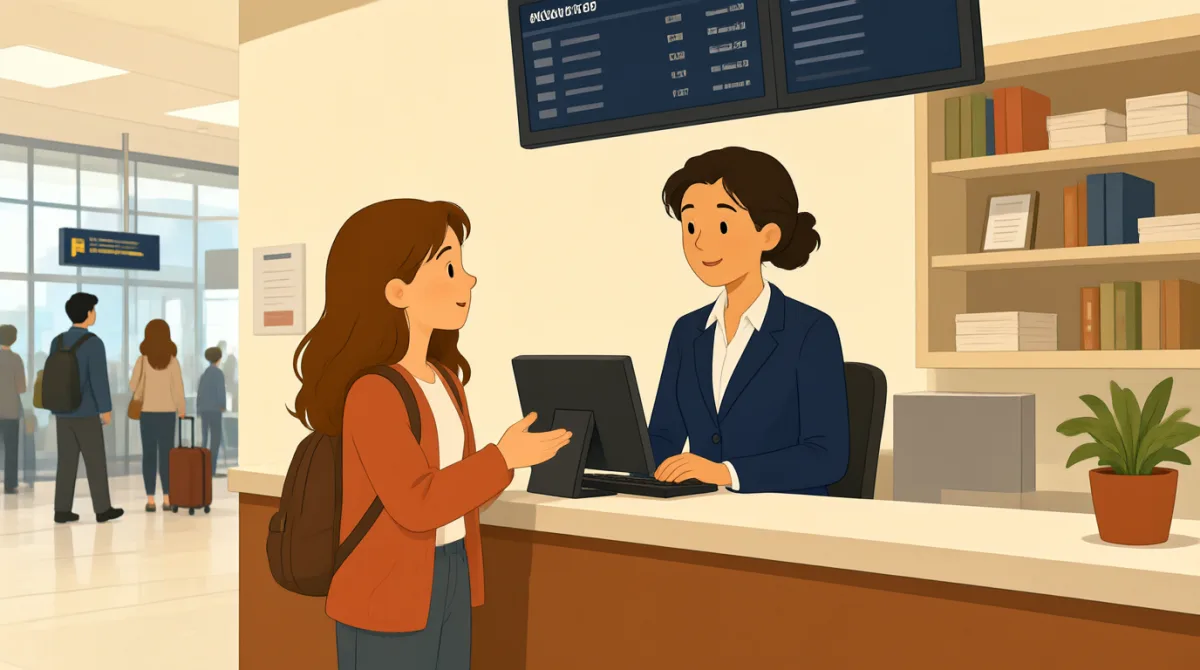

Hi, I missed my connection because my first train was late.
Hola, perdí mi conexión porque el primer tren llegó tarde.

I’m sorry to hear that. I can help you here.
Lo siento. Aquí puedo ayudarla.
Which ticket do I need to change, my first ticket or my connection ticket?
¿Qué billete tengo que cambiar, el del primer tren o el de la conexión?
Please show me your tickets, and I’ll check them for you.
Por favor, muéstreme sus billetes y los revisaré.
Here they are. I’m not sure which one is for the next train.
Aquí están. No sé cuál es el del próximo tren.
This one is for your missed connection. We can change it at this desk.
Este es el de la conexión que perdió. Podemos cambiarlo en esta ventanilla.
Great. Do I need to change it now, or can I wait?
Genial. ¿Tengo que cambiarlo ahora o puedo esperar?
It’s best to change it now. Then you’ll know which train to take.
Es mejor cambiarlo ahora. Así sabrá qué tren tomar.
Vocabulario8
- missed my connectionperdí mi conexión
You missed your connection when you arrived too late to catch the train that followed your first train.
Perdiste la conexión cuando llegaste demasiado tarde para tomar el tren que seguía al primero.
- first train was lateel primer tren llegó tarde
This explains why Emma did not catch her next train. Use “was late” to describe a past delay.
Esto explica por qué Emma no alcanzó el siguiente tren. Usa “was late” para describir un retraso en el pasado.
- show me your ticketsmuéstreme sus billetes
This is a polite way to ask someone to let you see their tickets.
Esta es una forma cortés de pedirle a alguien que te deje ver sus billetes.
- check them for youlos revisaré
Here, “check” means to look at the tickets and find out which one needs to be changed. You can use this phrase when offering help.
Aquí, “check” significa mirar los billetes y averiguar cuál hay que cambiar. Puedes usar esta expresión cuando ofreces ayuda.
- the next trainel próximo tren
This means the train that comes after the one you missed. Use it to ask or talk about your upcoming train.
Se refiere al tren que viene después del que perdiste. Usa esta expresión para preguntar por el tren que tomarás próximamente o hablar de él.
- at this desken esta ventanilla
This tells someone where a service is available. You can use it to give directions inside a station or office.
Esto le indica a alguien dónde está disponible un servicio. Puedes usarlo para dar indicaciones dentro de una estación o una oficina.
- change it nowcambiarlo ahora
In this conversation, “change” means to update the ticket for a different train. Use “now” to say something should happen immediately.
En esta conversación, “change” significa modificar el billete para tomar otro tren. Usa “now” para decir que algo debe hacerse de inmediato.
- It’s best to change it now.Es mejor cambiarlo ahora.
This phrase gives friendly advice about what someone should do. You can use “It’s best to…” to recommend an action.
Esta expresión da un consejo amable sobre lo que alguien debería hacer. Puedes usar “It’s best to…” para recomendar una acción.
Frases clave7
- 1
I missed my connection because my first train was late.
Perdí mi conexión porque el primer tren llegó tarde.
This sentence explains why you did not catch a connecting train. Reuse “I missed my connection because…” and give the reason.
Esta oración explica por qué no alcanzaste un tren de conexión. Puedes volver a usar “I missed my connection because…” y añadir el motivo.
- 2
Which ticket do I need to change, my first ticket or my connection ticket?
¿Qué billete tengo que cambiar, el del primer tren o el de la conexión?
Use this question when you are unsure which ticket needs to be updated. You can replace “ticket” with another item you need help with.
Usa esta pregunta cuando no estés seguro de qué billete hay que modificar. Puedes sustituir “ticket” por otro objeto con el que necesites ayuda.
- 3
Please show me your tickets, and I’ll check them for you.
Por favor, muéstreme sus billetes y los revisaré.
This is a polite way to offer help and explain what you will do. You can use “I’ll check it for you” when offering to look at something.
Esta es una forma cortés de ofrecer ayuda y explicar lo que vas a hacer. Puedes usar “I’ll check it for you” cuando te ofreces a revisar algo.
- 4
I’m not sure which one is for the next train.
No sé cuál es el del próximo tren.
Use this sentence when you cannot identify the right item. Replace “the next train” with the person or thing you are trying to find.
Usa esta oración cuando no puedas identificar el objeto correcto. Sustituye “the next train” por la persona o la cosa que intentas encontrar.
- 5
We can change it at this desk.
Podemos cambiarlo en esta ventanilla.
This sentence explains what service is available and where to get it. Replace “change it” with another action to give simple directions.
Esta oración explica qué servicio está disponible y dónde obtenerlo. Sustituye “change it” por otra acción para dar indicaciones sencillas.
- 6
Do I need to change it now, or can I wait?
¿Tengo que cambiarlo ahora o puedo esperar?
This question asks whether something must happen immediately or can happen later. You can reuse the pattern with other tasks or plans.
Esta pregunta sirve para saber si algo tiene que hacerse de inmediato o puede esperar. Puedes reutilizar el patrón para hablar de otras tareas o planes.
- 7
Then you’ll know which train to take.
Así sabrá qué tren tomar.
This explains the result of doing something first. Use “Then you’ll know…” to describe what someone will learn or be able to decide.
Esto explica el resultado de hacer algo primero. Usa “Then you’ll know…” para describir lo que alguien aprenderá o podrá decidir.