Going to the Ticket Office
After missing her connection, Emma goes to the ticket office for help. She asks which ticket she needs to change.
Dialogue8
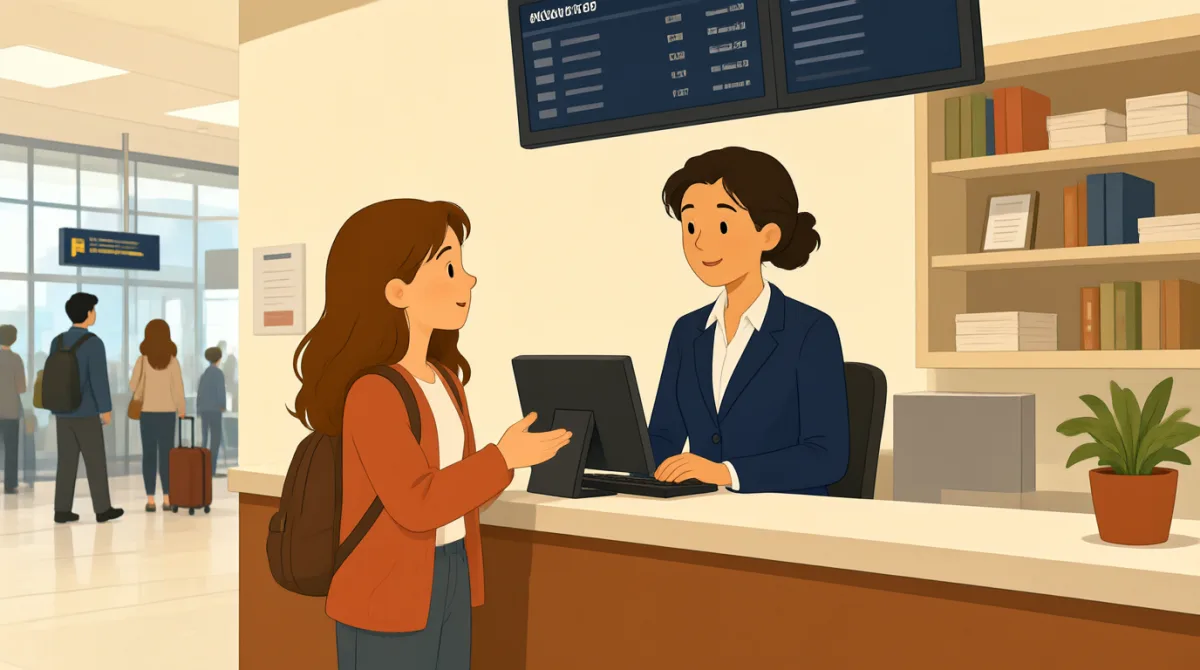

Hi, I missed my connection because my first train was late.

I’m sorry to hear that. I can help you here.
Which ticket do I need to change, my first ticket or my connection ticket?
Please show me your tickets, and I’ll check them for you.
Here they are. I’m not sure which one is for the next train.
This one is for your missed connection. We can change it at this desk.
Great. Do I need to change it now, or can I wait?
It’s best to change it now. Then you’ll know which train to take.
Vocabulary8
- missed my connection
You missed your connection when you arrived too late to catch the train that followed your first train.
- first train was late
This explains why Emma did not catch her next train. Use “was late” to describe a past delay.
- show me your tickets
This is a polite way to ask someone to let you see their tickets.
- check them for you
Here, “check” means to look at the tickets and find out which one needs to be changed. You can use this phrase when offering help.
- the next train
This means the train that comes after the one you missed. Use it to ask or talk about your upcoming train.
- at this desk
This tells someone where a service is available. You can use it to give directions inside a station or office.
- change it now
In this conversation, “change” means to update the ticket for a different train. Use “now” to say something should happen immediately.
- It’s best to change it now.
This phrase gives friendly advice about what someone should do. You can use “It’s best to…” to recommend an action.
Key Sentences7
- 1
I missed my connection because my first train was late.
This sentence explains why you did not catch a connecting train. Reuse “I missed my connection because…” and give the reason.
- 2
Which ticket do I need to change, my first ticket or my connection ticket?
Use this question when you are unsure which ticket needs to be updated. You can replace “ticket” with another item you need help with.
- 3
Please show me your tickets, and I’ll check them for you.
This is a polite way to offer help and explain what you will do. You can use “I’ll check it for you” when offering to look at something.
- 4
I’m not sure which one is for the next train.
Use this sentence when you cannot identify the right item. Replace “the next train” with the person or thing you are trying to find.
- 5
We can change it at this desk.
This sentence explains what service is available and where to get it. Replace “change it” with another action to give simple directions.
- 6
Do I need to change it now, or can I wait?
This question asks whether something must happen immediately or can happen later. You can reuse the pattern with other tasks or plans.
- 7
Then you’ll know which train to take.
This explains the result of doing something first. Use “Then you’ll know…” to describe what someone will learn or be able to decide.