Finding Water Under the Sink
Lavabonun Altında Su Bulmak
Emma finds water under her kitchen sink and calls her landlord, Jack, to explain what happened. They talk about where the leak is coming from.
Emma mutfak lavabosunun altında su bulur ve olanları anlatmak için ev sahibi Jack’i arar. Sızıntının nereden geldiğini konuşurlar.
Diyalog8
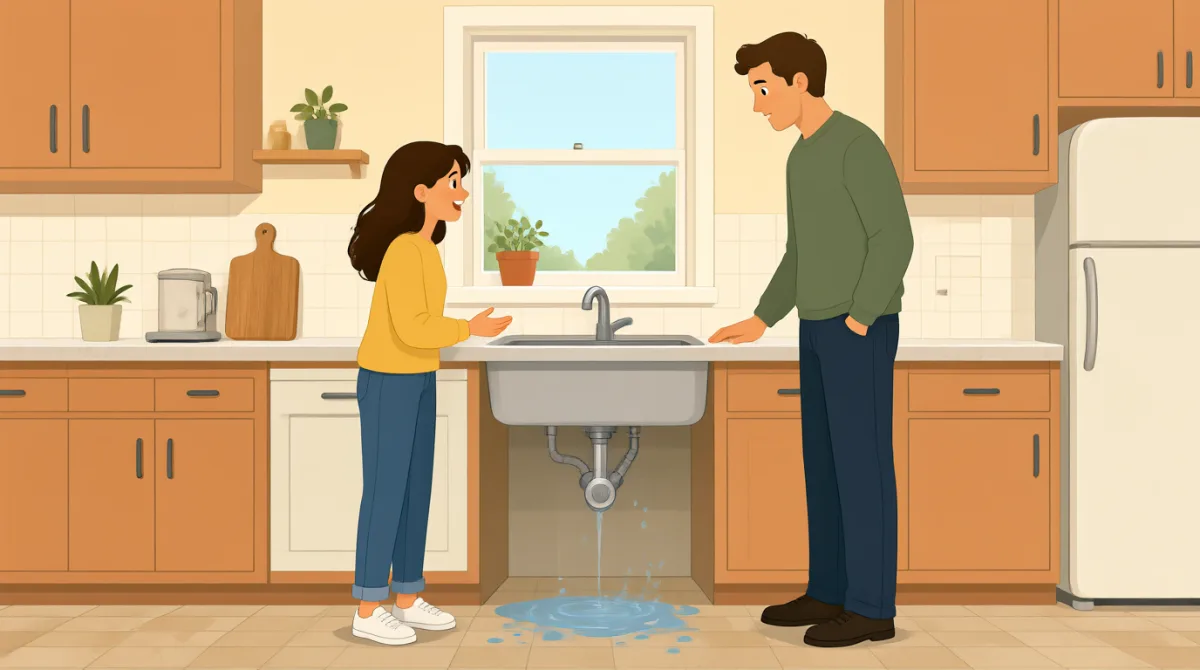

Hi, Jack. I found water under the kitchen sink this morning.
Merhaba Jack. Bu sabah mutfak lavabosunun altında su buldum.

Oh no. Is there a lot of water on the floor?
Eyvah. Yerde çok su var mı?
Not a lot, but the cabinet is wet. I put a towel down.
Çok değil ama dolap ıslak. Yere bir havlu koydum.
Thanks. Did you see where the water was coming from?
Teşekkürler. Suyun nereden geldiğini gördün mü?
I think it’s coming from a pipe under the sink. It’s dripping slowly.
Sanırım lavabonun altındaki bir borudan geliyor. Yavaş yavaş damlıyor.
Okay. Please don’t use the sink for now. I’ll call a plumber.
Peki. Şimdilik lütfen lavaboyu kullanma. Bir tesisatçı arayacağım.
Should I turn off the water? I’m not sure which handle to use.
Suyu kapatayım mı? Hangi vanayı kullanacağımdan emin değilim.
Yes, turn off the small valve under the sink. I’ll check on you soon.
Evet, lavabonun altındaki küçük vanayı kapat. Birazdan seni arayıp nasıl olduğunu soracağım.
Kelime Bilgisi8
- under the kitchen sinkmutfak lavabosunun altında
This means in the space below the kitchen sink, often inside a cabinet. Use it to say where you found something.
Bu ifade, mutfak lavabosunun altındaki, genellikle dolabın içindeki alanı anlatır. Bir şeyi nerede bulduğunu söylemek için kullanabilirsin.
- a lot of waterçok su
This means a large amount of water. You can use “a lot of” with many things, such as “a lot of food” or “a lot of rain.”
Bu, büyük miktarda su demektir. “a lot of” ifadesini “a lot of food” veya “a lot of rain” gibi başka şeylerle de kullanabilirsin.
- put a towel downyere bir havlu koymak
This means placed a towel on the floor to soak up water. Use “put [something] down” to say you placed it on a surface.
Bu, suyu emmesi için yere bir havlu koymak demektir. Bir şeyi bir yüzeye bıraktığını anlatmak için “put [something] down” kalıbını kullanabilirsin.
- coming fromgelmek
Here, this asks about the place where the water starts. You can also ask where a sound or smell is coming from.
Burada suyun başladığı yeri sorar. Bir sesin veya kokunun nereden geldiğini sormak için de kullanabilirsin.
- dripping slowlyyavaş yavaş damlamak
This means water is falling in small drops at a slow rate. Use it to describe a small, steady leak.
Bu, suyun yavaşça küçük damlalar hâlinde akması demektir. Küçük ve sürekli bir sızıntıyı anlatmak için kullanabilirsin.
- for nowşimdilik
This means for the present time, but perhaps not later. You can use it when giving a temporary instruction.
Bu, şu an için ama belki daha sonra değil demektir. Geçici bir talimat verirken kullanabilirsin.
- turn offkapatmak
This means to stop the flow of water by moving a valve or handle. You can also use “turn off” for lights and machines.
Bu, bir vanayı veya kolu hareket ettirerek su akışını durdurmak demektir. “turn off” ifadesini ışıklar ve makineler için de kullanabilirsin.
- check on younasıl olduğunu kontrol etmek
This means to contact or visit you later to see if you are okay. Use it when you plan to make sure someone is all right.
Bu, iyi olup olmadığını görmek için daha sonra seninle iletişime geçmek veya seni ziyaret etmek demektir. Birinin iyi olduğundan emin olmak istediğinde kullanabilirsin.
Önemli Cümleler8
- 1
I found water under the kitchen sink this morning.
Bu sabah mutfak lavabosunun altında su buldum.
This is a clear way to explain what you discovered and when. You can reuse the pattern “I found [something] [place/time].”
Bu cümle, ne bulduğunu ve ne zaman bulduğunu açıkça anlatır. “I found [something] [place/time].” kalıbını yeniden kullanabilirsin.
- 2
Is there a lot of water on the floor?
Yerde çok su var mı?
This is a useful question for finding out how serious a problem is. You can replace “water” with another thing, such as “dirt” or “food.”
Bir sorunun ne kadar ciddi olduğunu anlamak için bu soru işe yarar. “water” yerine “dirt” veya “food” gibi başka bir şey koyabilirsin.
- 3
I put a towel down.
Yere bir havlu koydum.
This tells someone what you did to deal with the water. You can use “I put [something] down” to describe placing an item on a surface.
Bu cümle, suyla ilgilenmek için ne yaptığını anlatır. Bir eşyayı bir yüzeye koyduğunu anlatmak için “I put [something] down” kalıbını kullanabilirsin.
- 4
I think it’s coming from a pipe under the sink.
Sanırım lavabonun altındaki bir borudan geliyor.
Use this sentence to explain where you believe a problem starts. “I think it’s coming from…” is useful when you are not completely sure.
Bir sorunun nereden kaynaklandığını düşündüğünü anlatmak için bu cümleyi kullan. Tam emin olmadığında “I think it’s coming from…” kalıbı işe yarar.
- 5
Please don’t use the sink for now.
Lütfen şimdilik lavaboyu kullanma.
This is a polite way to give someone a temporary instruction. You can replace “the sink” with another object or place.
Bu, birine geçici bir talimat vermenin kibar bir yoludur. “the sink” yerine başka bir eşya veya yer koyabilirsin.
- 6
I’ll call a plumber.
Bir tesisatçı arayacağım.
This is a simple way to say what you plan to do. Use “I’ll call…” to talk about a future action.
Bu, ne yapmayı planladığını söylemenin basit bir yoludur. Gelecekte yapacağın bir eylemden söz etmek için “I’ll call…” kalıbını kullan.
- 7
Should I turn off the water?
Suyu kapatayım mı?
This is a useful way to ask if you need to do something. You can reuse “Should I [action]?” when asking for advice.
Bir şeyi yapman gerekip gerekmediğini sormanın kullanışlı bir yoludur. Tavsiye isterken “Should I [action]?” kalıbını kullanabilirsin.
- 8
I’m not sure which handle to use.
Hangi vanayı kullanacağımdan emin değilim.
Use this when you do not know which item or option is correct. You can replace “handle” with another thing, such as “key” or “button.”
Hangi eşyanın veya seçeneğin doğru olduğunu bilmediğinde bu cümleyi kullan. “handle” yerine “key” veya “button” gibi başka bir kelime koyabilirsin.