Finding Water Under the Sink
发现水槽下面有水
Emma finds water under her kitchen sink and calls her landlord, Jack, to explain what happened. They talk about where the leak is coming from.
Emma发现厨房水槽下面有水,便打电话给房东Jack说明情况。他们讨论漏水的位置。
对话8
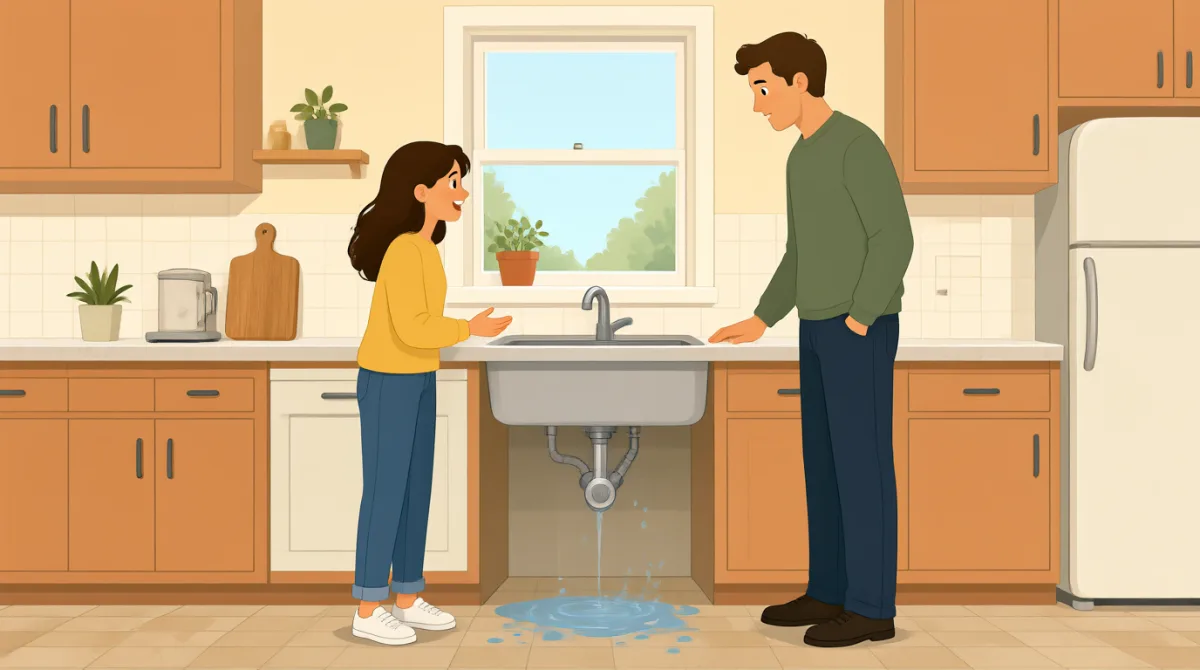

Hi, Jack. I found water under the kitchen sink this morning.
嗨,Jack。我今天早上发现厨房水槽下面有水。

Oh no. Is there a lot of water on the floor?
哎呀。地板上有很多水吗?
Not a lot, but the cabinet is wet. I put a towel down.
不算多,但橱柜湿了。我放了一条毛巾在下面。
Thanks. Did you see where the water was coming from?
谢谢。你看到水是从哪里漏出来的吗?
I think it’s coming from a pipe under the sink. It’s dripping slowly.
我觉得水是从水槽下面的一根管子漏出来的。水滴得很慢。
Okay. Please don’t use the sink for now. I’ll call a plumber.
好。现在先别用水槽。我会打电话找水管工。
Should I turn off the water? I’m not sure which handle to use.
我需要把水关掉吗?我不确定该拧哪个阀门。
Yes, turn off the small valve under the sink. I’ll check on you soon.
要,把水槽下面的小阀门关上。我很快会再联系你。
词汇8
- under the kitchen sink厨房水槽下面
This means in the space below the kitchen sink, often inside a cabinet. Use it to say where you found something.
这个短语指厨房水槽下方的空间,通常是在橱柜里面。可以用它来说明你在哪里发现了某样东西。
- a lot of water很多水
This means a large amount of water. You can use “a lot of” with many things, such as “a lot of food” or “a lot of rain.”
这个短语表示大量的水。你也可以用“a lot of”来描述很多其他东西,比如“a lot of food”(很多食物)或“a lot of rain”(很多雨水)。
- put a towel down铺了一条毛巾
This means placed a towel on the floor to soak up water. Use “put [something] down” to say you placed it on a surface.
这个短语表示把毛巾放在地上吸水。用“put [something] down”可以表示把某样东西放在一个表面上。
- coming from来自
Here, this asks about the place where the water starts. You can also ask where a sound or smell is coming from.
这里是在问水是从哪里开始漏出来的。你也可以问声音或气味是从哪里传来的。
- dripping slowly慢慢滴漏
This means water is falling in small drops at a slow rate. Use it to describe a small, steady leak.
这个短语表示水正缓慢地一滴一滴往下落。可以用它来描述少量而持续的漏水。
- for now暂时
This means for the present time, but perhaps not later. You can use it when giving a temporary instruction.
这个短语表示目前这段时间,不过之后情况可能会改变。给出临时指示时可以用它。
- turn off关掉
This means to stop the flow of water by moving a valve or handle. You can also use “turn off” for lights and machines.
这个短语表示通过转动阀门或把手来停止水流。“turn off”也可以用来表示关灯或关闭机器。
- check on you过会儿联系你,看看你这边怎么样
This means to contact or visit you later to see if you are okay. Use it when you plan to make sure someone is all right.
这个短语表示稍后联系或去看你,确认你是否安好。计划确认某人没事时可以用它。
重点句子8
- 1
I found water under the kitchen sink this morning.
今天早上我发现厨房水槽下面有水。
This is a clear way to explain what you discovered and when. You can reuse the pattern “I found [something] [place/time].”
这是清楚说明你发现了什么以及何时发现的说法。你可以套用“I found [something] [place/time].”这个句型。
- 2
Is there a lot of water on the floor?
地板上有很多水吗?
This is a useful question for finding out how serious a problem is. You can replace “water” with another thing, such as “dirt” or “food.”
这是了解问题有多严重的实用问法。你可以把“water”换成其他东西,比如“dirt”或“food”。
- 3
I put a towel down.
我铺了一条毛巾。
This tells someone what you did to deal with the water. You can use “I put [something] down” to describe placing an item on a surface.
这句话告诉对方你采取了什么措施来处理漏水。你可以用“I put [something] down”来描述把某样东西放在一个表面上。
- 4
I think it’s coming from a pipe under the sink.
我觉得水是从水槽下面的一根管子漏出来的。
Use this sentence to explain where you believe a problem starts. “I think it’s coming from…” is useful when you are not completely sure.
当你想说明自己认为问题是从哪里开始的,可以用这句话。“I think it’s coming from…”适合在你不太确定时使用。
- 5
Please don’t use the sink for now.
暂时请不要用水槽。
This is a polite way to give someone a temporary instruction. You can replace “the sink” with another object or place.
这是一种礼貌地提出临时要求的说法。你可以把“the sink”换成其他物品或地点。
- 6
I’ll call a plumber.
我会打电话找水管工。
This is a simple way to say what you plan to do. Use “I’ll call…” to talk about a future action.
这是简单说明自己打算做什么的说法。用“I’ll call…”来谈论将来要做的事。
- 7
Should I turn off the water?
我需要把水关掉吗?
This is a useful way to ask if you need to do something. You can reuse “Should I [action]?” when asking for advice.
这是询问自己是否需要做某事的实用问法。征求建议时可以套用“Should I [action]?”。
- 8
I’m not sure which handle to use.
我不确定该拧哪个把手。
Use this when you do not know which item or option is correct. You can replace “handle” with another thing, such as “key” or “button.”
不知道该选哪个东西或选项时,可以用这句话。你可以把“handle”换成其他东西,比如“key”或“button”。