Finding Water Under the Sink
싱크대 아래에서 발견한 물
Emma finds water under her kitchen sink and calls her landlord, Jack, to explain what happened. They talk about where the leak is coming from.
에마는 부엌 싱크대 아래에 물이 고인 것을 발견하고 집주인 잭에게 전화해 무슨 일이 있었는지 설명합니다. 두 사람은 물이 어디서 새는지 이야기합니다.
대화8
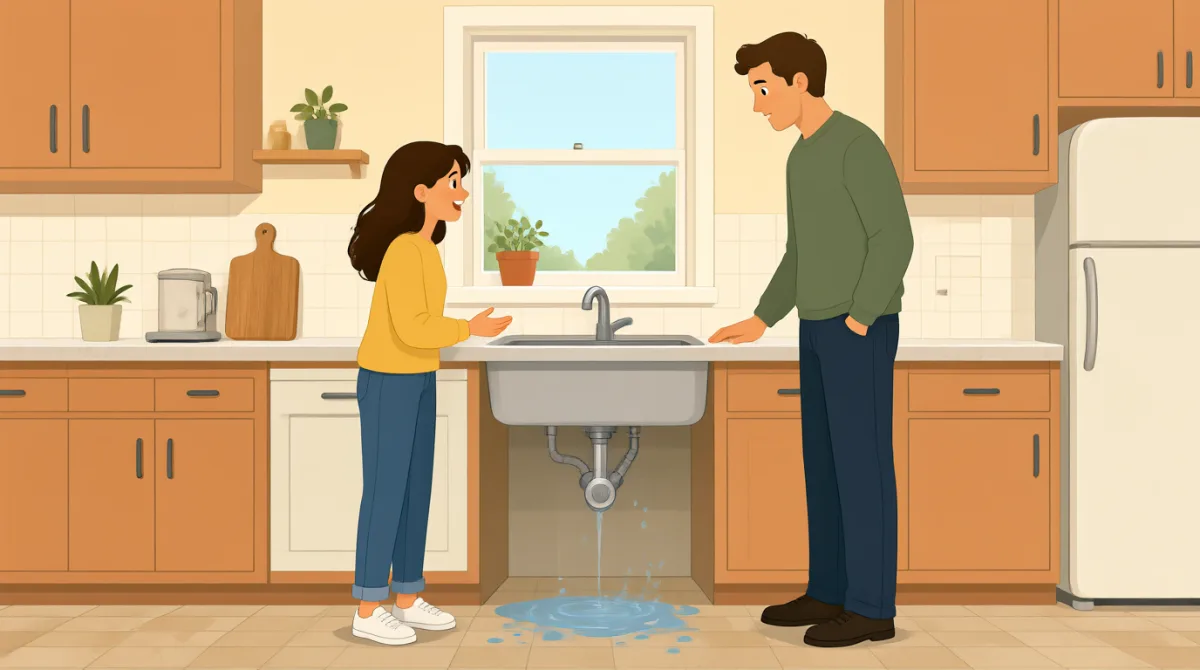

Hi, Jack. I found water under the kitchen sink this morning.
안녕하세요, 잭. 오늘 아침에 부엌 싱크대 아래에 물이 있는 걸 발견했어요.

Oh no. Is there a lot of water on the floor?
아이고. 바닥에 물이 많이 고였어요?
Not a lot, but the cabinet is wet. I put a towel down.
많지는 않은데, 수납장이 젖었어요. 수건을 깔아 뒀어요.
Thanks. Did you see where the water was coming from?
고마워요. 물이 어디서 나오는지 봤어요?
I think it’s coming from a pipe under the sink. It’s dripping slowly.
싱크대 아래 파이프에서 새는 것 같아요. 천천히 한 방울씩 떨어지고 있어요.
Okay. Please don’t use the sink for now. I’ll call a plumber.
알겠어요. 일단 싱크대는 사용하지 마세요. 배관공을 부를게요.
Should I turn off the water? I’m not sure which handle to use.
물을 잠가야 할까요? 어느 손잡이를 돌려야 하는지 잘 모르겠어요.
Yes, turn off the small valve under the sink. I’ll check on you soon.
네, 싱크대 아래에 있는 작은 밸브를 잠그세요. 제가 곧 확인하러 연락할게요.
어휘8
- under the kitchen sink부엌 싱크대 아래
This means in the space below the kitchen sink, often inside a cabinet. Use it to say where you found something.
부엌 싱크대 아래쪽 공간을 말해요. 보통 수납장 안쪽을 가리켜요. 무언가를 어디서 발견했는지 말할 때 쓸 수 있어요.
- a lot of water많은 양의 물
This means a large amount of water. You can use “a lot of” with many things, such as “a lot of food” or “a lot of rain.”
물의 양이 많다는 뜻이에요. “a lot of”는 “a lot of food”나 “a lot of rain”처럼 여러 가지와 함께 쓸 수 있어요.
- put a towel down수건을 깔아 두다
This means placed a towel on the floor to soak up water. Use “put [something] down” to say you placed it on a surface.
물을 흡수하도록 바닥에 수건을 놓았다는 뜻이에요. “put [something] down”은 무언가를 어떤 표면에 놓았다고 말할 때 써요.
- coming from~에서 나오다
Here, this asks about the place where the water starts. You can also ask where a sound or smell is coming from.
여기서는 물이 시작되는 곳이 어디인지 묻는 표현이에요. 소리나 냄새가 어디서 나는지 물을 때도 쓸 수 있어요.
- dripping slowly천천히 한 방울씩 떨어지다
This means water is falling in small drops at a slow rate. Use it to describe a small, steady leak.
물이 느린 속도로 작은 방울씩 떨어진다는 뜻이에요. 조금씩 계속 새는 상황을 묘사할 때 쓸 수 있어요.
- for now일단, 당분간
This means for the present time, but perhaps not later. You can use it when giving a temporary instruction.
지금은 그렇지만 나중에는 달라질 수도 있다는 뜻이에요. 임시로 지시할 때 쓸 수 있어요.
- turn off잠그다, 끄다
This means to stop the flow of water by moving a valve or handle. You can also use “turn off” for lights and machines.
밸브나 손잡이를 움직여 물의 흐름을 멈추게 한다는 뜻이에요. 조명이나 기계를 끌 때도 “turn off”를 쓸 수 있어요.
- check on you안부를 확인하다
This means to contact or visit you later to see if you are okay. Use it when you plan to make sure someone is all right.
나중에 연락하거나 찾아가서 상대방이 괜찮은지 확인한다는 뜻이에요. 누군가의 상태를 확인할 계획이라고 말할 때 써요.
핵심 문장8
- 1
I found water under the kitchen sink this morning.
오늘 아침에 부엌 싱크대 아래에 물이 있는 걸 발견했어요.
This is a clear way to explain what you discovered and when. You can reuse the pattern “I found [something] [place/time].”
무엇을 언제 발견했는지 분명하게 설명하는 표현이에요. “I found [something] [place/time].”이라는 패턴을 활용해 보세요.
- 2
Is there a lot of water on the floor?
바닥에 물이 많이 고였어요?
This is a useful question for finding out how serious a problem is. You can replace “water” with another thing, such as “dirt” or “food.”
문제가 얼마나 심각한지 알아볼 때 유용한 질문이에요. “water” 대신 “dirt”나 “food”처럼 다른 것을 넣어 물어볼 수도 있어요.
- 3
I put a towel down.
수건을 깔아 뒀어요.
This tells someone what you did to deal with the water. You can use “I put [something] down” to describe placing an item on a surface.
물이 있는 상황에 대처하려고 무엇을 했는지 알려 주는 표현이에요. 물건을 어떤 표면에 놓았다고 말할 때 “I put [something] down”을 쓸 수 있어요.
- 4
I think it’s coming from a pipe under the sink.
싱크대 아래 파이프에서 새는 것 같아요.
Use this sentence to explain where you believe a problem starts. “I think it’s coming from…” is useful when you are not completely sure.
문제가 어디서 시작된 것 같은지 설명할 때 쓰는 문장이에요. 확실하지 않을 때는 “I think it’s coming from…”이라고 말하면 좋아요.
- 5
Please don’t use the sink for now.
일단 싱크대는 사용하지 마세요.
This is a polite way to give someone a temporary instruction. You can replace “the sink” with another object or place.
상대방에게 임시로 어떤 일을 하지 말라고 정중하게 말하는 표현이에요. “the sink” 대신 다른 물건이나 장소를 넣어도 돼요.
- 6
I’ll call a plumber.
배관공을 부를게요.
This is a simple way to say what you plan to do. Use “I’ll call…” to talk about a future action.
앞으로 무엇을 할 계획인지 간단히 말하는 표현이에요. 미래에 할 일을 말할 때 “I’ll call…”을 쓸 수 있어요.
- 7
Should I turn off the water?
물을 잠가야 할까요?
This is a useful way to ask if you need to do something. You can reuse “Should I [action]?” when asking for advice.
무언가를 해야 하는지 물어볼 때 유용한 표현이에요. 조언을 구할 때 “Should I [action]?” 패턴을 활용해 보세요.
- 8
I’m not sure which handle to use.
어느 손잡이를 써야 할지 잘 모르겠어요.
Use this when you do not know which item or option is correct. You can replace “handle” with another thing, such as “key” or “button.”
어느 물건이나 선택지가 맞는지 모를 때 쓰는 표현이에요. “handle” 대신 “key”나 “button” 같은 말을 넣을 수 있어요.