Asking About the Last Ferry Back
Perguntando sobre a última balsa de volta
Before boarding, Emma asks when the last ferry back leaves. Jack helps her check the return time.
Antes de embarcar, Emma pergunta a que horas sai a última balsa de volta. Jack a ajuda a conferir o horário de retorno.
Diálogo8
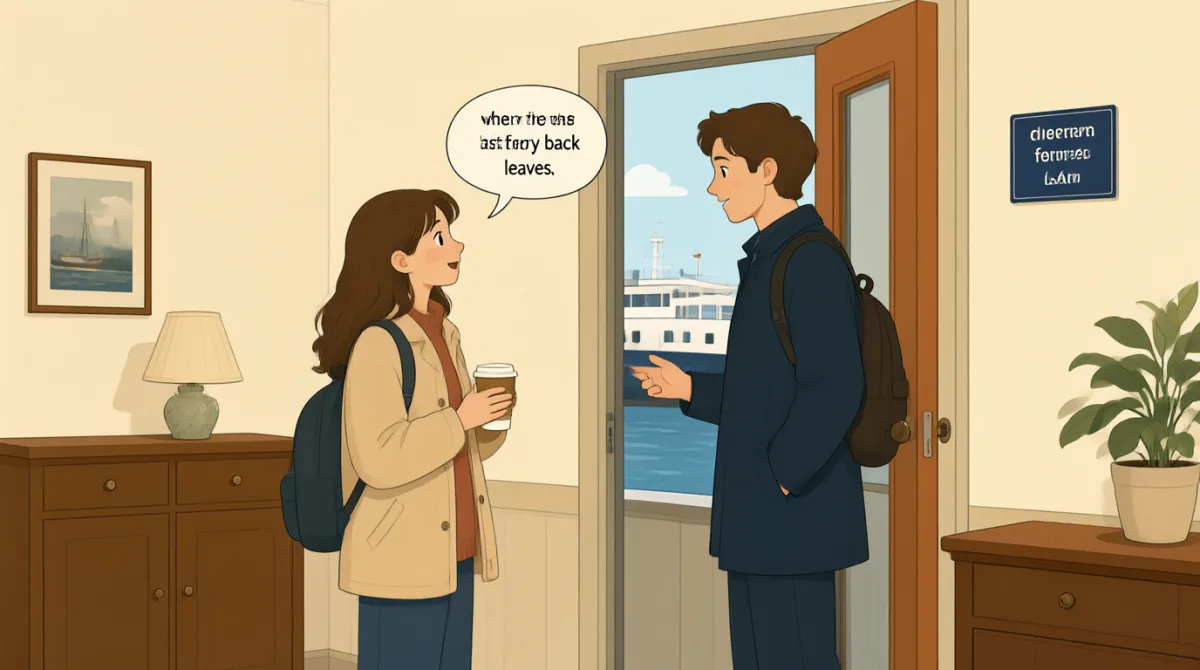

Before we get on, what time is the last ferry back to the mainland?
Antes de embarcarmos, a que horas sai a última balsa de volta para o continente?

Let me check the schedule. I think it leaves around six.
Deixa eu conferir os horários. Acho que sai por volta das seis.
Could we miss it if we stay for dinner?
Será que a gente perde a balsa se ficar para jantar?
The schedule says the last ferry leaves at six thirty.
O horário diz que a última balsa sai às seis e meia.
Good. How early should we get back to the dock?
Que bom. Quanto tempo antes a gente deve voltar para o cais?
Let's get there by six. The line can get long.
Vamos chegar lá até as seis. A fila pode ficar grande.
I'll set an alarm so we don't lose track of time.
Vou colocar um alarme para a gente não perder a noção do tempo.
Good idea. Let's take a photo of the schedule, too.
Boa ideia. Vamos tirar uma foto dos horários também.
Vocabulário8
- get onembarcar
To get on a ferry means to board it. You can also use this phrase for buses and trains.
“Get on” significa embarcar numa balsa. Você também pode usar essa expressão para ônibus e trens.
- the last ferry backa última balsa de volta
This means the final ferry that returns to the place you started from. You can say, “What time is the last bus back?”
Essa expressão se refere à última balsa que retorna ao lugar de onde você saiu. Você também pode dizer: “What time is the last bus back?” (A que horas sai o último ônibus de volta?).
- mainlandcontinente
The mainland is the large main area of land, not an island. Here, it is where Emma and Jack are returning.
“Mainland” é a parte principal e extensa de terra firme, não uma ilha. Aqui, é para lá que Emma e Jack vão voltar.
- schedulehorário
A schedule shows the times when ferries leave. You can check a schedule to plan a trip.
Um “schedule” mostra os horários de saída das balsas. Você pode consultar um horário para planejar uma viagem.
- get back tovoltar para
To get back to a place means to return there. You can say, “We should get back to the hotel by five.”
“Get back to” significa voltar a um lugar. Você pode dizer: “We should get back to the hotel by five.” (A gente deve voltar para o hotel até as cinco.).
- the line can get longa fila pode ficar grande
This means many people may be waiting in line. “Can” describes something that may happen.
Isso significa que pode haver muita gente esperando na fila. “Can” indica algo que pode acontecer.
- set an alarmcolocar um alarme
To set an alarm means to arrange for a phone or clock to make a sound at a certain time. It can help you remember when to do something.
“Set an alarm” significa programar um celular ou relógio para tocar em determinado horário. Isso pode ajudar você a se lembrar de quando precisa fazer alguma coisa.
- lose track of timeperder a noção do tempo
To lose track of time means to stop noticing how much time has passed. You might do this when you are having fun.
“Lose track of time” significa deixar de perceber quanto tempo passou. Isso pode acontecer quando você está se divertindo.
Frases-chave7
- 1
Before we get on, what time is the last ferry back to the mainland?
Antes de embarcarmos, a que horas sai a última balsa de volta para o continente?
Use this to ask when the final ferry returns. You can replace “ferry” with another kind of transport, such as “bus” or “train.”
Use essa frase para perguntar a que horas volta a última balsa. Você pode trocar “ferry” por outro meio de transporte, como “bus” ou “train”.
- 2
Let me check the schedule.
Deixa eu conferir os horários.
This is a useful way to say you will look up information before answering. You can use it when checking a timetable or appointment.
Essa é uma forma útil de dizer que você vai consultar uma informação antes de responder. Você pode usá-la ao conferir um horário ou um compromisso.
- 3
Could we miss it if we stay for dinner?
Será que a gente perde a balsa se ficar para jantar?
Use “Could we… if…?” to ask whether a possible choice may cause a problem. You can change the activity, for example, “Could we miss it if we stop for coffee?”
Use “Could we… if…?” para perguntar se uma escolha possível pode causar algum problema. Você pode mudar a atividade, por exemplo: “Could we miss it if we stop for coffee?” (Será que a gente perde a balsa se parar para tomar um café?).
- 4
How early should we get back to the dock?
Quanto tempo antes a gente deve voltar para o cais?
This asks how much time to allow before the ferry leaves. You can use “How early should we get back to…?” with other places, like a station or airport.
Essa pergunta é sobre quanto tempo antes da partida da balsa vocês devem chegar. Você pode usar “How early should we get back to…?” com outros lugares, como uma estação ou um aeroporto.
- 5
Let's get there by six.
Vamos chegar lá até as seis.
Use “Let’s” to suggest doing something together, and “by six” means no later than six. You can change the time to make a plan.
Use “Let’s” para sugerir que vocês façam algo juntos. “By six” quer dizer até as seis, no máximo. Você pode mudar o horário para combinar um plano.
- 6
I'll set an alarm so we don't lose track of time.
Vou colocar um alarme para a gente não perder a noção do tempo.
This explains a plan and its purpose: “so” connects the action to the result you want. You can use it to talk about setting a reminder for any important event.
Essa frase explica um plano e o objetivo dele: “so” liga a ação ao resultado que você deseja. Você pode usar essa estrutura para falar de um lembrete para qualquer acontecimento importante.
- 7
Let's take a photo of the schedule, too.
Vamos tirar uma foto dos horários também.
Use this sentence to suggest taking a picture for later. “Too” means you want to do this in addition to something else.
Use essa frase para sugerir tirar uma foto e consultá-la mais tarde. “Too” significa que você quer fazer isso além de outra coisa.