Asking About the Last Ferry Back
Nach der letzten Fähre zurück fragen
Before boarding, Emma asks when the last ferry back leaves. Jack helps her check the return time.
Bevor sie an Bord gehen, fragt Emma, wann die letzte Fähre zurückfährt. Jack hilft ihr, die Rückfahrtzeit zu überprüfen.
Dialog8
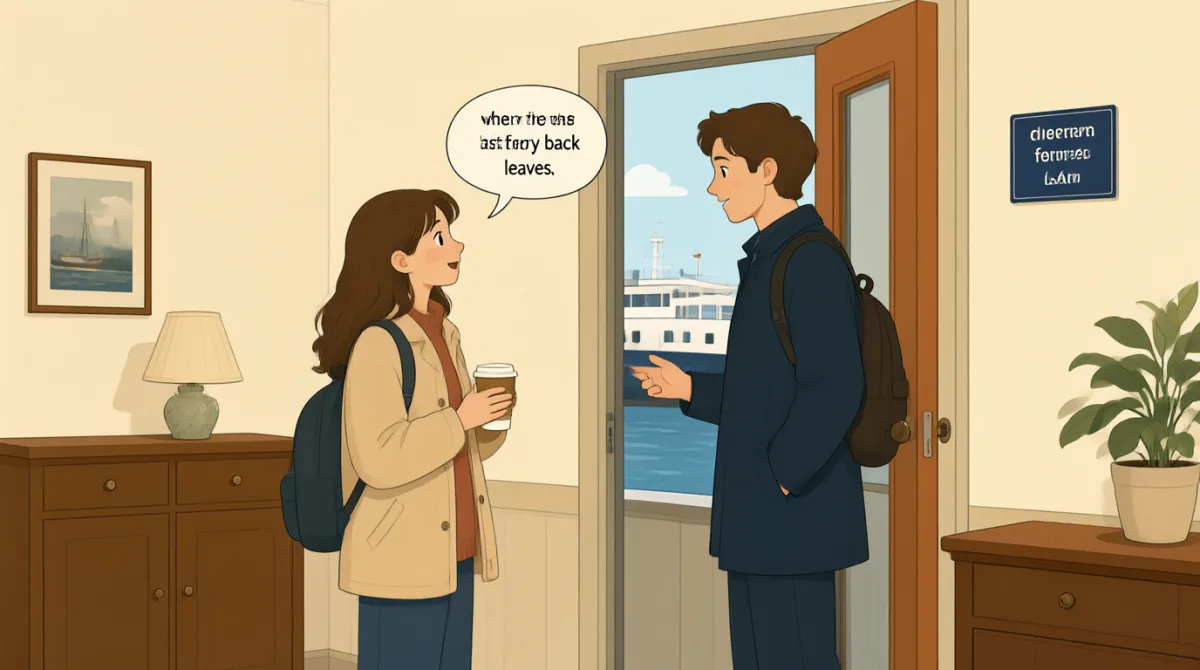

Before we get on, what time is the last ferry back to the mainland?
Bevor wir an Bord gehen: Wann fährt die letzte Fähre zurück zum Festland?

Let me check the schedule. I think it leaves around six.
Ich sehe mal im Fahrplan nach. Ich glaube, sie fährt gegen sechs.
Could we miss it if we stay for dinner?
Könnten wir sie verpassen, wenn wir zum Abendessen bleiben?
The schedule says the last ferry leaves at six thirty.
Laut Fahrplan fährt die letzte Fähre um halb sieben.
Good. How early should we get back to the dock?
Gut. Wie früh sollten wir wieder am Anleger sein?
Let's get there by six. The line can get long.
Lass uns bis sechs dort sein. Die Schlange kann lang werden.
I'll set an alarm so we don't lose track of time.
Ich stelle einen Wecker, damit wir die Zeit nicht aus den Augen verlieren.
Good idea. Let's take a photo of the schedule, too.
Gute Idee. Lass uns auch ein Foto vom Fahrplan machen.
Wortschatz8
- get onan Bord gehen
To get on a ferry means to board it. You can also use this phrase for buses and trains.
“Get on” heißt, an Bord einer Fähre zu gehen. Du kannst den Ausdruck auch für Busse und Züge verwenden.
- the last ferry backdie letzte Fähre zurück
This means the final ferry that returns to the place you started from. You can say, “What time is the last bus back?”
Damit ist die letzte Fähre gemeint, die dich zu dem Ort zurückbringt, von dem du gestartet bist. Du kannst auch sagen: “What time is the last bus back?” (Wann fährt der letzte Bus zurück?)
- mainlanddas Festland
The mainland is the large main area of land, not an island. Here, it is where Emma and Jack are returning.
Das Festland ist das große zusammenhängende Land und keine Insel. Hier kehren Emma und Jack dorthin zurück.
- scheduleder Fahrplan
A schedule shows the times when ferries leave. You can check a schedule to plan a trip.
In einem Fahrplan stehen die Abfahrtszeiten der Fähren. Du kannst darin nachsehen, wenn du eine Fahrt planst.
- get back tozurückkommen nach
To get back to a place means to return there. You can say, “We should get back to the hotel by five.”
“Get back to” bedeutet, an einen Ort zurückzukehren. Du kannst zum Beispiel sagen: “We should get back to the hotel by five.” (Wir sollten bis fünf wieder im Hotel sein.)
- the line can get longdie Schlange kann lang werden
This means many people may be waiting in line. “Can” describes something that may happen.
Das bedeutet, dass viele Leute anstehen könnten. “Can” beschreibt etwas, das passieren kann.
- set an alarmeinen Wecker stellen
To set an alarm means to arrange for a phone or clock to make a sound at a certain time. It can help you remember when to do something.
“Set an alarm” bedeutet, das Handy oder den Wecker so einzustellen, dass er zu einer bestimmten Zeit klingelt. Das kann dir helfen, daran zu denken, etwas zu tun.
- lose track of timedas Zeitgefühl verlieren
To lose track of time means to stop noticing how much time has passed. You might do this when you are having fun.
“Lose track of time” bedeutet, nicht mehr darauf zu achten, wie viel Zeit vergangen ist. Das kann passieren, wenn du Spaß hast.
Wichtige Sätze7
- 1
Before we get on, what time is the last ferry back to the mainland?
Bevor wir an Bord gehen: Wann fährt die letzte Fähre zurück zum Festland?
Use this to ask when the final ferry returns. You can replace “ferry” with another kind of transport, such as “bus” or “train.”
Mit diesem Satz fragst du, wann die letzte Fähre zurückfährt. Du kannst “ferry” durch ein anderes Verkehrsmittel ersetzen, zum Beispiel durch “bus” oder “train”.
- 2
Let me check the schedule.
Ich sehe mal im Fahrplan nach.
This is a useful way to say you will look up information before answering. You can use it when checking a timetable or appointment.
So sagst du, dass du etwas nachschlägst, bevor du antwortest. Das passt zum Beispiel, wenn du einen Fahrplan oder einen Termin überprüfst.
- 3
Could we miss it if we stay for dinner?
Könnten wir sie verpassen, wenn wir zum Abendessen bleiben?
Use “Could we… if…?” to ask whether a possible choice may cause a problem. You can change the activity, for example, “Could we miss it if we stop for coffee?”
Mit “Could we… if…?” fragst du, ob eine mögliche Entscheidung zu einem Problem führen könnte. Du kannst die Aktivität austauschen, zum Beispiel: “Could we miss it if we stop for coffee?” (Könnten wir sie verpassen, wenn wir für einen Kaffee anhalten?)
- 4
How early should we get back to the dock?
Wie früh sollten wir wieder am Anleger sein?
This asks how much time to allow before the ferry leaves. You can use “How early should we get back to…?” with other places, like a station or airport.
Damit fragst du, wie viel Zeit vor der Abfahrt der Fähre eingeplant werden sollte. Du kannst “How early should we get back to…?” auch für andere Orte verwenden, etwa einen Bahnhof oder Flughafen.
- 5
Let's get there by six.
Lass uns bis sechs dort sein.
Use “Let’s” to suggest doing something together, and “by six” means no later than six. You can change the time to make a plan.
Mit “Let’s” schlägst du vor, etwas gemeinsam zu tun. “By six” heißt spätestens um sechs. Du kannst die Uhrzeit ändern, um einen anderen Plan vorzuschlagen.
- 6
I'll set an alarm so we don't lose track of time.
Ich stelle einen Wecker, damit wir die Zeit nicht aus den Augen verlieren.
This explains a plan and its purpose: “so” connects the action to the result you want. You can use it to talk about setting a reminder for any important event.
Der Satz erklärt einen Plan und seinen Zweck: “so” verbindet die Handlung mit dem gewünschten Ergebnis. Du kannst das auch sagen, wenn du für ein wichtiges Ereignis eine Erinnerung einstellen möchtest.
- 7
Let's take a photo of the schedule, too.
Lass uns auch ein Foto vom Fahrplan machen.
Use this sentence to suggest taking a picture for later. “Too” means you want to do this in addition to something else.
Mit diesem Satz schlägst du vor, ein Foto zu machen, damit ihr später darauf zurückgreifen könnt. “Too” bedeutet, dass du das zusätzlich zu etwas anderem tun möchtest.