Asking About the Last Ferry Back
Preguntar por el último ferry de vuelta
Before boarding, Emma asks when the last ferry back leaves. Jack helps her check the return time.
Antes de subir, Emma pregunta a qué hora sale el último ferry de vuelta. Jack la ayuda a consultar el horario.
Diálogo8
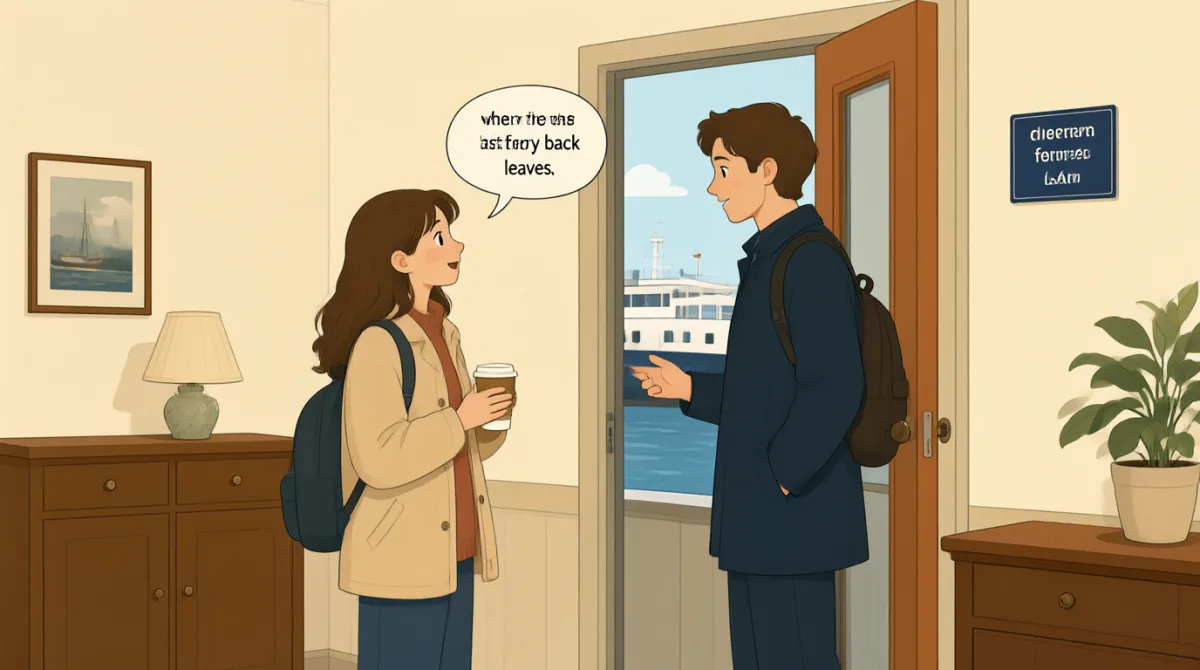

Before we get on, what time is the last ferry back to the mainland?
Antes de subir, ¿a qué hora sale el último ferry de vuelta al continente?

Let me check the schedule. I think it leaves around six.
Déjame consultar el horario. Creo que sale sobre las seis.
Could we miss it if we stay for dinner?
¿Podríamos perderlo si nos quedamos a cenar?
The schedule says the last ferry leaves at six thirty.
El horario dice que el último ferry sale a las seis y media.
Good. How early should we get back to the dock?
Bien. ¿Con cuánta antelación deberíamos volver al muelle?
Let's get there by six. The line can get long.
Vamos a llegar para las seis. Puede que haya mucha cola.
I'll set an alarm so we don't lose track of time.
Pondré una alarma para que no perdamos la noción del tiempo.
Good idea. Let's take a photo of the schedule, too.
Buena idea. Saquémosle una foto al horario también.
Vocabulario8
- get onsubir
To get on a ferry means to board it. You can also use this phrase for buses and trains.
"Get on" significa subir a un ferry. También puedes usar esta expresión para autobuses y trenes.
- the last ferry backel último ferry de vuelta
This means the final ferry that returns to the place you started from. You can say, “What time is the last bus back?”
Se refiere al último ferry que regresa al lugar desde donde saliste. Puedes decir: “What time is the last bus back?” (¿A qué hora sale el último autobús de vuelta?).
- mainlandcontinente
The mainland is the large main area of land, not an island. Here, it is where Emma and Jack are returning.
El "mainland" es la gran extensión principal de tierra, no una isla. En este caso, es adonde regresan Emma y Jack.
- schedulehorario
A schedule shows the times when ferries leave. You can check a schedule to plan a trip.
Un "schedule" muestra las horas a las que salen los ferries. Puedes consultar el horario para planear un viaje.
- get back tovolver a
To get back to a place means to return there. You can say, “We should get back to the hotel by five.”
"Get back to" significa regresar a un lugar. Puedes decir: “We should get back to the hotel by five.” (Deberíamos volver al hotel para las cinco).
- the line can get longpuede que haya mucha cola
This means many people may be waiting in line. “Can” describes something that may happen.
Significa que puede haber mucha gente esperando en una fila. “Can” expresa algo que podría ocurrir.
- set an alarmponer una alarma
To set an alarm means to arrange for a phone or clock to make a sound at a certain time. It can help you remember when to do something.
"Set an alarm" significa programar un teléfono o un reloj para que suene a una hora determinada. Puede ayudarte a recordar cuándo tienes que hacer algo.
- lose track of timeperder la noción del tiempo
To lose track of time means to stop noticing how much time has passed. You might do this when you are having fun.
"Lose track of time" significa dejar de darse cuenta de cuánto tiempo ha pasado. Puede ocurrirte cuando te estás divirtiendo.
Frases clave7
- 1
Before we get on, what time is the last ferry back to the mainland?
Antes de subir, ¿a qué hora sale el último ferry de vuelta al continente?
Use this to ask when the final ferry returns. You can replace “ferry” with another kind of transport, such as “bus” or “train.”
Usa esta frase para preguntar cuándo regresa el último ferry. Puedes cambiar “ferry” por otro medio de transporte, como “bus” o “train”.
- 2
Let me check the schedule.
Déjame consultar el horario.
This is a useful way to say you will look up information before answering. You can use it when checking a timetable or appointment.
Esta es una forma práctica de decir que vas a buscar información antes de responder. Puedes usarla al consultar un horario o una cita.
- 3
Could we miss it if we stay for dinner?
¿Podríamos perderlo si nos quedamos a cenar?
Use “Could we… if…?” to ask whether a possible choice may cause a problem. You can change the activity, for example, “Could we miss it if we stop for coffee?”
Usa “Could we… if…?” para preguntar si una decisión posible podría causar un problema. Puedes cambiar la actividad, por ejemplo: “Could we miss it if we stop for coffee?” (¿Podríamos perderlo si paramos a tomar un café?).
- 4
How early should we get back to the dock?
¿Con cuánta antelación deberíamos volver al muelle?
This asks how much time to allow before the ferry leaves. You can use “How early should we get back to…?” with other places, like a station or airport.
Esta pregunta sirve para saber cuánto tiempo antes de la salida del ferry conviene regresar. Puedes usar “How early should we get back to…?” con otros lugares, como una estación o un aeropuerto.
- 5
Let's get there by six.
Vamos a llegar para las seis.
Use “Let’s” to suggest doing something together, and “by six” means no later than six. You can change the time to make a plan.
Usa “Let’s” para proponer hacer algo juntos. “By six” significa como muy tarde a las seis. Puedes cambiar la hora para hacer un plan.
- 6
I'll set an alarm so we don't lose track of time.
Pondré una alarma para que no perdamos la noción del tiempo.
This explains a plan and its purpose: “so” connects the action to the result you want. You can use it to talk about setting a reminder for any important event.
Esta frase explica un plan y su propósito: “so” conecta la acción con el resultado que quieres. Puedes usarla para hablar de poner un recordatorio para cualquier evento importante.
- 7
Let's take a photo of the schedule, too.
Saquémosle una foto al horario también.
Use this sentence to suggest taking a picture for later. “Too” means you want to do this in addition to something else.
Usa esta frase para proponer sacar una foto y consultarla más tarde. “Too” significa que quieres hacer esto además de otra cosa.