Finding Seats Outside
Encontrando lugares para sentar ao ar livre
On the ferry, Emma and Jack look for seats outside. They find a place to sit and enjoy the view.
Na balsa, Emma e Jack procuram lugares para sentar ao ar livre. Eles encontram um lugar e aproveitam a vista.
Diálogo8
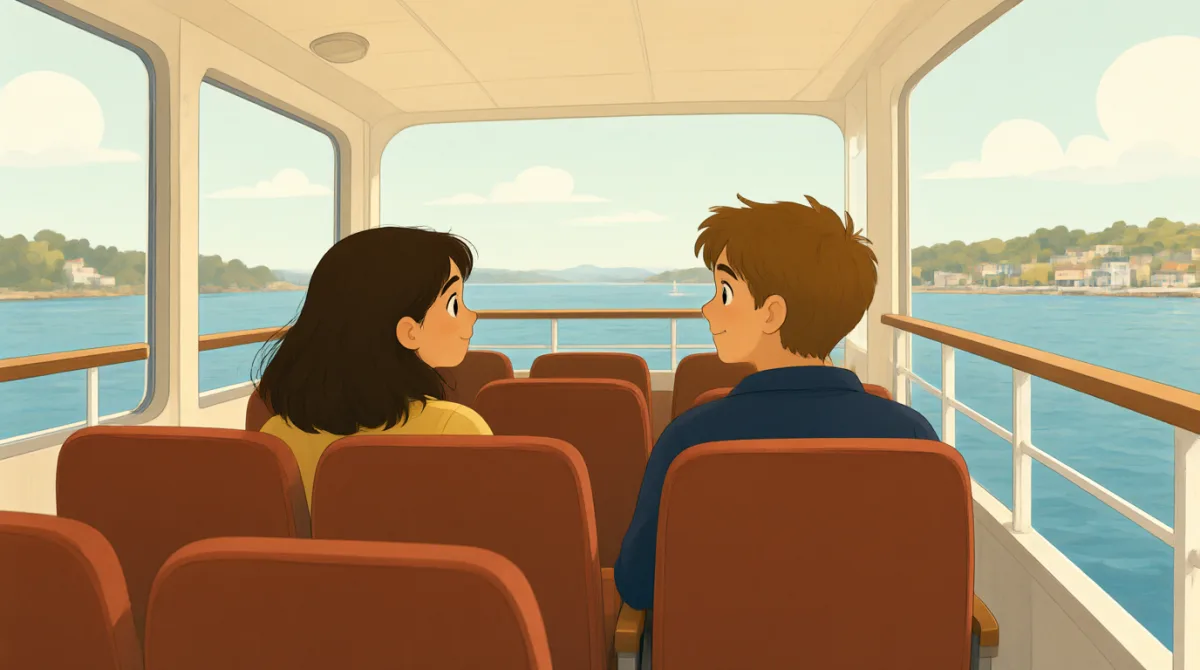

Is there a place to sit outside? I’d love to see the view.
Tem algum lugar para sentar lá fora? Adoraria ver a paisagem.

I think there are seats on the upper deck. Let’s go up.
Acho que tem lugares no convés superior. Vamos subir.
Are these seats free? I don’t see anyone here.
Esses lugares estão livres? Não vejo ninguém aqui.
They look free. Let’s sit here, near the rail.
Parece que sim. Vamos sentar aqui, perto da amurada.
Great! The water looks so blue today.
Que legal! A água está tão azul hoje.
Yeah, and we can see the island from here.
É, e daqui dá para ver a ilha.
I’m glad we came outside. It’s much nicer up here.
Ainda bem que viemos para fora. Aqui em cima é bem mais agradável.
Me too. Let’s enjoy the ride before we arrive.
Também acho. Vamos aproveitar o passeio antes de chegarmos.
Vocabulário8
- outsideao ar livre
In this conversation, outside means in the open air, not inside the ferry. You can ask, “Can we sit outside?”
Nesta conversa, “outside” significa ao ar livre, e não dentro da balsa. Você pode perguntar: “Can we sit outside?” (Podemos sentar ao ar livre?)
- the viewa vista
The view is what you can see around you, such as the sea and the island. Use “I’d love to see the view” to say you want to look at the scenery.
“The view” é aquilo que você consegue ver ao seu redor, como o mar e a ilha. Use “I’d love to see the view” para dizer que gostaria de apreciar a paisagem.
- upper deckconvés superior
The upper deck is the higher level of a boat or ferry. You can say, “Let’s go up to the upper deck.”
“Upper deck” é o nível mais alto de um barco ou de uma balsa. Você pode dizer: “Let’s go up to the upper deck.” (Vamos subir para o convés superior.)
- freelivre
Here, free means available for someone to use, not costing no money. You can ask, “Is this seat free?”
Aqui, “free” significa disponível para alguém usar, não que não custa nada. Você pode perguntar: “Is this seat free?” (Este lugar está livre?)
- near the railperto da amurada
Near the rail means close to the barrier along the edge of the deck. You can use this phrase to describe where you want to sit.
“Near the rail” significa perto da barreira que fica ao longo da borda do convés. Você pode usar essa expressão para dizer onde quer se sentar.
- the islanda ilha
An island is land with water all around it. In this dialogue, Emma and Jack can see the island from the ferry.
“An island” é uma porção de terra cercada por água. Neste diálogo, Emma e Jack conseguem ver a ilha da balsa.
- came outsideviemos para fora
“Came outside” means moved from inside to a place outdoors. You can say, “I’m glad we came outside” when you are happy you went outdoors.
“Came outside” significa sair de dentro de um lugar para ir ao ar livre. Você pode dizer “I’m glad we came outside” quando está feliz por ter saído.
- arrivechegar
To arrive means to reach a place. Use “before we arrive” to talk about what you can do before reaching your destination.
“To arrive” significa chegar a um lugar. Use “before we arrive” para falar do que você pode fazer antes de chegar ao seu destino.
Frases-chave7
- 1
Is there a place to sit outside?
Tem algum lugar para sentar ao ar livre?
Use this question to ask if there is somewhere to sit outdoors. You can replace “outside” with another place, such as “near the window.”
Use esta pergunta para saber se há algum lugar para sentar ao ar livre. Você pode substituir “outside” por outro lugar, como “near the window” (perto da janela).
- 2
I think there are seats on the upper deck.
Acho que tem lugares no convés superior.
This is a useful way to share information when you are not completely sure. You can replace “seats” or “on the upper deck” with other details.
Esta é uma maneira útil de compartilhar uma informação quando você não tem certeza absoluta. Você pode substituir “seats” ou “on the upper deck” por outros detalhes.
- 3
Are these seats free?
Esses lugares estão livres?
Use this question to check if seats are available. You can also ask, “Is this seat free?” when asking about one seat.
Use esta pergunta para saber se há lugares disponíveis. Você também pode perguntar “Is this seat free?” quando quiser saber sobre um único lugar.
- 4
Let’s sit here, near the rail.
Vamos sentar aqui, perto da amurada.
Use “Let’s” to suggest doing something together, and add a place to say where. For example, “Let’s sit here, near the window.”
Use “Let’s” para sugerir que vocês façam algo juntos e acrescente um lugar para dizer onde. Por exemplo: “Let’s sit here, near the window.” (Vamos sentar aqui, perto da janela.)
- 5
The water looks so blue today.
A água está tão azul hoje.
This sentence describes what you see and gives a simple opinion. You can change “blue” to another describing word, such as “calm.”
Esta frase descreve o que você está vendo e expressa uma opinião simples. Você pode trocar “blue” por outra palavra descritiva, como “calm” (calma).
- 6
I’m glad we came outside.
Ainda bem que viemos para fora.
Use this sentence to say you are happy about a choice you made. You can replace “came outside” with another activity, such as “took the ferry.”
Use esta frase para dizer que está feliz com uma escolha que fez. Você pode substituir “came outside” por outra atividade, como “took the ferry” (pegamos a balsa).
- 7
Let’s enjoy the ride before we arrive.
Vamos aproveitar o passeio antes de chegarmos.
This is a friendly suggestion to enjoy a journey before reaching your destination. You can replace “the ride” with “the trip.”
Esta é uma sugestão amigável para aproveitar a viagem antes de chegar ao destino. Você pode substituir “the ride” por “the trip” (a viagem).