Asking About the Last Ferry Back
Before boarding, Emma asks when the last ferry back leaves. Jack helps her check the return time.
Dialogue8
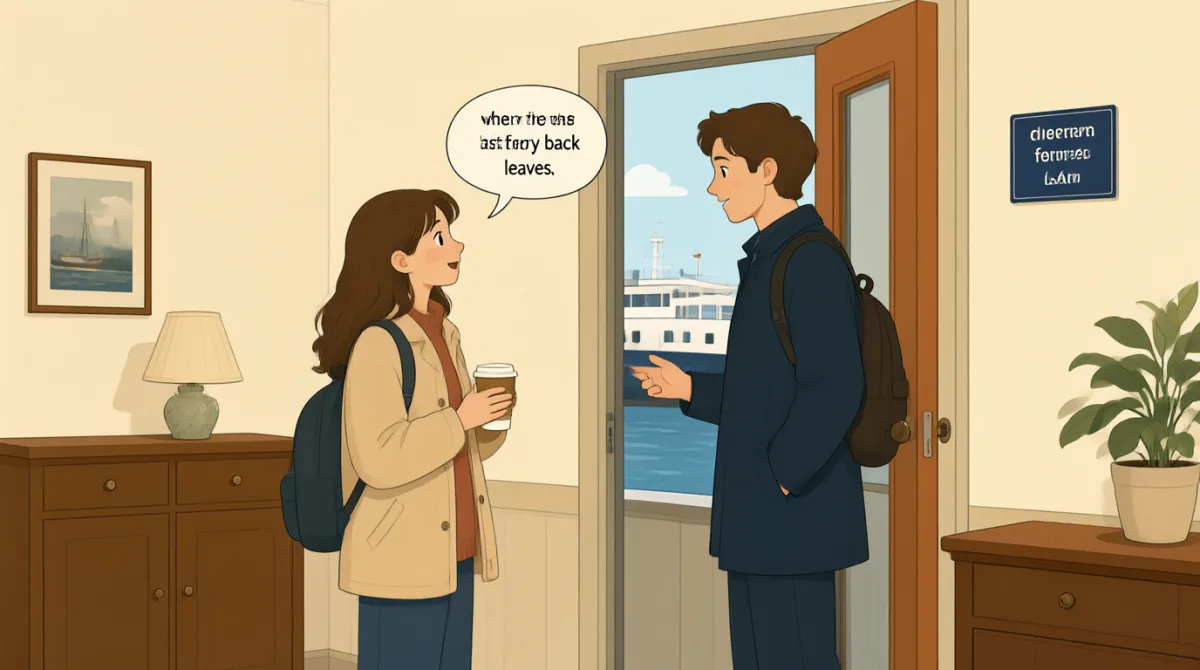

Before we get on, what time is the last ferry back to the mainland?

Let me check the schedule. I think it leaves around six.
Could we miss it if we stay for dinner?
The schedule says the last ferry leaves at six thirty.
Good. How early should we get back to the dock?
Let's get there by six. The line can get long.
I'll set an alarm so we don't lose track of time.
Good idea. Let's take a photo of the schedule, too.
Vocabulary8
- get on
To get on a ferry means to board it. You can also use this phrase for buses and trains.
- the last ferry back
This means the final ferry that returns to the place you started from. You can say, “What time is the last bus back?”
- mainland
The mainland is the large main area of land, not an island. Here, it is where Emma and Jack are returning.
- schedule
A schedule shows the times when ferries leave. You can check a schedule to plan a trip.
- get back to
To get back to a place means to return there. You can say, “We should get back to the hotel by five.”
- the line can get long
This means many people may be waiting in line. “Can” describes something that may happen.
- set an alarm
To set an alarm means to arrange for a phone or clock to make a sound at a certain time. It can help you remember when to do something.
- lose track of time
To lose track of time means to stop noticing how much time has passed. You might do this when you are having fun.
Key Sentences7
- 1
Before we get on, what time is the last ferry back to the mainland?
Use this to ask when the final ferry returns. You can replace “ferry” with another kind of transport, such as “bus” or “train.”
- 2
Let me check the schedule.
This is a useful way to say you will look up information before answering. You can use it when checking a timetable or appointment.
- 3
Could we miss it if we stay for dinner?
Use “Could we… if…?” to ask whether a possible choice may cause a problem. You can change the activity, for example, “Could we miss it if we stop for coffee?”
- 4
How early should we get back to the dock?
This asks how much time to allow before the ferry leaves. You can use “How early should we get back to…?” with other places, like a station or airport.
- 5
Let's get there by six.
Use “Let’s” to suggest doing something together, and “by six” means no later than six. You can change the time to make a plan.
- 6
I'll set an alarm so we don't lose track of time.
This explains a plan and its purpose: “so” connects the action to the result you want. You can use it to talk about setting a reminder for any important event.
- 7
Let's take a photo of the schedule, too.
Use this sentence to suggest taking a picture for later. “Too” means you want to do this in addition to something else.