Turning at the Corner
Fazendo a curva
Emma drives along a quiet street while David tells her when to slow down and signal. She asks when to turn the wheel and makes the turn safely.
Emma dirige por uma rua tranquila enquanto David diz quando ela deve reduzir a velocidade e dar a seta. Ela pergunta quando deve virar o volante e faz a curva com segurança.
Diálogo8
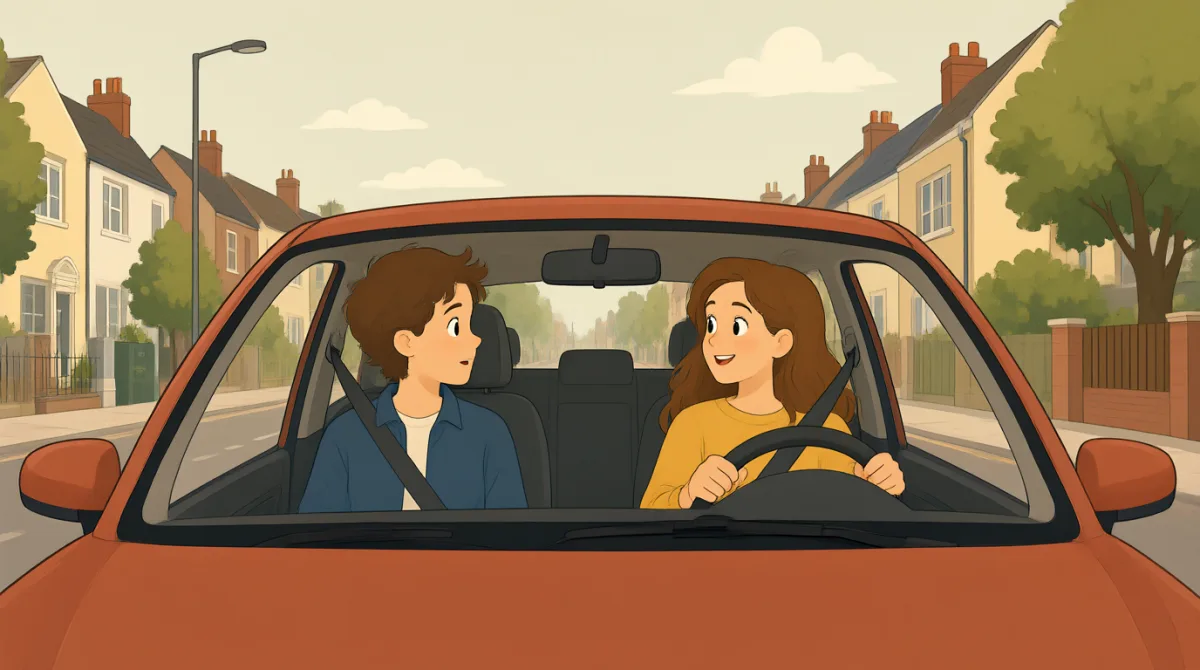

Keep going straight, Emma. There’s a corner coming up on your right.
Continue em frente, Emma. Tem uma esquina logo ali, à direita.

Should I slow down now, or wait until we get closer?
Devo reduzir a velocidade agora ou esperar até chegarmos mais perto?
Slow down now, and check the road ahead. No need to rush.
Reduza a velocidade agora e confira a rua à frente. Não precisa ter pressa.
I see the corner. Should I put on my signal now?
Estou vendo a esquina. Devo dar a seta agora?
Yes, signal right. Check your mirror, then look for people crossing.
Sim, dê a seta para a direita. Confira o retrovisor e depois veja se há pessoas atravessando.
The road looks clear. When should I turn the wheel?
A rua parece livre. Quando devo virar o volante?
Turn the wheel gently to the right as you reach the corner.
Vire o volante devagar para a direita quando chegar à esquina.
Okay, I’m turning now. I made it around safely!
Certo, estou virando agora. Consegui fazer a curva com segurança!
Vocabulário8
- keep going straightcontinue em frente
Continue driving forward without turning. You can use this phrase to give someone directions.
Continue dirigindo para a frente sem virar. Você pode usar essa expressão para dar uma orientação a alguém.
- coming uplogo ali
Something is approaching soon. Here, it means the corner is not far away.
Algo está se aproximando e vai acontecer em breve. Aqui, quer dizer que a esquina fica perto.
- slow downreduzir a velocidade
Drive more slowly. Use this phrasal verb when you want a driver to reduce speed.
Dirigir mais devagar. Use essa expressão verbal quando quiser pedir a alguém que diminua a velocidade.
- get closerchegar mais perto
Move nearer to something. You can use this phrase to talk about approaching a place or object.
Aproximar-se de algo. Você pode usar essa expressão para falar de chegar mais perto de um lugar ou objeto.
- put on my signaldar a seta
Turn on the car’s indicator to show which way you plan to turn. Drivers use it before changing direction.
Ligar a seta do carro para indicar para que lado você pretende virar. Os motoristas usam a seta antes de mudar de direção.
- look forprocurar
Try to see or find someone or something. Here, Emma should look for people crossing the road.
Tentar ver ou encontrar alguém ou alguma coisa. Aqui, Emma deve procurar pessoas atravessando a rua.
- turn the wheelvirar o volante
Move the steering wheel to change the direction of the car. You can say which way to turn it.
Girar o volante para mudar a direção do carro. Você pode dizer para que lado virá-lo.
- made it around safelyconsegui fazer a curva com segurança
Successfully went around the corner without danger. This phrase can describe completing a difficult movement safely.
Conseguiu contornar a esquina sem perigo. Essa expressão também pode descrever a conclusão segura de uma manobra difícil.
Frases-chave8
- 1
Should I slow down now, or wait until we get closer?
Devo reduzir a velocidade agora ou esperar até chegarmos mais perto?
Use this question to ask when to do something. You can replace “slow down” with another action.
Use essa pergunta para saber quando fazer algo. Você pode substituir “slow down” por outra ação.
- 2
Slow down now, and check the road ahead.
Reduza a velocidade agora e confira a rua à frente.
This gives two simple driving instructions. Use “and” to connect actions that someone should do.
Essa frase dá duas instruções simples para dirigir. Use “and” para ligar ações que alguém deve fazer.
- 3
No need to rush.
Não precisa ter pressa.
This is a reassuring way to say that someone can take their time. It is useful when a person feels hurried or nervous.
Essa é uma forma tranquilizadora de dizer que a pessoa pode fazer as coisas sem pressa. É útil quando alguém está se sentindo apressado ou nervoso.
- 4
Should I put on my signal now?
Devo dar a seta agora?
Use this question to ask if it is time to show that you are turning. Replace “put on my signal” with another action when asking for timing.
Use essa pergunta para saber se já é hora de sinalizar que vai virar. Ao perguntar o momento certo, substitua “put on my signal” por outra ação.
- 5
Check your mirror, then look for people crossing.
Confira o retrovisor e depois veja se há pessoas atravessando.
This gives two actions in the order they should happen. Use “then” to show what to do next.
Essa frase indica duas ações na ordem em que devem acontecer. Use “then” para mostrar o que fazer em seguida.
- 6
When should I turn the wheel?
Quando devo virar o volante?
Use this question to ask about the right time to do an action. You can replace “turn the wheel” with another task.
Use essa pergunta para saber o momento certo de fazer algo. Você pode substituir “turn the wheel” por outra tarefa.
- 7
Turn the wheel gently to the right as you reach the corner.
Vire o volante devagar para a direita quando chegar à esquina.
This gives a clear instruction about how and when to turn. “Gently” describes a careful action, and “as you reach” means when you arrive at the corner.
Essa frase dá uma instrução clara sobre como e quando virar. “Gently” descreve uma ação cuidadosa, e “as you reach” quer dizer quando você chega à esquina.
- 8
I made it around safely!
Consegui fazer a curva com segurança!
Use this sentence to say that you completed a turn or passed a difficult place without danger. “Made it” often means succeeded in doing something.
Use essa frase para dizer que você conseguiu fazer uma curva ou passar por um lugar difícil sem perigo. “Made it” muitas vezes significa que alguém conseguiu fazer algo.