Turning at the Corner
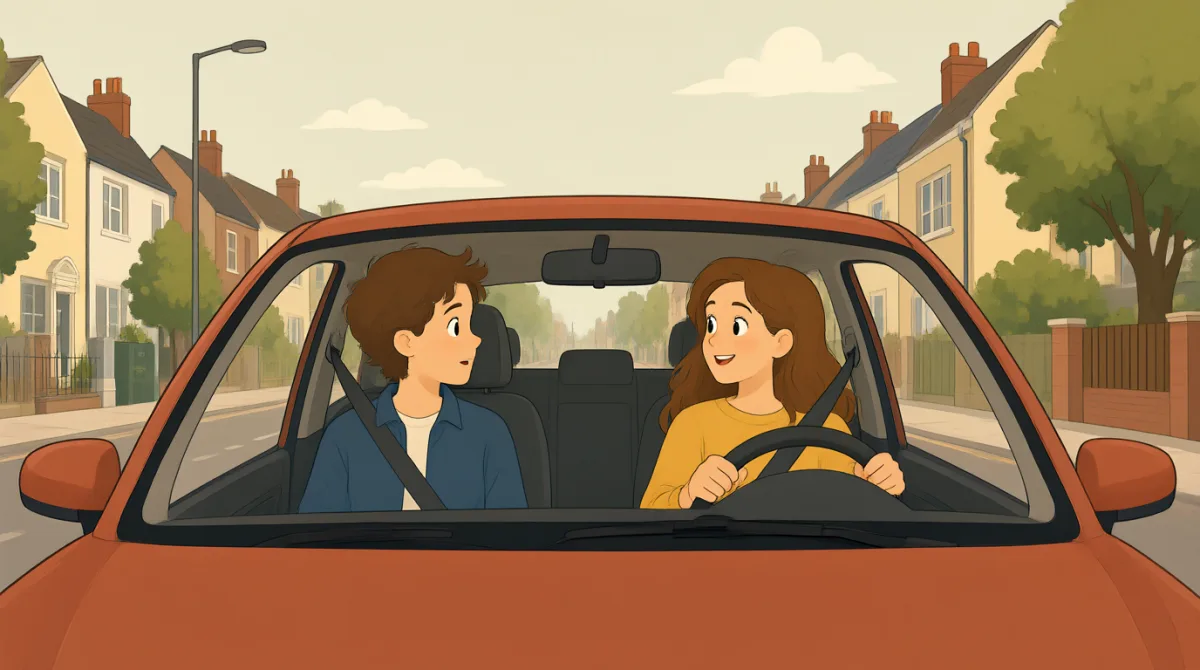
Emma drives along a quiet street while David tells her when to slow down and signal. She asks when to turn the wheel and makes the turn safely.
Dialogue8

Keep going straight, Emma. There’s a corner coming up on your right.

Should I slow down now, or wait until we get closer?
Slow down now, and check the road ahead. No need to rush.
I see the corner. Should I put on my signal now?
Yes, signal right. Check your mirror, then look for people crossing.
The road looks clear. When should I turn the wheel?
Turn the wheel gently to the right as you reach the corner.
Okay, I’m turning now. I made it around safely!
Vocabulary8
- keep going straight
Continue driving forward without turning. You can use this phrase to give someone directions.
- coming up
Something is approaching soon. Here, it means the corner is not far away.
- slow down
Drive more slowly. Use this phrasal verb when you want a driver to reduce speed.
- get closer
Move nearer to something. You can use this phrase to talk about approaching a place or object.
- put on my signal
Turn on the car’s indicator to show which way you plan to turn. Drivers use it before changing direction.
- look for
Try to see or find someone or something. Here, Emma should look for people crossing the road.
- turn the wheel
Move the steering wheel to change the direction of the car. You can say which way to turn it.
- made it around safely
Successfully went around the corner without danger. This phrase can describe completing a difficult movement safely.
Key Sentences8
- 1
Should I slow down now, or wait until we get closer?
Use this question to ask when to do something. You can replace “slow down” with another action.
- 2
Slow down now, and check the road ahead.
This gives two simple driving instructions. Use “and” to connect actions that someone should do.
- 3
No need to rush.
This is a reassuring way to say that someone can take their time. It is useful when a person feels hurried or nervous.
- 4
Should I put on my signal now?
Use this question to ask if it is time to show that you are turning. Replace “put on my signal” with another action when asking for timing.
- 5
Check your mirror, then look for people crossing.
This gives two actions in the order they should happen. Use “then” to show what to do next.
- 6
When should I turn the wheel?
Use this question to ask about the right time to do an action. You can replace “turn the wheel” with another task.
- 7
Turn the wheel gently to the right as you reach the corner.
This gives a clear instruction about how and when to turn. “Gently” describes a careful action, and “as you reach” means when you arrive at the corner.
- 8
I made it around safely!
Use this sentence to say that you completed a turn or passed a difficult place without danger. “Made it” often means succeeded in doing something.