Turning at the Corner
Girar en la esquina
Emma drives along a quiet street while David tells her when to slow down and signal. She asks when to turn the wheel and makes the turn safely.
Emma conduce por una calle tranquila mientras David le dice cuándo reducir la velocidad y señalizar. Ella pregunta cuándo debe girar el volante y toma la curva con seguridad.
Diálogo8
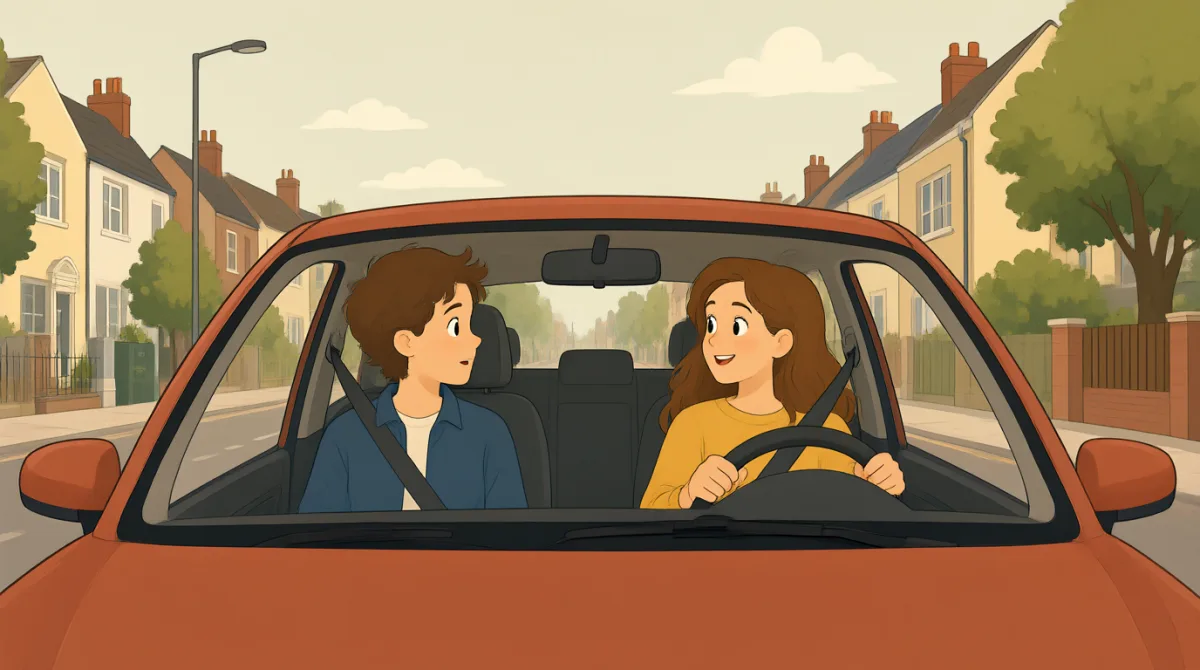

Keep going straight, Emma. There’s a corner coming up on your right.
Sigue recto, Emma. Tienes una esquina a la derecha más adelante.

Should I slow down now, or wait until we get closer?
¿Debería reducir la velocidad ahora o esperar hasta que estemos más cerca?
Slow down now, and check the road ahead. No need to rush.
Reduce la velocidad ahora y fíjate en la carretera que tienes delante. No hay que apurarse.
I see the corner. Should I put on my signal now?
Ya veo la esquina. ¿Pongo la señal ahora?
Yes, signal right. Check your mirror, then look for people crossing.
Sí, pon la señal hacia la derecha. Mira el retrovisor y luego fíjate si hay gente cruzando.
The road looks clear. When should I turn the wheel?
La carretera parece despejada. ¿Cuándo giro el volante?
Turn the wheel gently to the right as you reach the corner.
Gira el volante suavemente hacia la derecha al llegar a la esquina.
Okay, I’m turning now. I made it around safely!
Vale, estoy girando. ¡Pasé la esquina sin problemas!
Vocabulario8
- keep going straightseguir recto
Continue driving forward without turning. You can use this phrase to give someone directions.
Seguir conduciendo hacia delante sin girar. Puedes usar esta expresión para indicarle el camino a alguien.
- coming upmás adelante
Something is approaching soon. Here, it means the corner is not far away.
Algo se acerca y pronto estará aquí. En este caso, significa que la esquina está cerca.
- slow downreducir la velocidad
Drive more slowly. Use this phrasal verb when you want a driver to reduce speed.
Conducir más despacio. Usa este verbo frasal cuando quieras pedirle a alguien que conduzca más lentamente.
- get closeracercarse
Move nearer to something. You can use this phrase to talk about approaching a place or object.
Moverse hacia algo para estar más cerca. Puedes usar esta expresión para hablar de acercarte a un lugar o un objeto.
- put on my signalponer la señal
Turn on the car’s indicator to show which way you plan to turn. Drivers use it before changing direction.
Encender el intermitente del coche para indicar hacia dónde piensas girar. Los conductores lo usan antes de cambiar de dirección.
- look forbuscar
Try to see or find someone or something. Here, Emma should look for people crossing the road.
Tratar de ver o encontrar a alguien o algo. Aquí, Emma debe fijarse si hay gente cruzando la calle.
- turn the wheelgirar el volante
Move the steering wheel to change the direction of the car. You can say which way to turn it.
Mover el volante para cambiar la dirección del coche. Puedes decir hacia qué lado hay que girarlo.
- made it around safelypasar la esquina sin problemas
Successfully went around the corner without danger. This phrase can describe completing a difficult movement safely.
Pasar la esquina con éxito y sin peligro. Esta expresión puede describir cómo se completa una maniobra difícil de forma segura.
Frases clave8
- 1
Should I slow down now, or wait until we get closer?
¿Debería reducir la velocidad ahora o esperar hasta que estemos más cerca?
Use this question to ask when to do something. You can replace “slow down” with another action.
Usa esta pregunta para preguntar cuándo debes hacer algo. Puedes sustituir “slow down” por otra acción.
- 2
Slow down now, and check the road ahead.
Reduce la velocidad ahora y fíjate en la carretera que tienes delante.
This gives two simple driving instructions. Use “and” to connect actions that someone should do.
Esta frase da dos instrucciones sencillas para conducir. Usa “and” para unir acciones que alguien debe hacer.
- 3
No need to rush.
No hay que apurarse.
This is a reassuring way to say that someone can take their time. It is useful when a person feels hurried or nervous.
Esta es una forma tranquilizadora de decir que alguien puede tomarse su tiempo. Sirve cuando una persona se siente apurada o nerviosa.
- 4
Should I put on my signal now?
¿Pongo la señal ahora?
Use this question to ask if it is time to show that you are turning. Replace “put on my signal” with another action when asking for timing.
Usa esta pregunta para saber si ya es hora de indicar que vas a girar. Cuando preguntes cuándo hacer algo, puedes sustituir “put on my signal” por otra acción.
- 5
Check your mirror, then look for people crossing.
Mira el retrovisor y luego fíjate si hay gente cruzando.
This gives two actions in the order they should happen. Use “then” to show what to do next.
Esta frase indica dos acciones y el orden en que deben hacerse. Usa “then” para señalar qué hacer después.
- 6
When should I turn the wheel?
¿Cuándo giro el volante?
Use this question to ask about the right time to do an action. You can replace “turn the wheel” with another task.
Usa esta pregunta para preguntar cuál es el momento adecuado para hacer algo. Puedes sustituir “turn the wheel” por otra tarea.
- 7
Turn the wheel gently to the right as you reach the corner.
Gira el volante suavemente hacia la derecha al llegar a la esquina.
This gives a clear instruction about how and when to turn. “Gently” describes a careful action, and “as you reach” means when you arrive at the corner.
Esta frase da una instrucción clara sobre cómo y cuándo girar. “Gently” describe una acción cuidadosa, y “as you reach” significa cuando llegas a la esquina.
- 8
I made it around safely!
¡Pasé la esquina sin problemas!
Use this sentence to say that you completed a turn or passed a difficult place without danger. “Made it” often means succeeded in doing something.
Usa esta frase para decir que completaste un giro o pasaste por un lugar difícil sin peligro. “Made it” suele significar que lograste hacer algo.