Cleaning and Taking Photos Before You Leave
Emma cleans the apartment and photographs its condition before handing over the keys. She checks her move-in records so she can compare the photos with the original condition.
Dialogue9
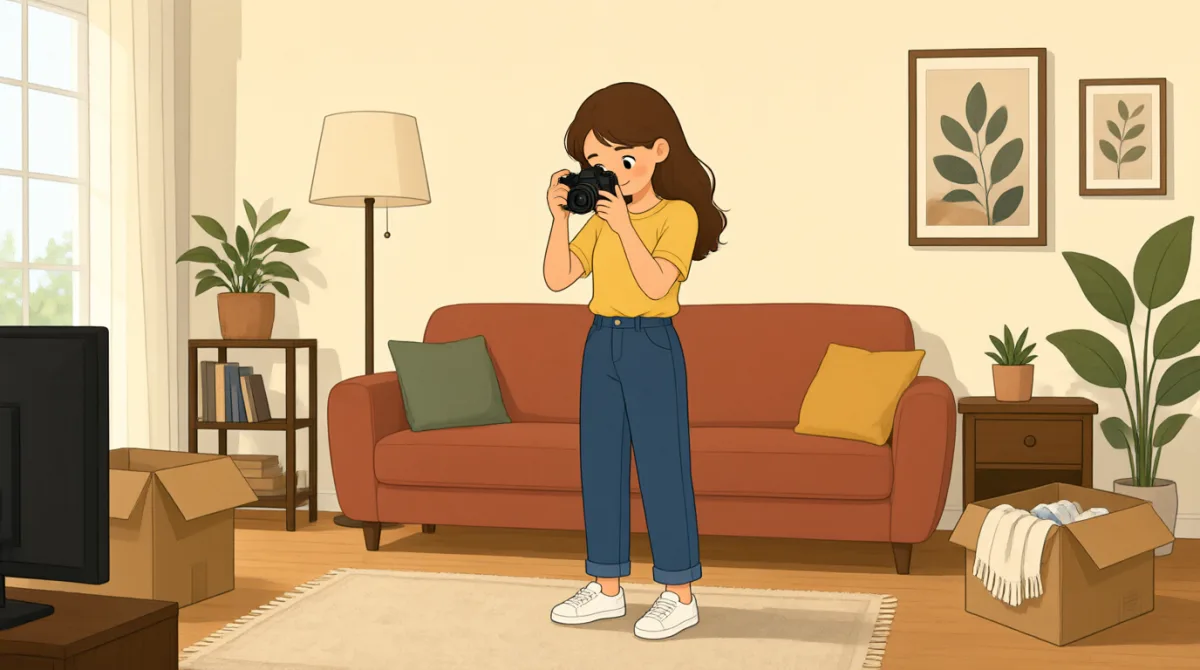

I’ve finished cleaning the kitchen and bathroom. Before I hand over the keys, I want to take photos of every room and check them against my move-in records.

Good call. Take a wide shot of each room first, then get close-ups of anything that could be questioned later, like that scuff by the hallway door.
I’ve got the original checklist here. It says the scuff was already there when I moved in, but the photo is a little blurry, so I’m taking another one now.
Make sure the date and time are saved with the pictures. If you email them to yourself, you’ll have a backup in case your phone acts up.
I’ve also photographed the appliances and the inside of the cabinets. The fridge is clean, and I want the pictures to show that I didn’t leave food or spills behind.
That should help. Did you check the bathroom fixtures? A quick shot of the tub, sink, and shower might head off any claim that you left them dirty.
Yes, and I’ve taken photos of the floors, too. There are a couple of small scratches, but my move-in pictures show similar marks in the same spots.
Keep the original files, not just screenshots. If anyone questions the condition later, the full-resolution images and your checklist will make a much stronger case.
I’ve saved everything in one folder and sent a copy to my email. I’ll take one last video as I walk through the apartment, then I’m ready to hand over the keys.
Vocabulary8
- hand over the keys
To give the keys to the person taking over the apartment. Here, Emma plans to do this after documenting the apartment’s condition.
- check them against my move-in records
To compare the photos with records made when you first moved in. This can help show whether damage was already there.
- wide shot
A photo that shows a large area, such as an entire room. It gives a clear overview of the apartment’s condition.
- close-ups
Photos taken from nearby to show small details clearly. They can document marks or other areas that might be questioned later.
- acts up
Stops working properly or behaves unpredictably. You can use it to describe a phone or other device that has problems.
- head off any claim
To prevent or reduce the chance that someone will make a complaint or accusation. Here, photos of the bathroom might prevent a claim that it was left dirty.
- make a much stronger case
To provide better evidence in support of your position. Original photos and a checklist can help someone prove the apartment’s condition.
- full-resolution images
Photos saved at their original level of detail and quality. They can show evidence more clearly than screenshots.
Key Sentences8
- 1
Before I hand over the keys, I want to take photos of every room and check them against my move-in records.
This sentence explains a plan and its purpose. Reuse “Before I [action], I want to [action]” to describe steps you’ll take before an important handover.
- 2
If you email them to yourself, you’ll have a backup in case your phone acts up.
This uses a conditional to explain how one action can protect you from a possible problem. Reuse “If you [action], you’ll have a backup in case…” when suggesting practical precautions.
- 3
I want the pictures to show that I didn’t leave food or spills behind.
This explains what evidence should demonstrate. Reuse “I want [evidence] to show that…” when documenting a situation or making your position clear.
- 4
A quick shot of the tub, sink, and shower might head off any claim that you left them dirty.
This is a tactful way to suggest that evidence could prevent a possible complaint. Reuse “might head off any claim that…” when discussing ways to avoid disputes.
- 5
There are a couple of small scratches, but my move-in pictures show similar marks in the same spots.
This acknowledges a problem while explaining why it may have existed before. Reuse “There are…, but…” to present a concern alongside relevant evidence.
- 6
If anyone questions the condition later, the full-resolution images and your checklist will make a much stronger case.
This conditional explains how evidence could help if a disagreement arises. Reuse “If anyone questions…, [evidence] will make a stronger case” when preparing for a possible dispute.
- 7
I’ve saved everything in one folder and sent a copy to my email.
This clearly describes how information has been organized and backed up. Reuse the present perfect to report completed actions that are relevant now.
- 8
I’ll take one last video as I walk through the apartment, then I’m ready to hand over the keys.
This links a final preparation step with being ready for the next action. Reuse “I’ll [action], then I’m ready to…” to explain your final steps before a handover.