The Move-Out Walkthrough
Emma and her landlord, David, walk through the apartment together. They discuss a few marks and repairs, and Emma asks David to note their observations on the inspection form.
Dialogue11
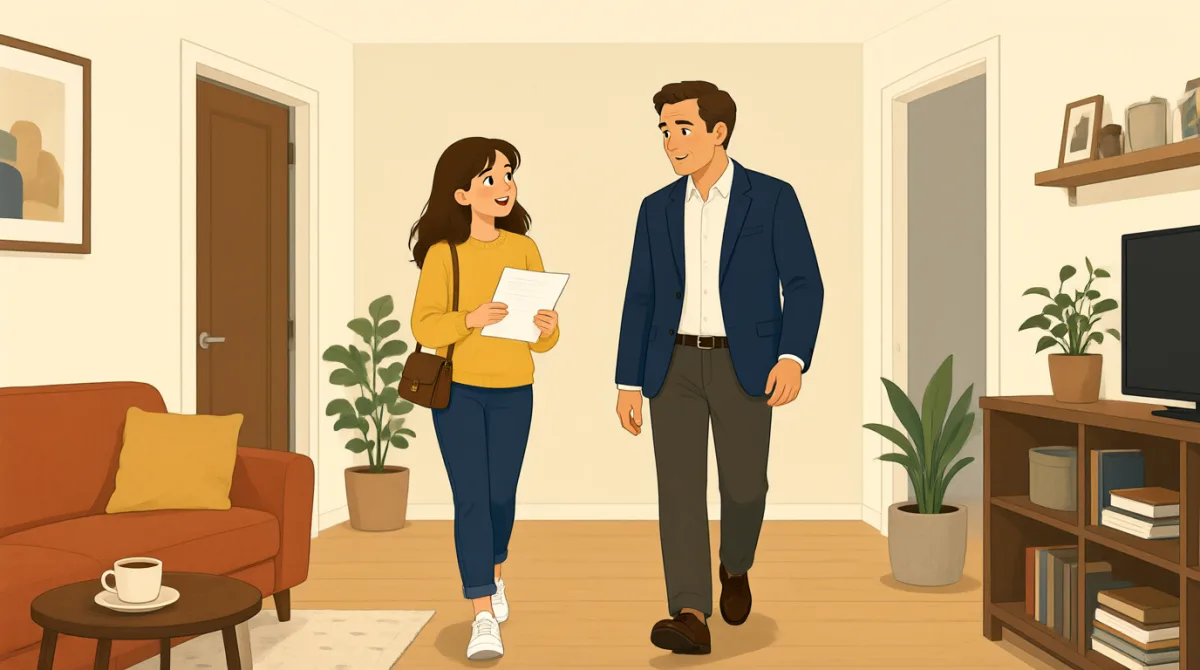

Thanks for meeting me for the walkthrough, David. I’ve got my move-in checklist and photos on my phone, so we can compare anything that’s changed.

That should make things easier. Let’s go room by room, and I’ll note the condition of each area on the inspection form as we go.
In the living room, there’s that small scuff near the doorway. It was already there when I moved in, and I’ve got a photo dated that week.
I see it. It’s not a major issue, but let’s put it down as pre-existing so there’s no confusion when I review the deposit later.
Great, thank you. The bedroom wall has a few faint marks, too. I wiped them, but I don’t want to overstate what came off.
That’s fair. I’d call those minor marks rather than damage. I’ll note their location and that they’re light, so we’re both working from the same record.
There’s also a loose handle on the kitchen cabinet. It was wobbly at move-in, although it seems a little looser now.
I can see that. Let’s note that it was loose at move-in and needs attention now. I’ll check the original checklist before deciding whether it needs repair.
That sounds reasonable. Could you make sure the form says which items were already there and which ones may have changed? I’d like us to have a clear record.
Absolutely. I’ll write that in, and you can take a look before you sign. Signing just confirms we completed the walkthrough, not that you agree with any future deductions.
I appreciate that. I’ll read it over carefully, then take a photo of the completed form so I have a copy alongside my move-in records.
Vocabulary8
- walkthrough
A careful inspection of a place, often done together before someone moves out. Here, Emma and David check the apartment’s condition.
- move-in checklist
A list that records the condition of a home when a tenant moves in. It can help show whether a mark or problem was already there.
- pre-existing
Already present before a particular time or event. Here, the scuff was in the apartment before Emma moved in.
- overstate
To describe something as more serious or important than it really is. Emma uses it to say she does not want to exaggerate how much of the marks she removed.
- working from the same record
Using the same written information so everyone has a shared understanding. It is useful when discussing details that could later be disputed.
- needs attention
Needs to be checked, dealt with, or possibly repaired. David uses this careful phrase for the loose cabinet handle.
- make sure
To take care that something happens or is done correctly. Emma asks David to make sure the form clearly identifies the items’ condition.
- read it over
To read something carefully, often to check it for accuracy. Emma plans to review the form before signing it.
Key Sentences7
- 1
I’ve got my move-in checklist and photos on my phone, so we can compare anything that’s changed.
This explains what evidence you have and why it may help. You can reuse “I’ve got [record or evidence], so we can compare…” when reviewing changes or resolving a disagreement.
- 2
It was already there when I moved in, and I’ve got a photo dated that week.
This calmly states that a problem existed earlier and mentions supporting evidence. It is useful when you need to distinguish pre-existing damage from something that happened later.
- 3
I’d call those minor marks rather than damage.
This is a tactful way to describe a problem without making it sound more serious than it is. Reuse “I’d call that [description] rather than [stronger description]” to express a measured opinion.
- 4
Let’s note that it was loose at move-in and needs attention now.
This records both the earlier condition and the current issue without immediately assigning blame. You can use “Let’s note that…” to suggest adding a clear detail to a shared record.
- 5
Could you make sure the form says which items were already there and which ones may have changed?
This polite request asks for a specific distinction to be included in writing. Reuse “Could you make sure [document] says…” when asking someone to record important details.
- 6
Signing just confirms we completed the walkthrough, not that you agree with any future deductions.
This clarifies what a signature means and limits the chance of misunderstanding. It is useful to ask what signing a document confirms before you agree to it.
- 7
I’ll read it over carefully, then take a photo of the completed form so I have a copy alongside my move-in records.
This describes practical steps for checking and keeping a record. You can adapt the pattern “I’ll [review something], then [save or share a copy]” when handling important paperwork.