Working Out the Tip
The friends check the total and figure out how much to leave for a tip. Grace explains an easy way to calculate it and makes sure the amount is included in each person’s share.
Dialogue8
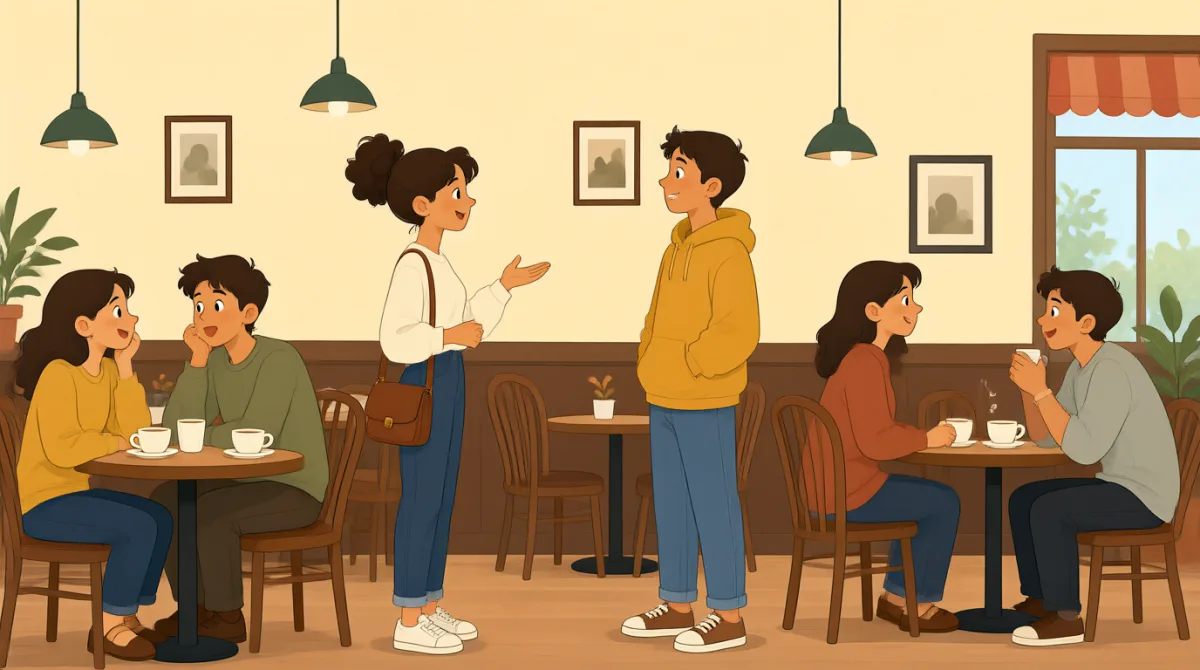

The food came to eighty dollars before tax. Let’s check the receipt and work out the tip before we divide it.

The service was good, so I think twenty percent is fair. That would make the tip sixteen dollars, right?

Right. The total with the tip is ninety-six dollars, but we should add the tax too. It’s listed right here.
Good catch. The tax is eight dollars, so the final total is one hundred and four. There are three of us.
If we split everything evenly, that’s about thirty-four sixty-seven each. The tip is already included in that amount.
That sounds fair to me. I was worried we’d forget to include the tip when figuring out what each person owes.
No worries. A quick way to estimate twenty percent is to move the decimal one place, then double that amount.
So ten percent of eighty is eight dollars, and double that is sixteen. Easy enough—and we’re all set.
Vocabulary8
- work out the tip
To calculate how much money to leave as a tip. You can also use “work out” to mean find an answer by doing a calculation.
- before tax
The price before tax is added. This phrase helps clarify which amount you are talking about.
- a quick way to estimate
A simple method for getting an approximate answer. Use it when you do not need an exact calculation.
- move the decimal one place
To shift the decimal point one position when doing a calculation. In this conversation, it is part of a quick way to find ten percent.
- double that amount
To multiply an amount by two. You can use this phrase to explain a simple calculation.
- split everything evenly
To divide the total into equal shares. It is useful when a group wants everyone to pay the same amount.
- included in that amount
Already counted as part of a total. Use this phrase to make clear that an extra cost, such as a tip, is not separate.
- we’re all set
A casual way to say that everything is ready or taken care of. Here, it means the friends have finished working out the bill.
Key Sentences8
- 1
Let’s check the receipt and work out the tip before we divide it.
This is a natural way to suggest checking the bill before sharing the cost. Reuse “Let’s check [something] and work out [a detail] before we [next step].”
- 2
The service was good, so I think twenty percent is fair.
This sentence gives an opinion and explains the reason for it. Use “I think [amount or choice] is fair” when discussing a reasonable price or share.
- 3
The total with the tip is ninety-six dollars, but we should add the tax too.
This sentence clarifies what is included in a total and points out another cost to add. Use “The total with [item] is [amount], but we should add [item] too” to check a bill.
- 4
Good catch.
This short, friendly phrase thanks someone for noticing something important. Use it when a person spots a detail or mistake you missed.
- 5
If we split everything evenly, that’s about thirty-four sixty-seven each.
This is a practical way to state each person’s approximate share. Use “If we split [the cost] evenly, that’s about [amount] each” when dividing a bill.
- 6
The tip is already included in that amount.
This makes clear that no one needs to add the tip again. Reuse “ [Cost] is already included in that amount” to explain what a total covers.
- 7
A quick way to estimate twenty percent is to move the decimal one place, then double that amount.
This sentence explains a simple mental-math method. Use “A quick way to estimate [amount] is to [step], then [next step]” to share an easy calculation.
- 8
Easy enough—and we’re all set.
This casual sentence says the calculation is simple and the task is finished. Use “Easy enough” to show something seems manageable, and “we’re all set” to wrap things up.