Explaining a Broken Taillight
While checking the car, Officer David notices a broken taillight. Emma explains when she noticed it and asks what she should do to get it fixed.
Dialogue9
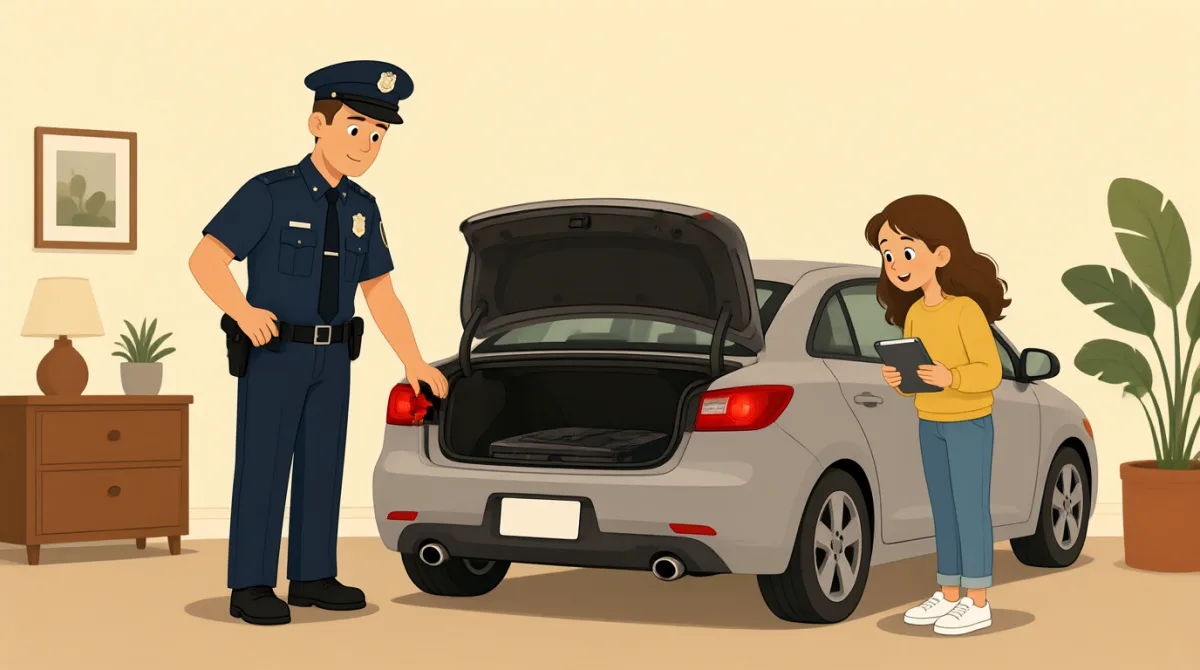

I noticed your right taillight is cracked, and part of the lens is missing. Do you know when that happened?

I saw it yesterday evening when I got home. I’m not sure how it happened, but I haven’t driven much since then.
All right. A broken taillight can be hard for other drivers to see, especially at night or in bad weather.
I understand. Is it safe to drive to a repair shop, or should I have the car towed?
If the light still works and the car is safe to drive, you can go straight to a nearby shop. Avoid driving after dark.
The light does come on, but the cover is broken. I’ll call a shop and see if they can fix it today.
That’s a good plan. Keep the repair receipt, and make sure the replacement light works before you leave the shop.
Should I show proof of the repair to the police, or is keeping the receipt enough?
You don’t need to bring it to me, but keep the receipt in case you’re asked about the repair later.
Vocabulary8
- taillight
A taillight is a red light at the back of a vehicle. It helps other drivers see the car, especially in the dark.
- cracked
Cracked means damaged with a line or split in the surface. Here, it describes the broken cover of the taillight.
- lens
The lens is the clear or colored cover over a light. In this dialogue, part of the taillight lens is missing.
- towed
Towed means pulled by another vehicle, usually because a car cannot be driven safely. You can ask whether a car needs to be towed to a repair shop.
- straight to
“Go straight to” means go directly to a place without stopping somewhere else. You can use it to give simple directions or explain what to do next.
- after dark
“After dark” means in the evening or at night, when it is dark outside. It is often used when discussing visibility or safety.
- repair receipt
A repair receipt is a document showing that you paid for a repair. Keep it as proof of the work in case someone asks about it later.
- proof of the repair
This means evidence that a repair has been completed, such as a receipt. You can use the phrase when asking what documents you need to show.
Key Sentences7
- 1
Do you know when that happened?
This is a polite way to ask when something occurred. You can reuse it when asking about damage, a problem, or a change.
- 2
I’m not sure how it happened, but I haven’t driven much since then.
This sentence explains that you do not know the cause while adding relevant information. Reuse “I’m not sure how..., but...” to give an honest answer with context.
- 3
Is it safe to drive to a repair shop, or should I have the car towed?
This asks someone to compare two options and recommend the safer one. You can reuse “Is it safe to..., or should I...?” when making a practical decision.
- 4
If the light still works and the car is safe to drive, you can go straight to a nearby shop.
This gives advice that depends on two conditions. The pattern “If..., you can...” is useful for explaining what someone may do in a particular situation.
- 5
I’ll call a shop and see if they can fix it today.
This explains a plan and checks whether it is possible. Reuse “I’ll [action] and see if...” when you intend to find out what someone can do.
- 6
Keep the repair receipt, and make sure the replacement light works before you leave the shop.
This gives two clear instructions using “keep” and “make sure.” You can use the same pattern to remind someone to save a document and check something before leaving.
- 7
You don’t need to bring it to me, but keep the receipt in case you’re asked about the repair later.
This tells someone what is unnecessary and what they should do instead. “In case” introduces something to prepare for, such as a future question or problem.