Understanding the Ticket and How to Pay
Officer David gives Emma a ticket and explains the payment deadline and her options. Emma asks a few clear questions to make sure she understands what to do next.
Dialogue10
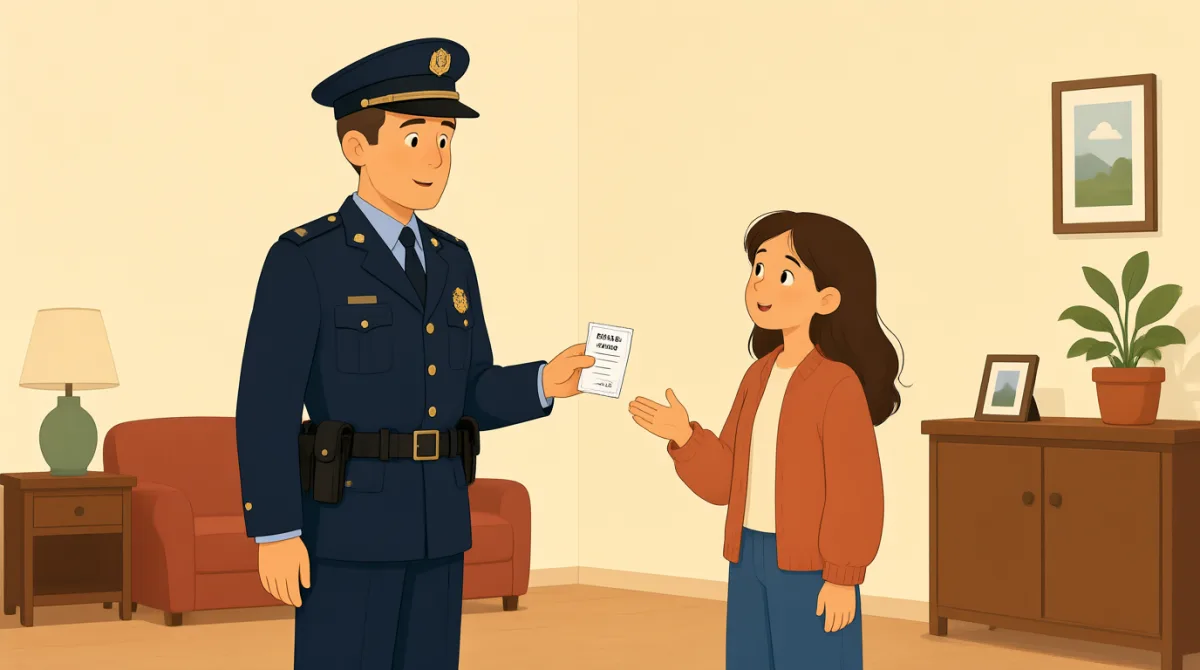

Here’s your ticket. It says you were going 42 in a 30-mile-per-hour zone.

I understand. When do I need to pay the fine?
You have 30 days from today. You can pay online, by mail, or in person at the courthouse.
If I pay online, do I need the ticket number?
Yes. The ticket number is at the top. The website is printed on the back, along with payment instructions.
Thanks. Does paying the fine mean I’m admitting I was speeding?
Yes, paying it is an admission. If you want to contest the ticket, follow the instructions to request a court hearing.
I see. If I request a hearing, should I still pay within those 30 days?
No. Follow the hearing instructions instead, and keep a copy of your ticket. That way, you’ll have the details handy.
All right. I’ll read everything carefully and take care of it before the deadline.
Vocabulary8
- fine
A fine is money you must pay as a penalty. Here, it is the penalty for speeding.
- 30 days from today
This means the deadline is 30 days after the current date. You can use this phrase to explain when something is due.
- in person
This means going somewhere yourself rather than paying online or by mail. Here, Emma can pay at the courthouse.
- payment instructions
These are directions explaining how to pay. You can use this phrase when asking how to complete a payment.
- admission
An admission is a statement that you accept something is true. Here, paying the ticket means accepting that you were speeding.
- contest the ticket
To contest a ticket is to challenge it because you disagree with it. You can use this phrase when asking how to dispute a fine or decision.
- court hearing
A court hearing is a meeting in court where a judge considers a case. Here, Emma can request one if she wants to challenge the ticket.
- keep a copy
To keep a copy means to save another version of a document for your records. This is useful when you may need to check the details later.
Key Sentences8
- 1
When do I need to pay the fine?
This is a clear way to ask about a payment deadline. You can reuse the pattern, “When do I need to [do something]?”
- 2
You can pay online, by mail, or in person at the courthouse.
This sentence explains different ways to complete a payment. Use “You can [option], [option], or [option]” to list choices.
- 3
If I pay online, do I need the ticket number?
This is a useful question for checking what information is required. Use “If I [choose an option], do I need [something]?” to ask about a condition.
- 4
Does paying the fine mean I’m admitting I was speeding?
This asks whether an action has a particular meaning or consequence. You can reuse “Does [action] mean I’m [doing something]?” to check what an action implies.
- 5
If you want to contest the ticket, follow the instructions to request a court hearing.
This gives a condition and the steps to take if you disagree with a ticket. Use “If you want to [goal], follow the instructions to [next step].”
- 6
If I request a hearing, should I still pay within those 30 days?
This is a useful way to ask whether a usual deadline still applies in a different situation. “Should I still…?” checks what to do when circumstances change.
- 7
That way, you’ll have the details handy.
“That way” introduces the result of doing something, and “handy” means easy to find or use. You can use this phrase to explain why a practical step is helpful.
- 8
I’ll read everything carefully and take care of it before the deadline.
This sentence confirms a plan and shows that the speaker will act on time. Use “I’ll [action] and take care of it before [time or event]” to describe a responsible next step.