Explaining a Broken Taillight
Explicar una luz trasera rota
While checking the car, Officer David notices a broken taillight. Emma explains when she noticed it and asks what she should do to get it fixed.
Mientras revisa el auto, el oficial David se da cuenta de que una luz trasera está rota. Emma explica cuándo lo notó y pregunta qué debe hacer para repararla.
Diálogo9
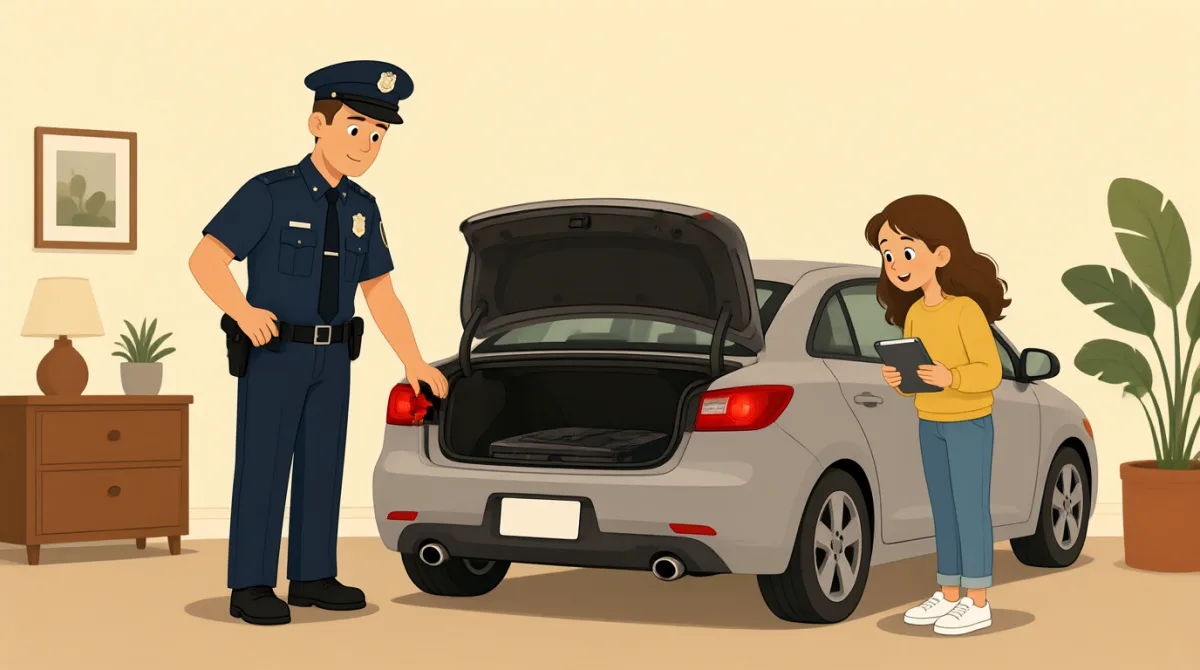

I noticed your right taillight is cracked, and part of the lens is missing. Do you know when that happened?
Veo que la luz trasera derecha está agrietada y le falta parte de la cubierta. ¿Sabe cuándo pasó?

I saw it yesterday evening when I got home. I’m not sure how it happened, but I haven’t driven much since then.
La vi ayer por la tarde, cuando llegué a casa. No sé cómo pasó, pero desde entonces casi no he conducido.
All right. A broken taillight can be hard for other drivers to see, especially at night or in bad weather.
De acuerdo. A los demás conductores les puede costar ver un auto con una luz trasera rota, sobre todo de noche o con mal tiempo.
I understand. Is it safe to drive to a repair shop, or should I have the car towed?
Entiendo. ¿Es seguro conducir hasta un taller o debería hacer que remolquen el auto?
If the light still works and the car is safe to drive, you can go straight to a nearby shop. Avoid driving after dark.
Si la luz todavía funciona y es seguro conducir el auto, puede ir directamente a un taller cercano. Evite conducir cuando ya haya oscurecido.
The light does come on, but the cover is broken. I’ll call a shop and see if they can fix it today.
La luz sí enciende, pero la cubierta está rota. Llamaré a un taller para ver si pueden arreglarla hoy.
That’s a good plan. Keep the repair receipt, and make sure the replacement light works before you leave the shop.
Me parece un buen plan. Guarde el recibo de la reparación y asegúrese de que la luz nueva funcione antes de salir del taller.
Should I show proof of the repair to the police, or is keeping the receipt enough?
¿Debo mostrarle a la policía un comprobante de la reparación o basta con guardar el recibo?
You don’t need to bring it to me, but keep the receipt in case you’re asked about the repair later.
No hace falta que me lo traiga, pero guarde el recibo por si más adelante le preguntan por la reparación.
Vocabulario8
- taillightluz trasera
A taillight is a red light at the back of a vehicle. It helps other drivers see the car, especially in the dark.
Una luz trasera es una luz roja en la parte posterior de un vehículo. Ayuda a que los demás conductores vean el auto, sobre todo cuando está oscuro.
- crackedagrietado/a
Cracked means damaged with a line or split in the surface. Here, it describes the broken cover of the taillight.
“Cracked” significa que algo está dañado y tiene una grieta o una fisura en la superficie. Aquí describe la cubierta rota de la luz trasera.
- lenscubierta
The lens is the clear or colored cover over a light. In this dialogue, part of the taillight lens is missing.
La cubierta es la pieza transparente o de color que protege una luz. En este diálogo, falta una parte de la cubierta de la luz trasera.
- towedremolcado/a
Towed means pulled by another vehicle, usually because a car cannot be driven safely. You can ask whether a car needs to be towed to a repair shop.
“Towed” significa que otro vehículo remolca el auto, normalmente porque no se puede conducir de manera segura. Puedes preguntar si hace falta remolcar un auto hasta un taller.
- straight todirectamente a
“Go straight to” means go directly to a place without stopping somewhere else. You can use it to give simple directions or explain what to do next.
“Go straight to” significa ir directamente a un lugar sin detenerse en otro sitio. Puedes usarlo para dar indicaciones sencillas o explicar qué hacer a continuación.
- after darkcuando ya haya oscurecido
“After dark” means in the evening or at night, when it is dark outside. It is often used when discussing visibility or safety.
“After dark” significa por la tarde o por la noche, cuando ya está oscuro. Se usa a menudo al hablar de visibilidad o seguridad.
- repair receiptrecibo de la reparación
A repair receipt is a document showing that you paid for a repair. Keep it as proof of the work in case someone asks about it later.
Un recibo de la reparación es un documento que demuestra que pagaste por una reparación. Guárdalo como comprobante del trabajo por si alguien te pregunta más adelante.
- proof of the repaircomprobante de la reparación
This means evidence that a repair has been completed, such as a receipt. You can use the phrase when asking what documents you need to show.
Esto significa una prueba de que la reparación ya se hizo, como un recibo. Puedes usar la expresión al preguntar qué documentos tienes que mostrar.
Frases clave7
- 1
Do you know when that happened?
¿Sabe cuándo pasó?
This is a polite way to ask when something occurred. You can reuse it when asking about damage, a problem, or a change.
Esta es una forma cortés de preguntar cuándo ocurrió algo. Puedes volver a usarla para preguntar por un daño, un problema o un cambio.
- 2
I’m not sure how it happened, but I haven’t driven much since then.
No sé cómo pasó, pero desde entonces casi no he conducido.
This sentence explains that you do not know the cause while adding relevant information. Reuse “I’m not sure how..., but...” to give an honest answer with context.
Esta oración explica que no sabes cuál fue la causa y añade información pertinente. Puedes reutilizar “I’m not sure how..., but...” para responder con sinceridad y dar contexto.
- 3
Is it safe to drive to a repair shop, or should I have the car towed?
¿Es seguro conducir hasta un taller o debería hacer que remolquen el auto?
This asks someone to compare two options and recommend the safer one. You can reuse “Is it safe to..., or should I...?” when making a practical decision.
Esta pregunta pide comparar dos opciones y recomendar la más segura. Puedes reutilizar “Is it safe to..., or should I...?” al tomar una decisión práctica.
- 4
If the light still works and the car is safe to drive, you can go straight to a nearby shop.
Si la luz todavía funciona y es seguro conducir el auto, puede ir directamente a un taller cercano.
This gives advice that depends on two conditions. The pattern “If..., you can...” is useful for explaining what someone may do in a particular situation.
Esto da un consejo que depende de dos condiciones. El patrón “If..., you can...” sirve para explicar qué puede hacer alguien en una situación determinada.
- 5
I’ll call a shop and see if they can fix it today.
Llamaré a un taller para ver si pueden arreglarla hoy.
This explains a plan and checks whether it is possible. Reuse “I’ll [action] and see if...” when you intend to find out what someone can do.
Esto explica un plan y averigua si es posible. Reutiliza “I’ll [action] and see if...” cuando quieras averiguar qué puede hacer alguien.
- 6
Keep the repair receipt, and make sure the replacement light works before you leave the shop.
Guarde el recibo de la reparación y asegúrese de que la luz nueva funcione antes de salir del taller.
This gives two clear instructions using “keep” and “make sure.” You can use the same pattern to remind someone to save a document and check something before leaving.
Esto da dos instrucciones claras con “keep” y “make sure”. Puedes usar el mismo patrón para recordarle a alguien que guarde un documento y revise algo antes de irse.
- 7
You don’t need to bring it to me, but keep the receipt in case you’re asked about the repair later.
No hace falta que me lo traiga, pero guarde el recibo por si más adelante le preguntan por la reparación.
This tells someone what is unnecessary and what they should do instead. “In case” introduces something to prepare for, such as a future question or problem.
Esto le dice a alguien qué no hace falta hacer y qué debe hacer en su lugar. “In case” introduce algo para lo que conviene estar preparado, como una pregunta o un problema futuro.