Telling a Friend What Happened
Emma tells Mia about being pulled over, the broken taillight, and the ticket. Mia listens and helps her make a practical plan to pay the fine and get the car repaired.
Dialogue9
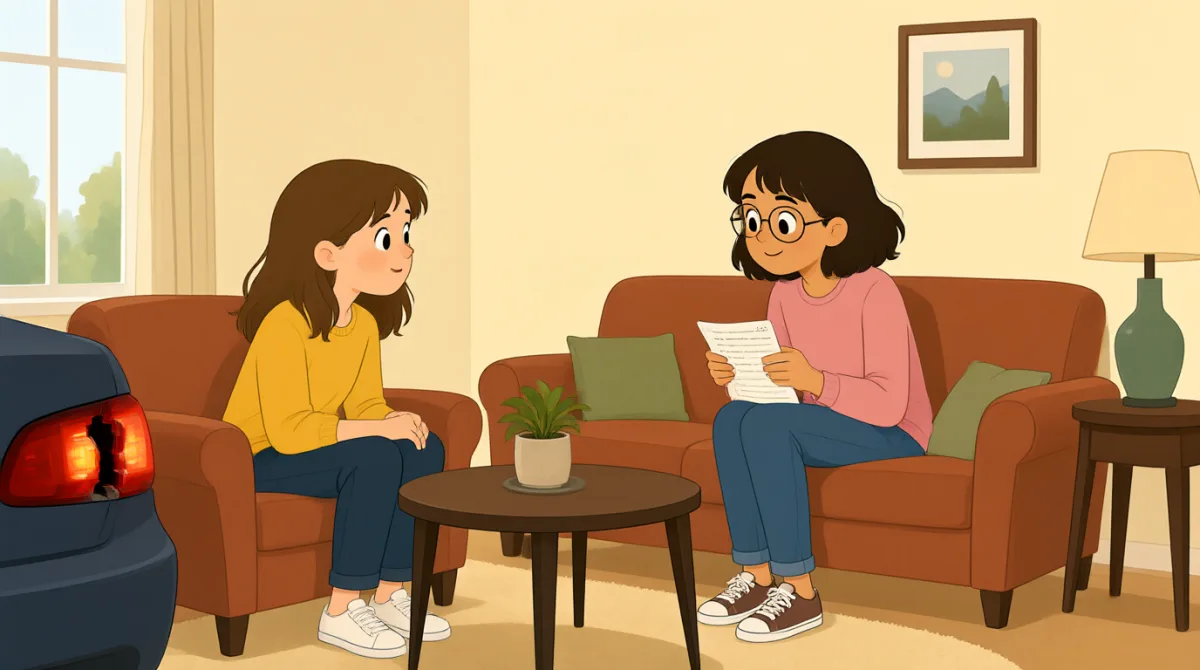

Mia, I got pulled over yesterday. The officer said I was speeding, and then he noticed my broken taillight.

That sounds stressful. Were you okay? Did he explain what you need to do about the light?
I was nervous, but I stayed calm. He gave me a ticket and said I should get the taillight fixed soon.
Did you check the ticket for the payment deadline? It should also say how you can pay the fine.
Yes, I have to pay within thirty days. I can pay online, but I’m not sure how to show the repair is done.
Let’s read the instructions together. Then you can call the number on the ticket and ask if they need proof.
Good idea. I’ll book a repair appointment today and keep the receipt, just in case they ask for it.
That’s a solid plan. Pay the fine before the deadline, and put a reminder on your phone so it doesn’t slip your mind.
Thanks, Mia. I’ll handle the repair first, check the ticket details, and make sure everything is taken care of.
Vocabulary8
- got pulled over
This means a police officer stopped your car at the side of the road. You can use it to describe a traffic stop.
- stayed calm
This means remained relaxed and in control, even when feeling nervous. Use it to describe how you handled a stressful situation.
- payment deadline
This is the last date by which you must pay. You can use it when checking when a bill or fine is due.
- pay the fine
This means give the required money as a penalty for breaking a rule. You can use it when talking about traffic tickets or other penalties.
- proof
Here, proof means information or a document showing that the taillight has been repaired. You can use it when someone needs evidence that something was done.
- just in case
This means in case something happens or someone asks for something. You can use it when taking a precaution, such as keeping a receipt.
- slip your mind
This means be forgotten, often because you are busy. You can use it when talking about something you might forget to do.
- taken care of
This means dealt with or completed. You can use it to describe tasks or problems that have been handled.
Key Sentences8
- 1
That sounds stressful.
This is a simple way to show sympathy when someone describes a difficult experience. You can replace “stressful” with another suitable adjective, such as “frustrating” or “scary.”
- 2
I was nervous, but I stayed calm.
This sentence shows a contrast between how you felt and how you acted. Use “I was [feeling], but I stayed [way of acting]” to describe handling a challenging moment.
- 3
Did you check the ticket for the payment deadline?
This is a practical question for finding out when a payment is due. You can use “Did you check [document] for [important detail]?” in everyday situations.
- 4
I can pay online, but I’m not sure how to show the repair is done.
This sentence explains what you can do and what you are uncertain about. Use “I can..., but I’m not sure how to...” to ask for help with the next step.
- 5
Then you can call the number on the ticket and ask if they need proof.
This gives clear, practical advice by naming an action and what to ask. You can use “call [person or organization] and ask if...” when suggesting how to get information.
- 6
I’ll book a repair appointment today and keep the receipt, just in case they ask for it.
This sentence describes a plan and a precaution. Use “I’ll [action] and keep [item], just in case...” when preparing for a possible request.
- 7
Pay the fine before the deadline, and put a reminder on your phone so it doesn’t slip your mind.
This gives two useful instructions and explains the reason for the reminder. You can use “so it doesn’t slip your mind” when suggesting a way to remember something.
- 8
I’ll handle the repair first, check the ticket details, and make sure everything is taken care of.
This is a useful way to summarize a plan with several steps. Use “I’ll [action], [action], and make sure...” to explain how you will finish a task.