Showing Your License and Registration
Officer David asks Emma for her license and registration. She tells him where the documents are before reaching for them and hands them over politely.
Dialogue8
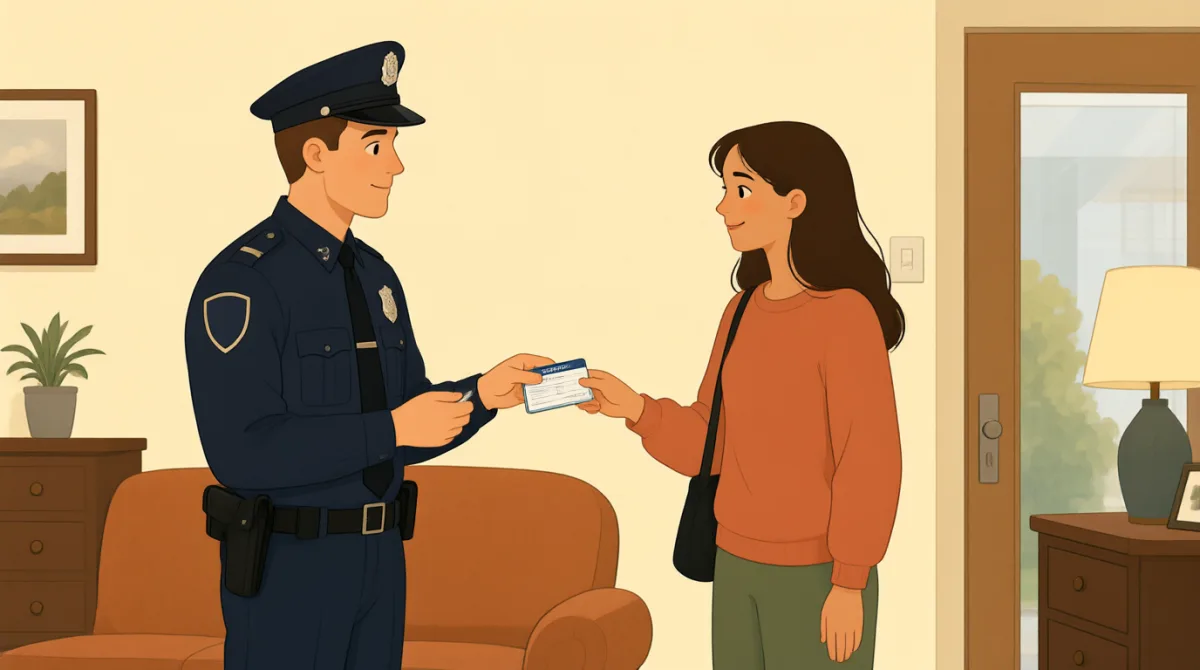

Good afternoon, ma'am. Before we continue, may I see your driver's license and vehicle registration, please?

Of course, Officer. My license is in my wallet, and the registration is in the glove compartment.
Thank you. Please leave your hands where I can see them, and tell me before reaching for anything.
Understood. I’ll take my wallet from my jacket pocket first, then open the glove compartment for the registration.
That’s fine. Go ahead slowly, and place both documents on the dashboard when you have them.
Here’s my license, and here’s the registration. Please let me know if you need anything else.
I appreciate that. I’ll check these documents and your vehicle information; please wait here for a moment.
No problem. I’ll keep my hands on the steering wheel and wait for your instructions.
Vocabulary7
- vehicle registration
The official document showing that a vehicle is registered. In this conversation, Emma tells the officer where she keeps it.
- glove compartment
A small storage space in the dashboard of a car. You can use this phrase when explaining where something is in your vehicle.
- Go ahead slowly
A polite instruction allowing someone to proceed carefully. You can use it to give permission while asking someone to take their time.
- place both documents
Put the two papers in a particular spot. This phrase is useful when giving clear instructions about where to put something.
- I appreciate that.
A polite way to show that you are grateful for someone's action or cooperation. It works well in formal situations.
- for a moment
For a short time. You can use it when asking someone to wait briefly.
- instructions
Directions about what someone should do. In this dialogue, Emma says she will wait for the officer to tell her what to do.
Key Sentences7
- 1
My license is in my wallet, and the registration is in the glove compartment.
This sentence clearly explains where two important items are. Reuse the pattern “X is in [place], and Y is in [place]” to describe where you keep things.
- 2
Please leave your hands where I can see them, and tell me before reaching for anything.
This is a clear, polite instruction that explains what someone should do and when to speak. You can reuse “Please [action], and tell me before [doing something]” to set expectations.
- 3
I’ll take my wallet from my jacket pocket first, then open the glove compartment for the registration.
This sentence explains the steps you plan to take before you do them. Reuse “I’ll [first action] first, then [next action]” to describe a sequence.
- 4
Go ahead slowly, and place both documents on the dashboard when you have them.
This gives permission and provides a clear instruction about what to do next. Reuse “Go ahead [carefully], and place [item] [location]” when guiding someone through a task.
- 5
Please let me know if you need anything else.
A polite way to offer further help. You can use it at work or in a service situation after giving someone the information or items they requested.
- 6
I’ll check these documents and your vehicle information; please wait here for a moment.
This sentence explains what will happen next and asks someone to wait briefly. Reuse “I’ll check [items]; please wait here for a moment” in similar service situations.
- 7
I’ll keep my hands on the steering wheel and wait for your instructions.
This calmly describes what you will do while waiting for directions. Reuse “I’ll [action] and wait for your instructions” when someone else is guiding the process.