Calling Back About a Reaction
After taking the medicine, Emma calls Jack because she feels dizzy and has an upset stomach. Jack asks about her symptoms and helps her decide what to do next.
Dialogue9
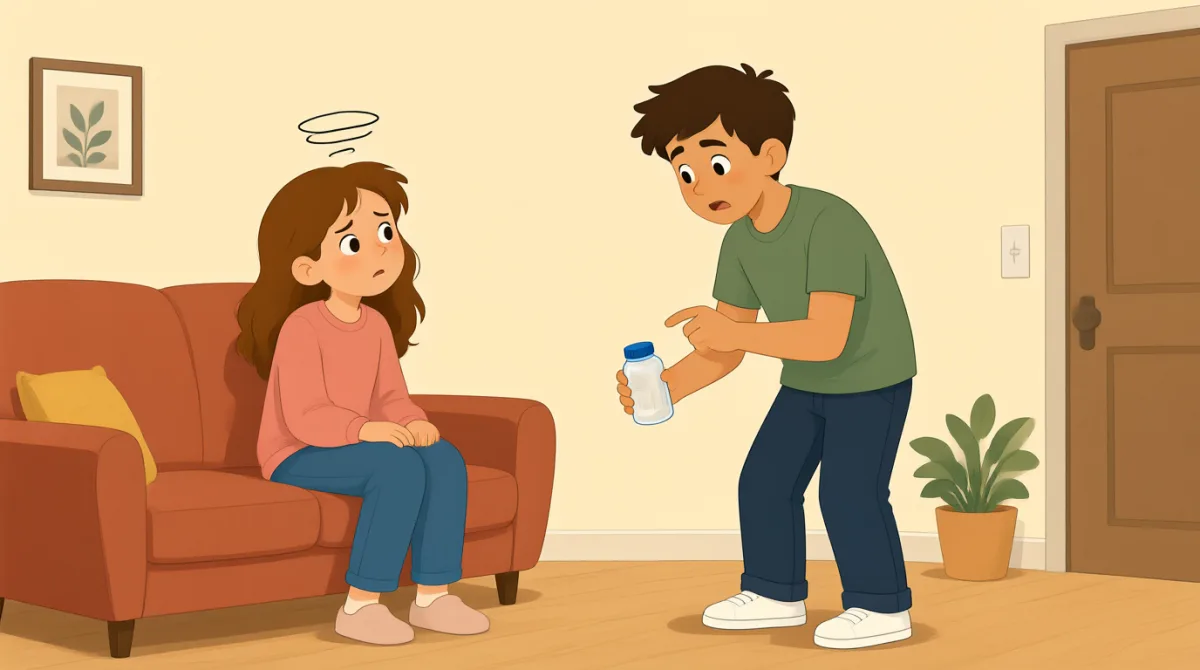

Hi, Jack. I started the new medicine last night, and now I feel dizzy and have an upset stomach.

I’m sorry you’re feeling rough. How much did you take, and did you take it with food?
I took one tablet with dinner, just as the label says. The dizziness started this morning when I got out of bed.
Have you fainted, had trouble breathing, or noticed any swelling or a rash? Those symptoms need urgent medical attention.
No, none of those. I’m just light-headed and a little nauseous, but I can keep food and water down.
For now, sit or lie down, drink some water, and don’t drive while you’re dizzy. I’ll check the medication details.
Should I take the next dose tonight, or wait until I speak with my doctor? I don’t want to make it worse.
Since you’re having symptoms, call your doctor today for advice before the next dose. If you get worse, seek urgent care.
Okay, I’ll call the doctor now and stay home. Thanks for helping me figure out what to do next.
Vocabulary6
- take it with food
To take medicine while eating or after eating. You can ask, “Should I take this with food?”
- faint
To suddenly lose consciousness for a short time. This is an important symptom to mention when asking for medical help.
- light-headed
Feeling as if you might faint or lose your balance. You can use it to describe dizziness to a health professional.
- keep food and water down
To eat or drink without vomiting. This phrase helps explain how serious an upset stomach feels.
- lie down
To rest in a flat position. It’s a useful suggestion when someone feels dizzy or unwell.
- seek urgent care
To get medical help quickly for a serious or worsening problem. You can use this phrase when explaining what to do if symptoms get worse.
Key Sentences7
- 1
I started the new medicine last night, and now I feel dizzy and have an upset stomach.
This sentence clearly explains when you started taking medicine and what symptoms you have. Reuse the pattern “I started [medicine] [time], and now I feel [symptom].”
- 2
I took one tablet with dinner, just as the label says.
This is a clear way to explain how much medicine you took and whether you followed the instructions. Replace “one tablet” and “with dinner” with your own details.
- 3
Have you fainted, had trouble breathing, or noticed any swelling or a rash?
This question checks for several serious symptoms. You can adapt it to ask someone about warning signs in other situations.
- 4
For now, sit or lie down, drink some water, and don’t drive while you’re dizzy.
This gives practical advice using clear, direct instructions. You can use the pattern “For now, [action], [action], and don’t [risky activity].”
- 5
Since you’re having symptoms, call your doctor today for advice before the next dose.
This sentence gives a reason and a specific next step. Reuse “Since you’re [situation], [action] before [next step]” to explain what someone should do.
- 6
If you get worse, seek urgent care.
This is a concise way to explain what to do if a condition becomes more serious. You can replace “get worse” with a specific change in symptoms.
- 7
I’ll call the doctor now and stay home.
This sentence explains your immediate plan in a simple, natural way. Use “I’ll [action] and [action]” to say what you intend to do next.