Picking Up a New Prescription
Emma picks up a new prescription from pharmacist Jack and checks that it is the medicine her doctor ordered. Jack explains what the label says.
Dialogue10
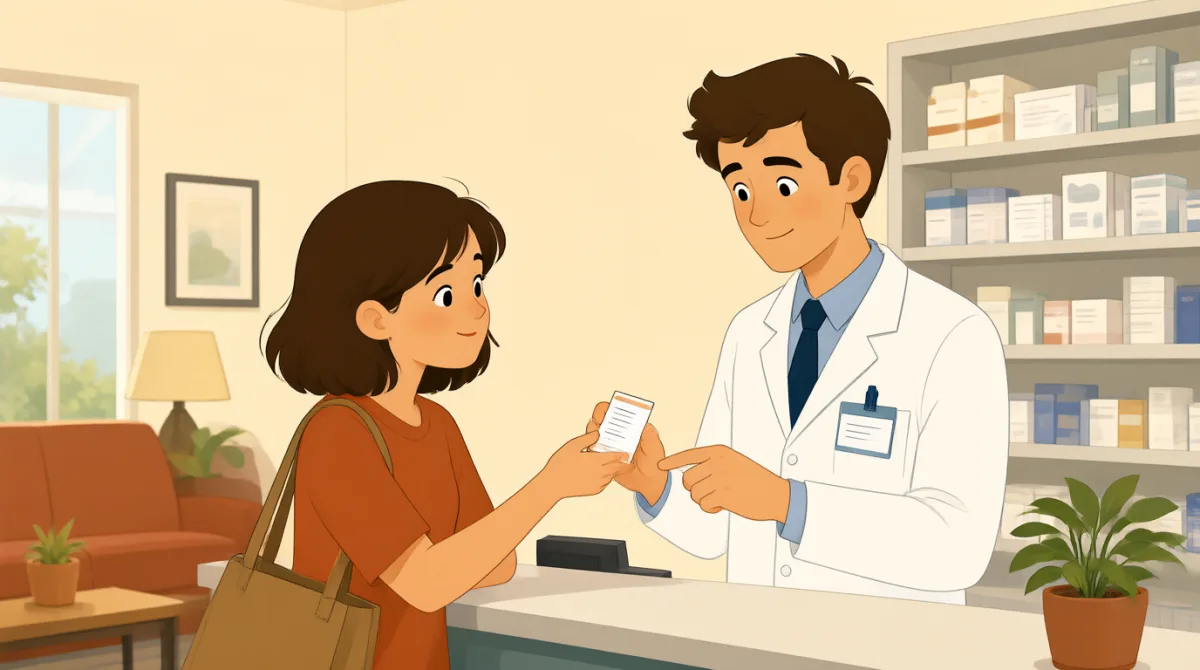

Hi, I’m here to pick up a new prescription. It should be for me, Emma Carter.

Hi, Emma. Let me check the details. What’s the name of the medicine your doctor prescribed?
I think it’s called amoxicillin, but I want to make sure I’m picking up the right one.
That’s right. This is amoxicillin, and it was prescribed by your doctor for a bacterial infection.
Great. Could you explain what the label says? I’d like to understand the instructions before I leave.
Sure. The label has your name, the medicine’s name and strength, and the directions for taking it.
And is the amount in this bottle the amount my doctor ordered? I just want to double-check.
Yes. It matches the prescription: twenty-one capsules. The pharmacy label also shows the date it was filled.
Thanks for checking. I’ll read the label carefully, and I’ll ask if anything doesn’t make sense.
You’re welcome. Good call—if the medicine or your name looks wrong, check with us before taking it.
Vocabulary8
- pick up a new prescription
To collect medicine that a doctor has ordered from a pharmacy. You can say this when explaining why you are there.
- prescribed
Ordered by a doctor for a patient. For example, a doctor may prescribe medicine to treat an infection.
- make sure
To check that something is correct or certain. You can use it when confirming you have the right medicine.
- label
The information printed on a medicine container or package. It can include the patient’s name and instructions.
- directions for taking it
Instructions about how to use the medicine. You can ask a pharmacist to explain them.
- double-check
To check something again to make sure it is correct. This is useful when confirming an order or quantity.
- matches the prescription
Is the same as what the doctor ordered. You can use this phrase to confirm that the medicine and amount are correct.
- doesn’t make sense
Is unclear or difficult to understand. You can use this phrase when asking someone to explain information.
Key Sentences7
- 1
I’m here to pick up a new prescription.
A natural way to tell pharmacy staff why you are there. You can replace “prescription” with another item you have come to collect.
- 2
I think it’s called amoxicillin, but I want to make sure I’m picking up the right one.
This combines what you believe with a polite request to confirm it. Replace the medicine name to check a different prescription.
- 3
Could you explain what the label says?
A polite way to ask someone to clarify written information. You can use this question about instructions, forms, or notices.
- 4
I’d like to understand the instructions before I leave.
This explains why you are asking for information. You can reuse the structure “I’d like to understand…” when asking for clarification.
- 5
I just want to double-check.
A friendly way to explain that you want to confirm something. Use it before asking someone to verify a detail.
- 6
I’ll ask if anything doesn’t make sense.
This says you will ask questions if something is unclear. You can adapt it for instructions, plans, or other information.
- 7
If the medicine or your name looks wrong, check with us before taking it.
This gives a clear safety instruction using “if” to describe a possible problem. You can use the same pattern to explain what someone should do in a similar situation.