Talking About Your Availability
Emma tells Grace about her class schedule and the days and hours she can work. They discuss how to fit her shifts around her studies.
Dialogue10
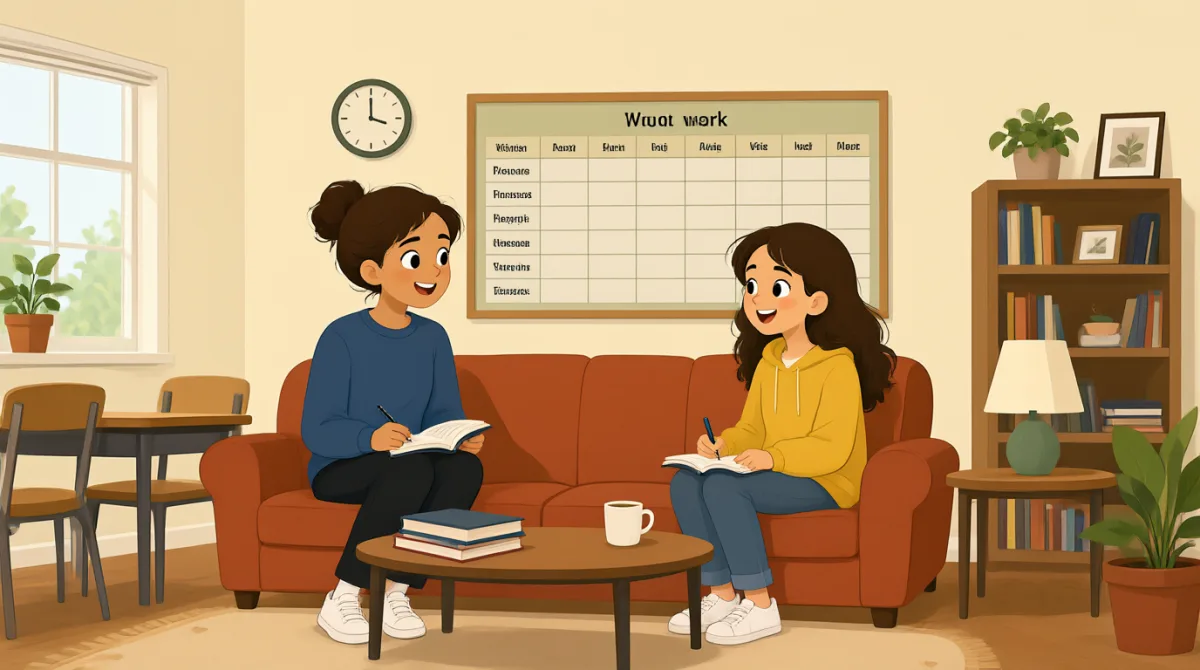

I checked my class schedule. I have lectures Monday through Thursday, mostly in the mornings, but Fridays are free.

That helps. What days and times could you work without having to rush from class?
I could work Monday and Wednesday after two, and I’m available all day Friday and most weekends.
We usually need extra help on Friday afternoons and weekends. Could you work one weekend day regularly?
Yes, Saturday would work well. I’d prefer to keep Sunday free for studying, especially before exams.
That sounds reasonable. How many hours a week are you hoping to work?
Around fifteen hours would be ideal. I want to earn some money, but I also need to keep up with my coursework.
We can probably arrange two weekday shifts and one Saturday shift. Your schedule may change during exam weeks, though.
I can let you know well in advance if I need fewer hours. I’m happy to be flexible when my classes allow.
Great. I’ll note your availability and check the rota. We’ll try to fit your shifts around your studies.
Vocabulary8
- class schedule
A plan showing when your classes take place. You can use it to explain when you are free.
- available all day
Free to work or do something at any time during the day. For example, “I’m available all day Friday.”
- work well
To be suitable or convenient. Use it to say that a particular day or time fits your plans.
- keep Sunday free
To avoid making plans for Sunday so you can use that time for something else. You can replace “Sunday” with another day.
- keep up with
To stay at the right pace with work or responsibilities. Here, Emma wants to manage her coursework while working.
- well in advance
A good amount of time before something happens. Use it when you promise to give someone early notice.
- be flexible
To be willing to change plans or adapt to different needs. It is useful when discussing schedules or arrangements.
- rota
A schedule showing who is working and when. This word is commonly used in British English.
Key Sentences8
- 1
What days and times could you work without having to rush from class?
This is a polite way to ask about someone’s work availability and practical limits. You can replace “rush from class” with another situation, such as “rush from another job.”
- 2
I could work Monday and Wednesday after two, and I’m available all day Friday and most weekends.
This sentence clearly gives several possible work times. Use “I could work…” and “I’m available…” to describe your schedule.
- 3
I’d prefer to keep Sunday free for studying, especially before exams.
Use “I’d prefer to…” to state a preference politely and give a reason. You can change the day and activity to match your own plans.
- 4
Around fifteen hours would be ideal.
This is a concise way to say how many hours you would like to work. “Around” makes the number approximate, while “would be ideal” expresses a preference.
- 5
I want to earn some money, but I also need to keep up with my coursework.
This explains two priorities that need to be balanced. Use “but I also need to…” to introduce another important responsibility.
- 6
I can let you know well in advance if I need fewer hours.
This is useful when promising to give early notice about a possible change. You can replace “fewer hours” with another change you may need.
- 7
I’m happy to be flexible when my classes allow.
This shows that you are willing to adapt while still respecting your commitments. You can replace “my classes” with another factor that affects your availability.
- 8
We’ll try to fit your shifts around your studies.
This describes arranging work times to suit someone’s other commitments. You can reuse “fit [something] around [something]” for schedules and plans.