Your First Shift
On Emma’s first shift, Grace shows her the routine and introduces her to the café team. Emma learns the basics and gets ready to help customers.
Dialogue9
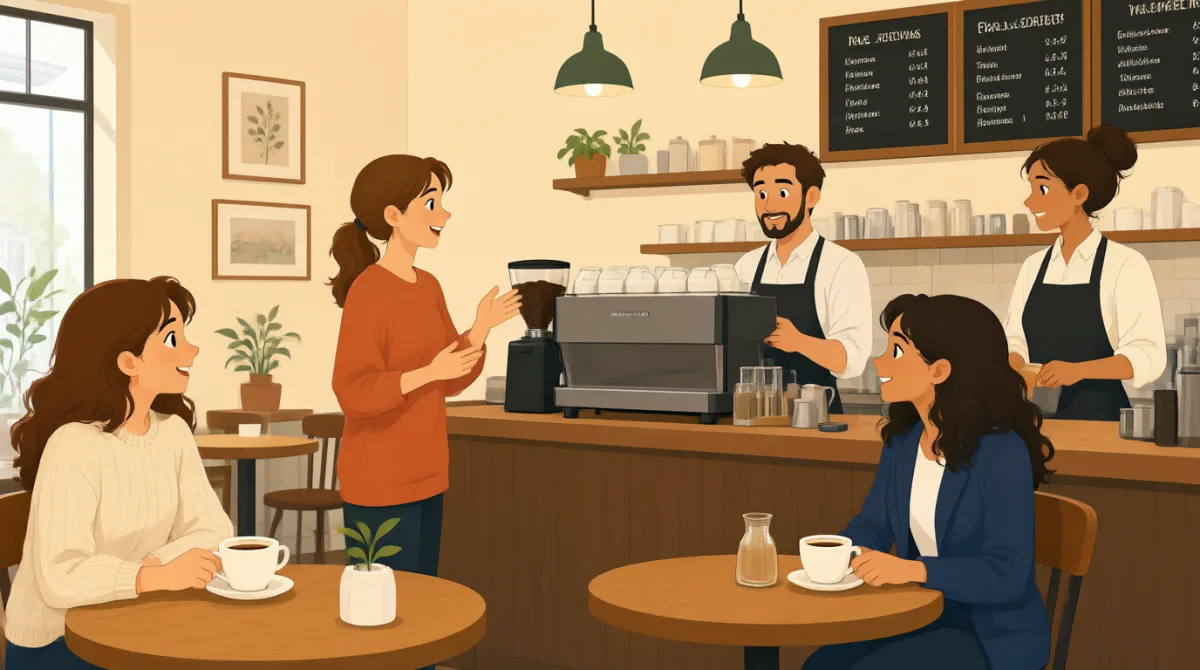

Welcome to your first shift, Emma. I’ll show you how we open the café, then Leo can walk you through the register.

Thanks, Grace. I’m excited, but a little nervous. I’ve never worked in a café before, so I’ll probably have a few questions.

No worries! We all start somewhere. First, tie your apron here, and keep your hair away from the food-prep area.
Exactly. We wash our hands before handling food, and we wipe the counter between tasks. Clean as you go—it saves time later.
Got it. Where should I start if a customer comes in while I’m still learning the menu?
Just smile and say hello. If you’re not sure about something, ask me or Grace instead of guessing. We’ve got your back.
That’s right. You can take simple orders today, and I’ll stay nearby. The register is easy once you get the hang of it.
Thanks, both of you. I’ll take it one step at a time. That customer by the door looks ready to order!
Go ahead, Emma. Greet them, listen carefully, and don’t rush. I’ll be right here if you need a hand.
Vocabulary8
- a little nervous
Slightly worried or uneasy. Use it to describe how you feel in a new or unfamiliar situation.
- We all start somewhere.
A reassuring way to say that everyone is inexperienced when they begin. Use it to encourage someone who is learning.
- keep your hair away from the food-prep area
Make sure your hair does not come near the place where food is prepared. This is a practical hygiene instruction in a kitchen or café.
- Clean as you go
Clean things while you work instead of leaving all the cleaning until later. This phrase is useful for describing an efficient routine.
- instead of guessing
Rather than trying to answer when you are unsure. Use this phrase to explain a safer or more reliable choice.
- We’ve got your back.
We’re here to support and help you. This informal phrase reassures someone that they are not alone.
- get the hang of it
Learn how to do something through practice. Use it when a task feels difficult at first but becomes easier over time.
- take it one step at a time
Do things gradually, focusing on one part before moving to the next. This phrase can help someone stay calm when learning something new.
Key Sentences7
- 1
I’m excited, but a little nervous.
This sentence expresses two feelings at once. Use “I’m excited, but a little [feeling]” to describe mixed emotions about a new experience.
- 2
I’ve never worked in a café before, so I’ll probably have a few questions.
This is a natural way to explain that you are new to something and may need help. You can replace “worked in a café” with another activity or situation.
- 3
If you’re not sure about something, ask me or Grace instead of guessing.
This gives clear, supportive advice for handling uncertainty. Reuse “If you’re not sure about something, [action] instead of [less helpful action].”
- 4
We’ve got your back.
This informal phrase lets someone know you will support them. It works well when reassuring a new colleague or friend.
- 5
The register is easy once you get the hang of it.
This sentence reassures someone that a task becomes easier with practice. Use “It’s easy once you get the hang of it” for other skills or routines.
- 6
I’ll take it one step at a time.
This is a calm way to say you will handle a task gradually. Use it when you want to avoid feeling overwhelmed.
- 7
Greet them, listen carefully, and don’t rush.
These are concise instructions for helping a customer. The sentence uses direct verbs to give a clear sequence of actions.