Meeting the Host Family
ホストファミリーとの対面
Emma arrives at the family home and meets Grace and Jack. They help her feel welcome and show her where she will stay.
エマは家族の家に到着し、グレースとジャックに会います。二人はエマを温かく迎え、滞在する部屋を案内します。
会話8
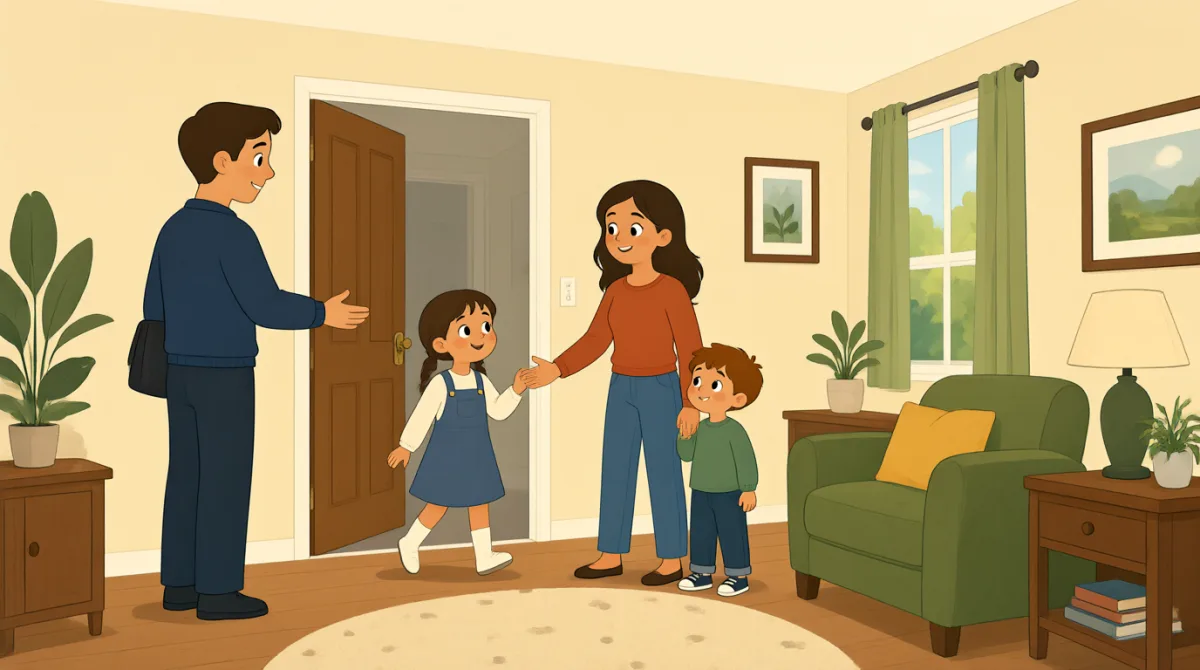

Hi, I’m Emma. Thanks for having me. It’s nice to meet you!
こんにちは、エマです。泊めてくれてありがとう。会えてうれしい!

Welcome, Emma! I’m Grace, and this is my son, Jack. Come on in.
ようこそ、エマ!私はグレースで、こちらは息子のジャックよ。さあ、入って。

Hi, Emma! Let me take your bag. Was your trip okay?
やあ、エマ!バッグを持つよ。旅は大丈夫だった?
Thanks! Yes, it was good, but I’m a little tired.
ありがとう!うん、よかったよ。でもちょっと疲れた。
That’s understandable. Your room is upstairs. I’ll show you the way.
それは無理もないわ。部屋は2階よ。案内するね。
Great, thank you. Is there a bathroom near my room?
ありがとう。部屋の近くにバスルームはある?
Yes, there is. It’s at the end of the hall, next to your room.
あるよ。廊下の突き当たりで、君の部屋の隣だよ。
Here we are! You can unpack and rest. We’ll have dinner at seven.
着いたわ!荷物を出して、ゆっくりしてね。夕食は7時よ。
語彙8
- Thanks for having me.泊めてくれてありがとう。
This is a polite way to thank someone for inviting you to stay or visit.
誰かの家に泊めてもらったり、招いてもらったりしたときに、お礼を伝える丁寧な表現です。
- Come on in.さあ、入って。
This friendly phrase invites someone to enter a home. You can also say it to welcome a visitor inside.
家に入るよう相手を招く、親しみのある表現です。訪問客を中に迎え入れるときにも使えます。
- Let me take your bag.バッグを持つよ。
Use this to offer to carry someone’s bag. You can also say, “Let me take your coat.”
相手のバッグを持ってあげると申し出るときに使います。“Let me take your coat.”(コートを預かるよ)のようにも言えます。
- a little tiredちょっと疲れている
This means slightly tired, but not very tired. You can use “a little” before other describing words, such as “a little hungry.”
「少し疲れている」という意味で、とても疲れているわけではありません。“a little”は、“a little hungry”(少しお腹がすいている)のように、ほかの状態を表す言葉の前にも使えます。
- That’s understandable.それは無理もないね。
Say this to show that you understand why someone feels a certain way. For example, you can say it when someone is tired after a long trip.
相手がそう感じる理由がわかると伝える表現です。たとえば、長旅のあとに疲れている人に言えます。
- at the end of the hall廊下の突き当たりに
This describes a place at the far end of a hallway. You can use it to explain where a room or bathroom is.
廊下のいちばん奥の場所を表します。部屋やバスルームがどこにあるか説明するときに使えます。
- unpack and rest荷物を出して、休む
“Unpack” means to take your things out of your bag. “Rest” means to relax after doing something tiring.
“Unpack”はバッグから荷物を出すこと、“rest”は疲れることをしたあとにゆっくりすることです。
- have dinner at seven7時に夕食をとる
This tells someone the time of a meal. You can change the meal or time, as in “We’ll have lunch at one.”
食事の時間を相手に伝える表現です。“We’ll have lunch at one.”(昼食は1時にとるよ)のように、食事や時間を変えて使えます。
重要な文8
- 1
Thanks for having me.
泊めてくれてありがとう。
This is a polite way to thank a host for welcoming you. You can use it when you arrive at someone’s home or stay with them.
迎えてくれたホストにお礼を伝える丁寧な表現です。誰かの家に着いたときや、そこに泊まるときに使えます。
- 2
Was your trip okay?
旅は大丈夫だった?
This is a friendly question to ask someone after they travel. You can replace “trip” with “flight” or “train ride.”
旅行した人に、到着後に尋ねる親しみのある質問です。“trip”を“flight”(飛行機の旅)や“train ride”(電車の旅)に置き換えることもできます。
- 3
I’m a little tired.
ちょっと疲れた。
Use this sentence to say that you feel slightly tired. You can replace “tired” with another feeling, such as “hungry” or “nervous.”
少し疲れていると伝える文です。“tired”を“hungry”(お腹がすいた)や“nervous”(緊張している)など、別の気持ちに置き換えられます。
- 4
Your room is upstairs.
部屋は2階だよ。
This gives someone simple information about where their room is. You can replace “upstairs” with a place like “down the hall.”
部屋がどこにあるか、簡潔に伝える文です。“upstairs”を“down the hall”(廊下の先)などの場所に置き換えられます。
- 5
Is there a bathroom near my room?
部屋の近くにバスルームはある?
This is a polite way to ask if a bathroom is close to a place. You can use the same question pattern to ask about other places, such as “Is there a bus stop near the house?”
ある場所の近くにバスルームがあるか、丁寧に尋ねる表現です。“Is there a bus stop near the house?”(家の近くにバス停はありますか?)のように、同じ質問の形でほかの場所についても尋ねられます。
- 6
It’s at the end of the hall, next to your room.
廊下の突き当たりで、あなたの部屋の隣です。
This sentence explains where something is by giving two location details. You can use it to describe where a room or other place is.
場所について2つの情報を伝えて、位置を説明する文です。部屋などがどこにあるか説明するときに使えます。
- 7
You can unpack and rest.
荷物を出して、ゆっくりしてね。
This is a kind way to tell someone they can settle in and relax. You can replace the actions with other helpful suggestions, such as “You can sit and have some water.”
落ち着いてくつろいでいいよ、と相手に優しく伝える文です。“You can sit and have some water.”(座って水を飲んでいいよ)のように、ほかの行動をすすめる表現にもできます。
- 8
We’ll have dinner at seven.
夕食は7時だよ。
Use this sentence to tell someone a future meal time. You can change the meal and time, as in “We’ll have breakfast at eight.”
これからの食事の時間を相手に伝える文です。“We’ll have breakfast at eight.”(朝食は8時にとるよ)のように、食事や時間を変えて使えます。