Meeting the Host Family
Emma arrives at the family home and meets Grace and Jack. They help her feel welcome and show her where she will stay.
Dialogue8
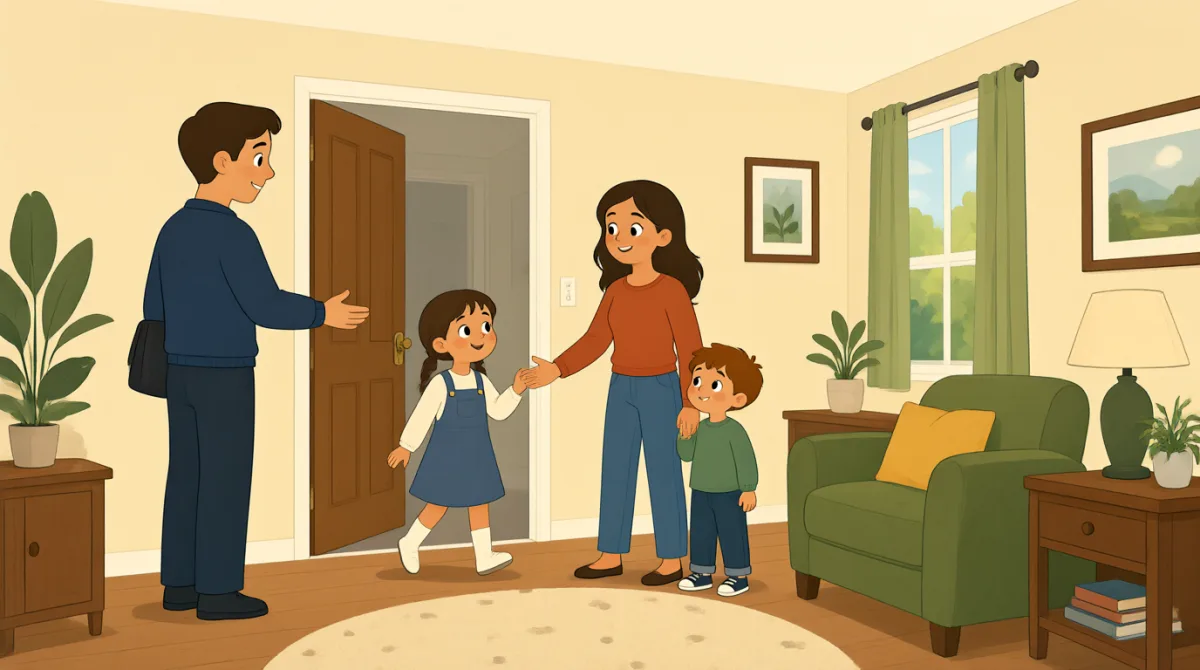

Hi, I’m Emma. Thanks for having me. It’s nice to meet you!

Welcome, Emma! I’m Grace, and this is my son, Jack. Come on in.

Hi, Emma! Let me take your bag. Was your trip okay?
Thanks! Yes, it was good, but I’m a little tired.
That’s understandable. Your room is upstairs. I’ll show you the way.
Great, thank you. Is there a bathroom near my room?
Yes, there is. It’s at the end of the hall, next to your room.
Here we are! You can unpack and rest. We’ll have dinner at seven.
Vocabulary8
- Thanks for having me.
This is a polite way to thank someone for inviting you to stay or visit.
- Come on in.
This friendly phrase invites someone to enter a home. You can also say it to welcome a visitor inside.
- Let me take your bag.
Use this to offer to carry someone’s bag. You can also say, “Let me take your coat.”
- a little tired
This means slightly tired, but not very tired. You can use “a little” before other describing words, such as “a little hungry.”
- That’s understandable.
Say this to show that you understand why someone feels a certain way. For example, you can say it when someone is tired after a long trip.
- at the end of the hall
This describes a place at the far end of a hallway. You can use it to explain where a room or bathroom is.
- unpack and rest
“Unpack” means to take your things out of your bag. “Rest” means to relax after doing something tiring.
- have dinner at seven
This tells someone the time of a meal. You can change the meal or time, as in “We’ll have lunch at one.”
Key Sentences8
- 1
Thanks for having me.
This is a polite way to thank a host for welcoming you. You can use it when you arrive at someone’s home or stay with them.
- 2
Was your trip okay?
This is a friendly question to ask someone after they travel. You can replace “trip” with “flight” or “train ride.”
- 3
I’m a little tired.
Use this sentence to say that you feel slightly tired. You can replace “tired” with another feeling, such as “hungry” or “nervous.”
- 4
Your room is upstairs.
This gives someone simple information about where their room is. You can replace “upstairs” with a place like “down the hall.”
- 5
Is there a bathroom near my room?
This is a polite way to ask if a bathroom is close to a place. You can use the same question pattern to ask about other places, such as “Is there a bus stop near the house?”
- 6
It’s at the end of the hall, next to your room.
This sentence explains where something is by giving two location details. You can use it to describe where a room or other place is.
- 7
You can unpack and rest.
This is a kind way to tell someone they can settle in and relax. You can replace the actions with other helpful suggestions, such as “You can sit and have some water.”
- 8
We’ll have dinner at seven.
Use this sentence to tell someone a future meal time. You can change the meal and time, as in “We’ll have breakfast at eight.”